
job search
How to Follow Up After Sending a Resume in AU & NZ (2026 Guide + Templates)
By Job Sparrow Team

You've done the hard work. You've polished your resume, written a compelling cover letter, and sent your application into the digital ether. And now… silence. The waiting game begins, and with it, a wave of uncertainty. Should you follow up? Will you seem too pushy? Or will you be forgotten in a sea of applicants if you stay silent?
This is the core dilemma for job seekers across Australia and New Zealand. For migrants and career changers, this anxiety is often amplified by the challenge of navigating a new professional culture. You fear that one wrong move could jeopardize your chances, but you also know that passive waiting rarely leads to success.
Let's be clear: a strategic, professional follow-up is not pushy. It's a sign of continued interest, confidence, and professionalism. This guide provides the exact strategies, timing, and culturally-aware templates you need to follow up with confidence in the AU and NZ job markets, turning anxiety into action.
Why Following Up is a Crucial (and Expected) Step in AU & NZ
First, let's dismantle the biggest fear: that following up is considered rude or annoying. The data and official advice suggest the complete opposite. According to a survey highlighted by SEEK, Australia's largest employment marketplace, 65% of employers view a candidate following up as a positive gesture. It shows you are genuinely interested and proactive.
This practice is so normalized that it's reflected in official government policy. For those on government support, the Department of Employment and Workplace Relations lists 'following up on job referrals' as a key mutual obligation requirement under Workforce Australia — formal recognition that proactive follow-up is a standard part of the job-search process.
In New Zealand, the same expectation holds. A polite, well-timed follow-up email signals professionalism and continued interest — it reinforces your engagement with the role and keeps your application top-of-mind without crossing into being pushy.
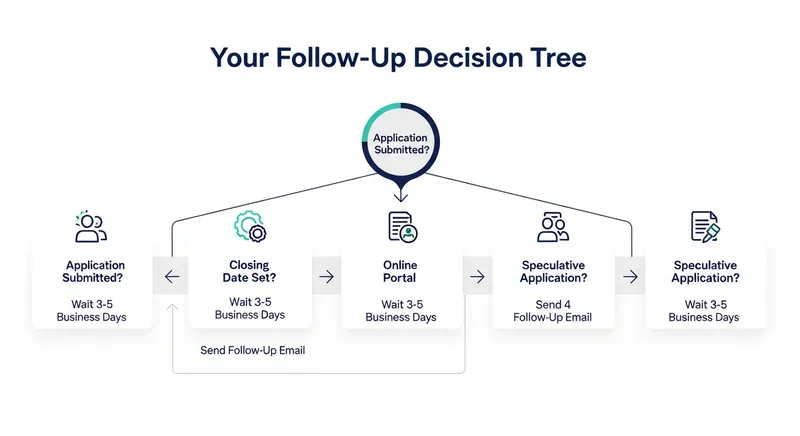
The Golden Rule: When to Follow Up on Your Application
Timing is everything. Follow up too soon, and you might seem impatient. Wait too long, and the decision might have already been made. Keeping track of different timelines for each application can be challenging, which is where a dedicated tool like JobSparrow's Job Application Tracker becomes invaluable. Here's how to time your follow-up based on the situation.
The General Rule: 5-7 Business Days
If the job advertisement doesn't specify a closing date or a timeline, the sweet spot is about one week (five to seven business days) after you've submitted your application. This gives the hiring manager or recruiter enough time to sort through initial applications without letting yours get buried.
After an Application Closing Date
This is a key content gap many guides miss. If the job ad listed a closing date, do not follow up before this date has passed. The hiring team is likely waiting to review all candidates at once.
Actionable Tip: Wait 3-5 business days after the closing date before sending your follow-up email. This positions your message perfectly as they begin the screening process.
For Applications via Online Portals (SEEK, LinkedIn, Indeed)
When you apply through a large portal, your application is almost certainly entering an Applicant Tracking System (ATS). These systems can receive hundreds of applications for a single role. Before you even think about following up, ensure you've submitted an ATS-optimised resume to pass the initial screening.
Actionable Tip: For these high-volume roles, it's wise to wait a little longer. A follow-up around 7-10 business days after applying is appropriate.
For Speculative Applications
When you've sent a speculative resume to a company that wasn't actively advertising a role, the rules are different. You're not in a formal application process, so your follow-up is more of a relationship-building nudge. This is a great way to tap into the hidden job market in Australia & NZ.
Actionable Tip: Wait 1-2 weeks before following up. Your goal is to gently remind them of your interest and value proposition without demanding an immediate response.
How to Write the Perfect Follow-Up Email: Structure & Best Practices
A great follow-up email is concise, professional, and adds value. It's not just about asking for an update; it's another chance to make a positive impression.
-
Find the Right Person: Avoid generic greetings like "To Whom It May Concern." Use LinkedIn to find the name of the hiring manager, the head of the relevant department, or the company's internal recruiter. A personalised email is always more effective.
-
Craft a Clear and Professional Subject Line: The recipient should know exactly what your email is about. Keep it simple and direct.
- Following up on [Job Title] Application
- Checking in: [Your Name] for [Job Title] Role
- Follow-up regarding your [Job Title] vacancy
-
Write a Polite and Direct Message:
- Opening: Start with a polite greeting and state your purpose. Remind them which role you applied for and when.
- Body: Briefly reiterate your enthusiasm for the role. Crucially, try to add a new piece of value. As advised by a Managing Director at PageGroup in an article for SEEK, you can align your personal values with the organization's or connect one of your achievements more directly to a company goal you've recently read about.
- Closing: End with a polite closing and a soft call to action. Instead of demanding an update, say something like, "I look forward to hearing about the next steps in the hiring process."
-
Include a Professional Signature: Make it easy for them to find your details. Include your full name, phone number, and a link to your LinkedIn profile.
Pro Tip: Leverage LinkedIn After sending your follow-up email, consider sending a personalized connection request on LinkedIn to the hiring manager about 24 hours later if you haven't received a response. A simple message like, "Hi [Name], I recently applied for your [Job Title] role and just wanted to connect. I'm very impressed with [Company Name]'s work in [Industry/Field]." can strengthen the connection.
AU & NZ Follow-Up Email Templates for Every Situation
Use these templates as a starting point. Always customise them to reflect your personality and the specific role.
Template 1: The Standard Follow-Up (After 1 Week)
Subject: Following up on [Job Title] Application
Dear [Mr./Ms./Mx. Last Name],
I hope this email finds you well.
I am writing to follow up on my application for the [Job Title] position, which I submitted last week on [Date of Application].
My strong background in [mention 1-2 key skills or experiences] aligns well with the requirements you outlined in the job description, and I am very enthusiastic about the opportunity to contribute to [Company Name]'s work in [mention a specific area, e.g., sustainable innovation, customer engagement].
Could you please provide a brief update on the status of my application and the timeline for the hiring process? I am very interested in this role and confident I have the skills to excel.
Thank you for your time and consideration. I look forward to hearing from you soon.
Best regards,
[Your Name] [Your Phone Number] [Your LinkedIn Profile URL]
Template 2: The Post-Closing Date Follow-Up
Subject: Checking in: [Your Name] for [Job Title] Role
Dear [Mr./Ms./Mx. Last Name],
I am writing to express my continued interest in the [Job Title] position at [Company Name]. I submitted my application on [Date] ahead of the [Closing Date] deadline.
Since applying, I've been following [Company Name]'s recent launch of [mention a recent project, product, or news] with great interest. My experience in [mention a relevant skill] could directly support the success of such initiatives.
I understand you are likely reviewing a high volume of applications and appreciate you taking the time to consider mine. I am eager to learn more about this opportunity and discuss how my skills can benefit your team.
Thank you for your consideration.
Sincerely,
[Your Name] [Your Phone Number] [Your LinkedIn Profile URL]
Template 3: The "Polite Nudge" Second Follow-Up (1-2 Weeks After First Follow-Up)
Subject: Re: Following up on [Job Title] Application
Dear [Mr./Ms./Mx. Last Name],
I hope you are having a productive week.
I am just quickly and politely following up on my application for the [Job Title] position. I know how busy things can get, so I wanted to gently bring my application back to your attention.
My enthusiasm for this role and for [Company Name] remains high. I am confident that my expertise in [mention one key area] would make me a valuable asset to your team.
If the position has been filled, I would appreciate you letting me know. Otherwise, I look forward to any updates you can share.
Thank you again for your time.
Best regards,
[Your Name] [Your Phone Number] [Your LinkedIn Profile URL]
Tailored Templates for Migrants & Career Changers
Navigating a job search as a migrant or career changer requires a slightly different approach. Your follow-up is a subtle but effective way to demonstrate strong communication skills and an understanding of local professional norms, which employers value as part of 'local cultural fit'. These templates help address unique circumstances with confidence.
Template 4: Follow-Up for Migrant Job Seekers
Focus: Emphasise transferable international experience and enthusiasm for the local market. Do not mention visa status unless asked.
Subject: Following up: [Your Name], application for [Job Title]
Dear [Mr./Ms./Mx. Last Name],
I am writing to follow up on my application for the [Job Title] role, submitted on [Date].
I was particularly drawn to this opportunity at [Company Name] because of your commitment to [mention a company value or project]. Having recently relocated to [City, e.g., Sydney/Auckland], I am incredibly motivated to apply my international experience in [mention your field] to the Australian/New Zealand market.
My background in [mention a specific achievement from your home country] is directly transferable to the challenges outlined in your job description. I am eager to bring a fresh perspective and a strong global work ethic to your team.
I appreciate you considering my application and look forward to hearing about the next steps.
Sincerely,
[Your Name] [Your Phone Number] [Your LinkedIn Profile URL]
Template 5: Follow-Up for Career Changers
Focus: Explicitly connect the dots between your past career and the new one. Show, don't just tell.
Subject: Continued interest in the [Job Title] position
Dear [Mr./Ms./Mx. Last Name],
I am writing to reiterate my strong interest in the [Job Title] position at [Company Name], for which I applied on [Date].
As a career changer moving from [Your Old Field] to [Your New Field], I am particularly excited about this role as it allows me to leverage my core strengths in a new context. For example, my 5 years of experience in project management in [Old Field] has equipped me with advanced skills in stakeholder communication and budget oversight, which I am confident will be directly applicable to managing [New Field Task] for your team.
I am a dedicated and fast learner, and I am passionate about applying my transferable skills to help [Company Name] achieve its goals.
Thank you for considering a candidate with a non-traditional background. I am eager to discuss how my unique perspective can be an asset to your team.
Best regards,
[Your Name] [Your Phone Number] [Your LinkedIn Profile URL]
What About Following Up by Phone?
In 2026, a phone call is a high-risk, high-reward move that should be used with extreme caution. In AU/NZ corporate culture, unsolicited calls are increasingly viewed as intrusive. The SEEK survey found that 66% of employers prefer to be contacted via email, which is less disruptive and provides a written record.
Reserve phone follow-ups for specific situations:
- You're applying to a smaller company where you might have direct access.
- You haven't received a response to two follow-up emails sent over several weeks.
- The job ad specifically listed a phone number for enquiries.
If you do call, be prepared. Have a short, professional script ready:
"Hi [Hiring Manager's Name], this is [Your Name] calling. I submitted an application for the [Job Title] position last week and just wanted to quickly reiterate my interest and confirm you received my application. Is now a good time for a brief chat?"
Be ready for any response, and always remain polite and professional, even if they can't speak.
Build Your Confidence Before You Call Nervous about the call? After you follow up, the next step is often an interview. Use JobSparrow's AI Mock Interviews to practice your script, prepare for role-specific questions, and build the confidence to handle any response gracefully.
Conclusion: Turn Waiting into Winning
The silence after a job application doesn't have to be a source of anxiety. In Australia and New Zealand, a well-crafted follow-up is a powerful tool in your job-seeking arsenal. It demonstrates professionalism, confirms your interest, and brings your name back to the top of the pile.
By following the right timeline, personalising your message, and using the targeted templates in this guide, you can transform passive waiting into proactive engagement. You show employers that you are not just another applicant, but a motivated and resourceful candidate ready to add value.
Ready to take control of your job search? Tailor your first resume with JobSparrow in minutes and see the difference it makes.
Frequently Asked Questions
What is the best subject line for a follow-up email?
A great subject line is clear, concise, and professional. It should immediately tell the recipient who you are and why you're emailing. Avoid vague or demanding language. Stick to one of these proven formats:
- Simple & Direct: Following up on [Job Title] Application
- Personalised: Checking in: [Your Name] for [Job Title] Role
- Formal: Follow-up regarding your [Job Title] vacancy Replying to the original application submission email (if you have one) can also be effective, as it keeps the conversation in one thread.
How many times should I follow up on a job application?
A good rule is to follow up a maximum of two times via email. Send your first follow-up about a week after applying (or 3-5 days after the closing date). If you don't receive a response, you can send a second, gentler follow-up email about one to two weeks later. If there's still no reply after the second attempt, it's best to move on and focus your energy on other opportunities. Persisting beyond this point can cross the line from proactive to annoying.
Is it rude to follow up on a job application in NZ or Australia?
Absolutely not. It's a common misconception, but in the professional cultures of Australia and New Zealand, a polite follow-up is generally seen as a positive sign. As data from SEEK shows, a majority of employers appreciate the gesture. It demonstrates your continued interest and professionalism. The key is to be polite, patient, and professional in your communication.
How do I follow up if I applied through an online portal like SEEK or LinkedIn?
First, check the portal itself for any status updates on your application. If there are none, the process is similar to a direct application, but with a slight adjustment in timing. Wait 7-10 business days, as your resume first needs to pass through an ATS. Your best strategy is to find a specific person to contact, such as a hiring manager or recruiter at the company, via LinkedIn. A personalised email to a real person is always more effective than a generic message sent back through the portal.
How do I follow up if I applied through a recruiter?
If you applied through an external (agency) recruiter, they are your primary point of contact. Follow up directly with them, not the company. Recruiters are motivated to place you, so they will usually provide updates. A simple email to your recruiter after a week is perfectly acceptable. If you applied via an internal recruiter (someone who works for the company), they are the hiring manager's representative, and you can follow up with them using the templates in this guide.
As a migrant, should I mention my visa status in a follow-up email?
No, you should not mention your visa status in a follow-up email unless you have been specifically asked to. Your follow-up should focus on your skills, your enthusiasm for the role, and the value you can bring to the company. Bringing up visa status prematurely can distract from your qualifications. The appropriate time to discuss work rights is during the formal screening or interview stages, when the employer will typically ask.
What should I write in a follow-up email after no response for a week?
After a week of no response, your email should be a polite and professional check-in. Use Template 1 from this guide as your base. The key elements are:
- Remind them of the role you applied for and when.
- Briefly reiterate your enthusiasm and a key qualification.
- Politely ask for an update on the hiring timeline.
- Keep the email short and easy to read. Your goal is to gently nudge your application back to the top of their inbox without demanding an immediate answer.
Tags
Keep reading
Recommended articles.
job application · job search
How to Follow Up on a Job Application: The Ultimate 2026 AU & NZ Guide
Master job application follow-ups in AU & NZ with our 2026 guide. Get email templates, phone scripts, and LinkedIn strategies to land your next interview.
job search · resume tips
Job Application Black Hole AU/NZ: 8 Reasons You're Not Hearing Back & How to Fix It
Getting ghosted by jobs in AU/NZ? We reveal 8 reasons your application is ignored and a framework to get seen. Get your free resume match score now.
redundancy · job search
Made Redundant? Your 90-Day Action Plan for a Better Job in AU/NZ
Made redundant in AU/NZ? This 90-day action plan helps you land a better job faster. From mental health to AI-powered applications, regain control today.