
counter offer
Should You Accept a Counter Offer From Your Current Employer? A Recruiter's Take (Plus the Stats)
By Job Sparrow Team

You have just done the hardest part of the job hunt. You updated your resume, navigated multiple interview rounds, and finally secured a great new offer. But when you walk into your manager's office to resign, the unexpected happens. They panic. They plead with you to stay, and suddenly, they slide a piece of paper across the desk offering you a 20 percent raise.
The paralyzing anxiety and guilt set in immediately. You are torn between the safety of a known environment with more money, and the fear that staying will destroy your relationship with management, leaving you trapped in a stagnant role. If you are wondering, "should I accept a counter offer from my current employer", you are not alone. It is one of the most high-stress scenarios a professional can face.
At JobSparrow, we have reviewed over 100,000 resumes and hired candidates across four major global markets. We look at this scenario from both sides of the hiring table. In this guide, we will break down the counter offer statistics you need to know, the hidden recruiter perspective on why employers really make these offers, and how to navigate this career crossroads without burning bridges.
The counter offer dilemma: why more money is rarely the answer
A counter offer feels incredibly validating in the moment. For months, you may have felt underappreciated, and now your employer is finally recognizing your true worth. However, this sudden realization is rarely about your value. It is almost always a calculated business decision.
When you resign, you create an immediate problem for your manager. They now have to spend time and money recruiting a replacement, training a new hire, and managing the workload gap in the meantime. Offering you a raise is simply the fastest, cheapest way to solve their immediate headache.
This creates a complex dilemma. If you stay, you get more money, but the original reasons you wanted to leave (poor management, lack of growth, toxic culture) remain completely unchanged. Furthermore, your loyalty is now permanently in question. From the perspective of the business, you are now a flight risk who had to be bribed to stay.
Actionable Tip: When presented with a counter offer, pause and take a deep breath. Never accept or decline the offer in the room. Say, "I appreciate the offer and the confidence you have in me. I need 24 hours to review this and discuss it with my family before making a final decision." This buys you time to think objectively without the pressure of your manager staring at you.
Counter offer statistics you need to know (and how reliable they are)
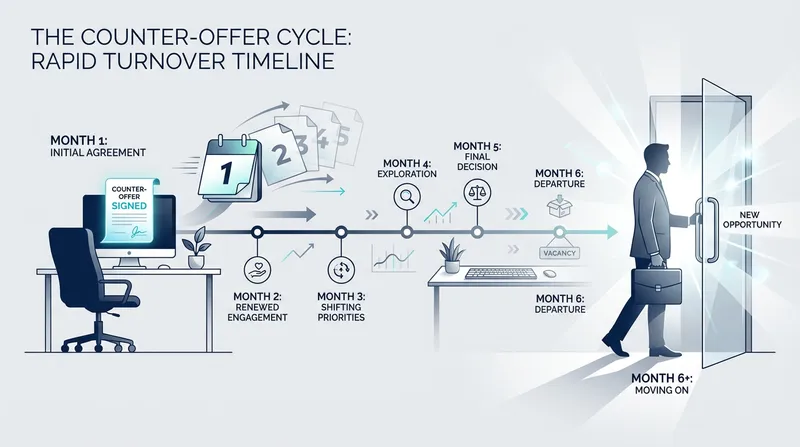
When you remove the emotion from the situation, the data paints a very clear picture of what happens if you accept a counter offer. The long-term outcomes are overwhelmingly negative for the employee.
You will often hear that 80 percent of people who accept a counter offer leave within six months. Be cautious with that number: recruiters who have tried to trace it, and Momentum Legal, have found no robust study behind it. More grounded data from the Hays Salary Guide finds that, on average, only 29 percent of counter-offered staff stay longer than 12 months. The extra money is rarely enough to mask a poor working environment.
The conversation becomes even more concerning when you look at termination claims. Some recruitment firms, such as NLC Recruiting, claim that around 80 percent of people who accept counter offers are let go within 12 months, citing unnamed national surveys, but no primary study has been published to support this. Still, why does the risk of being replaced exist? Because the employer now knows you are looking elsewhere. They may simply be buying time to find your replacement on their own schedule, rather than being caught off guard by your sudden resignation.
If you are weighing the value of staying versus leaving, you might also be evaluating the tools you use to manage your career moving forward. For a broader perspective on modern career management, check out our comparison of a human career coach vs. an AI career advisor.
Actionable Tip: Use these counter offer statistics as a warning sign, not a precise forecast. Even the most reliable data suggests most counter-offered employees are gone within a year.
Why employers make counter offers (a recruiter's perspective)
To truly understand an employer counter offer after putting in notice, you have to look at it through the lens of a hiring manager. From our experience sitting on both sides of the table, an unexpected resignation is a logistical nightmare for a company.
According to global recruitment leaders at Hays, employers often counter offer because recruiting a replacement is costly, time-consuming, and disrupts current workflow. It is not necessarily because they suddenly value the employee more. Offering you a 15 or 20 percent raise is often a bargain compared to the cost and disruption of hiring someone new.
Additionally, losing a key team member impacts the morale of the remaining staff. Managers desperately want to avoid a domino effect where one resignation inspires others to start looking for new jobs. Keeping you is about stabilizing the department, not necessarily advancing your career.
If you decide to leave and need to start building connections in your new target industry, having a strong profile is essential. Learn how to write a resume without a job description to stay prepared for networking and informal conversations.
Actionable Tip: Evaluate the counter offer based on your true market value, not your employer's sudden panic. If they could afford to pay you this new salary today, ask yourself why they were perfectly comfortable underpaying you yesterday.
The pros and cons of accepting a counter offer
Every career decision comes with trade-offs. While the statistics lean heavily against staying, it is important to objectively weigh the pros and cons of accepting a counter offer before making your final choice.
The Pros:
- Immediate Financial Gain: You get a significant raise without having to prove yourself in a new environment.
- Comfort and Familiarity: You avoid the stress of onboarding, learning new systems, and building new relationships from scratch.
- Retained Seniority: You keep your unwritten workplace capital, such as your reputation, accrued vacation time, and established trust with certain colleagues.
The Cons:
- Broken Trust: Management now knows you were actively looking to leave. Your loyalty is permanently in question, which can exclude you from future promotions or sensitive projects.
- Target on Your Back: When budget cuts happen, the highest-paid employee who already tried to quit is usually the first one on the chopping block.
- Unresolved Core Issues: As noted by Momentum Legal, a counter offer may address surface-level issues like salary or title, but it rarely resolves deeper dissatisfaction stemming from poor management, toxic work culture, or a lack of genuine growth opportunities.
If you decide to move forward with your new employer instead of staying, you can still maximize your compensation. Read our salary negotiation guide and recruiter-approved scripts to ensure you leave nothing on the table.
Actionable Tip: Write down the original three reasons you started job hunting in the first place. If the counter offer does not fix 100 percent of those issues, you should walk away. More money will not make a bad boss become a good one.
The psychology of accepted counter offer regret
One of the most overlooked risks of accepting a counter offer is the psychological toll it takes in the weeks and months that follow. This is commonly known as accepted counter offer regret.
When the initial excitement of the pay raise wears off, reality sets back in. You are still doing the exact same job, dealing with the same stressors, and reporting to the same leadership. According to insights from The Undercover Recruiter, counter offers usually address dissatisfaction (like a low salary), but it is usually demotivation (like poor company culture or a lack of meaningful work) that leads employees to seek career moves in the first place. Money cures dissatisfaction, but it cannot cure demotivation.
Furthermore, a lingering resentment often builds. You start asking yourself, "If I was worth this much money all along, why did I have to threaten to quit just to get it?" This realization fractures the relationship between you and your employer, making it incredibly difficult to stay engaged and motivated in your daily tasks.
Actionable Tip: Do a "future-self" visualization exercise. Imagine it is six months from today. The new salary is now just your normal paycheck. Are you happy coming to work, or are you still frustrated by the same systemic issues? If the answer is the latter, politely decline the offer.
Special considerations for migrants (US, UK, AU, NZ)
For job seekers and career changers who are working on employer-sponsored visas in the United States, United Kingdom, Australia, or New Zealand, the stakes are significantly higher. Using a job offer as leverage with a current employer is a dangerous game when your legal residency is tied to your job status.
If you accept a counter offer and your employer subsequently decides to replace you in three months, you are not just losing a job. Losing a sponsored job can put your visa status at risk, and grace periods to find a new sponsor are limited, so check the rules for your visa with an official government source or a registered migration adviser. Migrant workers must navigate these waters with extreme caution.
Migrant professionals must prioritize long-term stability and continuous market readiness over a short-term cash grab. A new employer willing to sponsor your visa has made a meaningful investment in hiring you.
To ensure you are always ready to interview for stable, sponsoring roles, practice your delivery with our guide on how to pass a competency-based interview.
Actionable Tip: If you are on a sponsored visa, never accept a counter offer unless you have an ironclad, legally binding contract that guarantees your employment and visa sponsorship for a set period (which is incredibly rare). Always choose the secure path with the new employer.
How to decline a counter offer professionally (with scripts)
Learning how to decline a counter offer from your current employer is an essential career skill. You want to be firm in your decision while expressing genuine gratitude, ensuring you do not burn any bridges on your way out.
When figuring out how to respond to a counter offer after resignation, keep your communication brief, professional, and forward-looking. Do not use this as an opportunity to air grievances or complain about past issues.
Verbal Script for the Meeting: "Thank you so much for this generous offer, and for the confidence you have shown in me. It means a lot. However, after careful consideration, I have decided to stick with my original plan and accept the new position. My decision is final, but I am fully committed to making my remaining time here productive and ensuring a smooth handover of all my projects."
Follow-Up Email Template: Subject: Follow-Up Regarding Counter Offer - [Your Name]
Hi [Manager's Name],
I want to sincerely thank you again for the counter offer and for the support you have given me during my time at [Company Name].
As we discussed, I have decided to move forward with the new opportunity, as it aligns closely with my long-term career goals. My last day will remain [Date], and I am completely focused on wrapping up my current tasks and training the team to ensure a seamless transition.
I have truly valued my time here and hope we can stay in touch.
Best regards, [Your Name]
For more advice on handling delicate career conversations, review our templates on how to negotiate a salary offer in the UK and US.
Actionable Tip: Deliver your refusal verbally first, out of respect, and immediately follow up with a written email to create a paper trail of your final decision and transition plan.
Stop relying on counter offers: the JobSparrow Offer Path
The best way to handle a counter offer is to build a career where you never need one in the first place. Relying on the threat of quitting just to get a raise is a reactive, stressful way to manage your professional life.
Instead, shift to proactive career management. JobSparrow is your AI career advisor, guiding you through the entire Offer Path: Diagnose, Position, Execute, Prepare, and Close. By maintaining your Master Career Profile on our platform, you keep every skill, project, and achievement in one place, and our AI suggests improvements to how you describe them. Our AI identifies your career gaps and helps you fill them before you ever apply for a job.
When you are always market-ready, you can confidently apply to better roles and secure the compensation you deserve without playing dangerous negotiation games with your current boss. If you want to see how top candidates present themselves, check out our breakdown of the 3 types of resume formats and which style is best.
Actionable Tip: Do not wait until you are desperate to leave. Start with a free diagnosis today. Upload your current CV to JobSparrow to see your recruiter-lens score and identify the exact gaps you need to fill to command a higher salary in the open market.
Frequently asked questions
Is it ever a good idea to accept a counter offer?
It rarely works out long-term. However, it may be acceptable only if your sole reason for leaving was purely financial, you genuinely love your work environment, and you have an exceptionally high-trust relationship with your manager.
How long do people usually stay after accepting a counter offer?
The data is mixed. Widely repeated claims that 80 percent leave within 6 to 12 months have no verified source, but Hays Salary Guide data suggests fewer than a third of counter-offered employees stay beyond 12 months. The underlying issues that caused them to look for a new job usually remain unresolved.
Should I use a job offer as leverage to get a raise?
We strongly advise against this tactic. While it might work in the short term, it destroys trust. It marks you as a flight risk, meaning you will likely be passed over for future promotions and could be the first to go during company layoffs.
Can an employer fire you after you accept a counter offer?
Yes. In many cases, employers use the counter offer simply to buy time. They pay you a little more for a few months while they quietly search for your replacement on their own terms, eventually letting you go. In the US most employment is at-will, while in the UK, Australia, and New Zealand employers generally must give notice and follow a fair process.
How do I tell my new employer about a counter offer?
If you intend to decline the counter offer (which we strongly recommend), you do not need to mention it to your new employer at all. Keep the process clean and focus on your excitement to start the new role. If you are trying to use it to negotiate a slightly higher starting salary with the new company, tread very carefully, as this can make you appear indecisive and uncommitted.
Tags
Keep reading
Recommended articles.
salary negotiation · job offer
Salary Negotiation Email Template & Samples | Job Sparrow
Negotiate a higher salary with our proven email templates and counter-offer samples. Copy, paste, and get the pay you deserve. Boost your offer today!
salary negotiation · salary negotiation email template
How to Negotiate Salary & Ask for More Money on a Job Offer (Recruiter-Approved Scripts)
Use our recruiter-approved salary negotiation email templates and live phone scripts to counter your job offer confidently without risking the relationship.
salary negotiation · job offer
How to Negotiate a Salary Offer in the UK & US: Recruiter Scripts & Email Templates (Without Losing the Job)
Learn how to negotiate a salary offer safely in the US and UK. Get recruiter scripts, email templates, and total compensation tactics without losing the job.