
salary negotiation
What's Your Expected Annual Base Salary? Navigating Plus vs. Inclusive of Super in Australia
By Job Sparrow Team

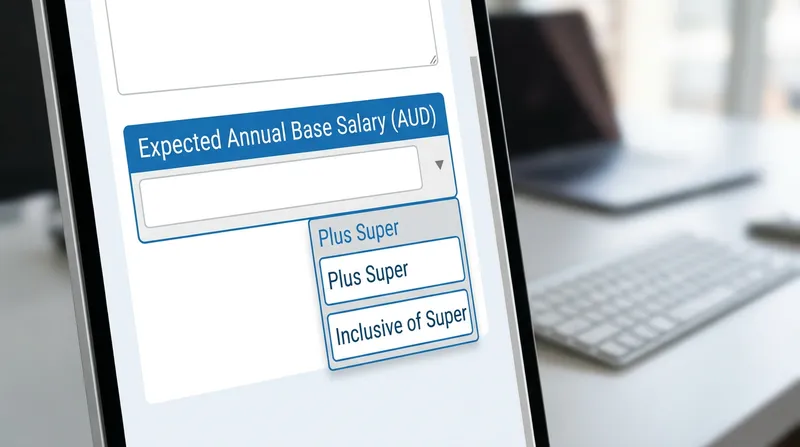
Imagine this scenario. You are filling out a job application on SEEK. You reach a mandatory drop-down menu asking for your expected annual base salary. You were aiming for a $112,000 total package, so you type in $112,000. Without realizing it, you may have just priced yourself out of the role entirely.
This is the most common and costly mistake we see from the recruiter side of the hiring table. Job seekers, especially migrants and early-career professionals, frequently confuse a "base salary" with a "Total Remuneration Package" (TRP). They fail to factor in the mandatory Australian superannuation correctly during the application phase.
Note: The Superannuation Guarantee rate increased to 12% on 1 July 2025. All calculations in this guide use the current 12% rate.
Whether you are a local professional stepping up into management or a migrant translating your expectations to the Australian market, understanding how to quote your salary is critical. In this guide, we will break down the exact math, explain how to navigate automated tracking systems, and show you how to answer this question confidently in interviews.
Why employers ask about salary expectations (and the SEEK ATS trap)
Employers ask about your salary expectations early in the process for one simple reason: they need to know if they can afford you. Hiring takes time and money. Recruiters do not want to put you through three rounds of interviews only to discover your baseline requirement is $30,000 above their maximum budget.
However, in the digital age, this question has become a trap.
When you apply through platforms like SEEK or LinkedIn, your salary input is collected and passed to the employer's Applicant Tracking System (ATS), a separate software platform like Workday or Greenhouse that the hiring company uses to screen candidates. The ATS may use your answer as a hard filter. If the company has budgeted $90,000 plus superannuation for a role, and you enter $100,000 because you were calculating your total package inclusive of super, the ATS may flag or filter your application before a human recruiter ever sees it. (Filtering behavior varies by employer and ATS platform, but salary mismatches are a common early-stage filter.)
Understanding how these systems filter candidates is the first step to beating them. You can learn more about navigating these automated filters in our guide on 5 Tests the Best AI Resume Builder in 2026 Must Pass to Beat the ATS | Blog | JobSparrow.
The core difference: Base salary vs. Total Remuneration Package (TRP)
To avoid pricing yourself out of a job or leaving money on the table, you must understand the legal and corporate definitions of Australian compensation.
What is a base salary? Under Australian employment law, the Fair Work Ombudsman clarifies that the base rate of pay is the rate payable to an employee for their ordinary hours of work. It explicitly excludes superannuation, bonuses, overtime, and allowances. When an application asks for your "expected annual base salary," they are asking for this raw, pre-tax number before any retirement contributions are added.
What is a Total Remuneration Package (TRP)? The Australian Public Service Commission (APSC) notes that a Total Remuneration Package covers your base salary plus all additional financial benefits. Superannuation is the main component captured in a TRP above your base salary. Depending on the company, a TRP might also include a company car, health insurance allowances, or guaranteed bonuses.
When a job advertisement lists a salary as "$100k Package" or "$100k Inclusive of Super," they are quoting the TRP.
Plus super vs. inclusive of super: The 12% math breakdown
The Australian Taxation Office (ATO) mandates a Superannuation Guarantee (SG) rate of 12% of an employee's ordinary time earnings for the 2025-2026 and 2026-2027 financial years. This is a mandatory employer contribution to your retirement fund.
Mixing up "plus super" and "inclusive of super" is where candidates lose money. Let us look at the exact mathematical breakdown for a $100,000 offer.
| Component | Scenario A: $100,000 Plus Super | Scenario B: $100,000 Inclusive of Super (TRP) |
|---|---|---|
| Base Salary | $100,000 | $89,285.71 |
| Employer Super (12%) | $12,000 | $10,714.29 |
| Total Package (TRP) | $112,000 | $100,000 |
| Take-Home Pay Basis | Calculated on $100,000 | Calculated on $89,285 |
The difference in your actual base salary between these two scenarios is nearly $11,000. If you fill out an application and state your expected base salary is $112,000 because you calculated your desired TRP, the recruiter will assume you want $112,000 PLUS 12% super on top. They will categorize you as too expensive and move on to the next candidate.
The migrant translation guide: Superannuation for expats
If you are migrating to Australia or New Zealand, the local compensation terminology can be incredibly confusing.
For US expats: In the United States, retirement contributions are typically handled through a 401(k). Employer matches are often optional, usually capped at 3% to 5%, and frequently require the employee to contribute their own money first. In Australia, the 12% superannuation contribution is mandatory. It is paid entirely by the employer on top of your base salary (unless the offer explicitly states it is a "package"). Do not negotiate your Australian salary using US compensation frameworks, or you will drastically undervalue your take-home pay.
For UK expats: Workplace pensions in the United Kingdom usually operate on a matched system, typically requiring a 3% employer contribution and a 5% employee contribution. Australian superannuation does not require a mandatory employee deduction from your base pay to trigger the employer contribution. The employer covers the full 12% by law.
For New Zealand expats: If you are migrating to New Zealand, note that KiwiSaver operates differently. Employer contributions are currently a minimum of 3.5% (up from 3% on 1 April 2026, rising to 4% on 1 April 2028), and employee contributions are mandatory. Always confirm the specific contribution structure with your NZ employer.
Actionable tip for migrants: Always ask the recruiter to clarify the terminology. A simple email asking, "Could you please confirm if the quoted salary band is exclusive or inclusive of superannuation?" demonstrates professional diligence and protects your financial interests.
How to research your market value
Before you can confidently state your expected salary, you need to know the current market rate for your specific skills, location, and industry experience.
- Consult salary guides: Major recruitment firms publish annual salary guides tailored to the Australian market. These guides break down compensation by city (Sydney and Melbourne typically command higher salaries than Adelaide or Perth) and by experience level.
- Analyze job boards: Search SEEK and LinkedIn for roles similar to your target job. Even if a company hides the salary, you can often use the website's internal search filters to guess the salary band. Adjust the salary filter up and down until the job disappears from the search results.
- Evaluate your unique value: Do you have specialized skills that bridge a gap in the market? If you are pivoting industries, you might need to adjust your expectations. Learn how to position your transferable skills effectively in our guide on How to Write a Resume for a Career Change: Translating Skills & Filling Gaps | Blog | JobSparrow.
Should you give a salary range?
Yes. When filling out forms that allow text, or when speaking to a recruiter, providing a range is always better than providing a single, rigid number.
According to Robert Half, providing a tight salary range shows market knowledge and flexibility without pricing yourself out.
In the Australian market, a practical example: if your research shows the market rate for a senior project manager in Melbourne is $120,000 to $140,000 base plus super, quoting a range of $125,000 to $135,000 signals that you have done your homework and are serious without anchoring too low or too high.
From a recruiter's perspective, a range shows that you are open to negotiation based on the entire offer. If you say, "I am looking for a base salary between $125,000 and $135,000 plus super," it tells the employer that you know your worth, but you are willing to accept the lower end of the range if the company offers excellent non-monetary perks, such as remote work flexibility or extra annual leave.
How to answer salary questions in an interview
Answering a drop-down menu on a website is one thing. Looking a hiring manager in the eye and answering the question live is entirely different. It requires confidence, preparation, and a strategic script.
Step 1: Delay if possible If the question comes up in the first five minutes of a screening call, try to delay it gracefully. You can say, "I want to make sure I have a complete picture of the role before giving you a precise number. Could we walk through the key responsibilities and expectations first?" This maintains strategic control without signaling excessive flexibility.
Step 2: Pivot to your researched range If they press for a number, rely on your research. Say, "Based on my market research and the requirements of this role, I am looking for a base salary in the range of $125,000 to $135,000."
Step 3: Always clarify the terms Never leave the room without clarifying the superannuation structure. Immediately follow your range by stating, "...and that is exclusive of superannuation." This prevents any miscommunication that could lead to an underwhelming formal offer.
Delivering these lines naturally takes practice. Reading a script is easy, but sounding confident under pressure is hard. This is where JobSparrow's AI tools become your greatest asset. You can read more about perfecting your delivery in our article on Why Good Answers Fail: How to Practice Mock Interviews Online with Voice AI | Blog | JobSparrow.
What to do if the offer is too low
Sometimes, despite your best efforts and clear communication, the company returns with an offer below your expected range. Do not panic, and do not immediately decline.
First, evaluate the entire package. Does the company offer a higher superannuation contribution than the mandatory 12%? Many universities and top-tier corporate firms in Australia offer 14% or even 17% superannuation. Does the role offer a guaranteed annual bonus, a company vehicle, or heavily subsidized health insurance?
One more thing to check is salary packaging. In Australia, particularly in the not-for-profit, healthcare, and education sectors, employers may offer salary packaging arrangements that reduce your taxable income. A $90,000 base with generous packaging can be worth more than a $100,000 base without it. Always ask your recruiter whether packaging is available and factor it into your total offer evaluation.
If the base salary is low but the non-monetary perks are high, you have a decision to make. If the offer is simply a lowball attempt, you must be prepared to negotiate. Reiterate the value you bring to the company, point back to your initial stated range, and ask if there is any flexibility to bridge the gap.
If they cannot meet your minimum baseline, you must be willing to walk away. Accepting a salary that breeds immediate resentment will only lead to burnout and a renewed job search six months later.
The JobSparrow advantage: Navigating the offer path
Getting to the salary negotiation stage means you have successfully navigated the initial application, beaten the ATS, and impressed the hiring manager. JobSparrow is an AI career advisor that coaches you through the entire hunt to the offer, representing a shift away from one-off resume tools. We call this the Offer Path: Diagnose, Position, Execute, Prepare, Close.
1. Diagnose and position with the Master Profile Before you can confidently quote a salary range, you need to know your own value. JobSparrow's Master Profile and Gap Filler ensure you have a complete, metric-rich picture of your achievements, so when a recruiter asks what you bring to the table, you have a precise answer ready.
2. Execute with intelligent tailoring Sending generic resumes leads to generic rejections. When you find a job you want, JobSparrow's AI analyzes the specific job description and intelligently selects the most relevant experience from your Master Profile. It rewrites your bullet points to match the job's keywords and requirements in under 60 seconds. We also generate a personalized cover letter to match. Discover why this matters in our guide on The Consistency Rule: How an Integrated Resume and Cover Letter Creator Lands More Interviews | Blog | JobSparrow.
3. Prepare with AI mock interviews When it is time to discuss your expected annual base salary, you need to be ready. JobSparrow's AI Mock Interviews allow you to practice role-specific scenarios with real-time audio recording. You receive instant, actionable feedback on your clarity, tone, and answer quality, ensuring you sound confident and professional during negotiations.
4. Manage your search in one place Stop losing track of which salary range you quoted to which company. Our centralized dashboard tracks your applications, fetches job details instantly from URLs, and provides a Match Score showing how well you fit a role before you apply.
Take control of your salary expectations today
Quoting your expected annual base salary does not have to be a guessing game. By understanding the critical difference between base pay and a Total Remuneration Package, calculating the 12% superannuation correctly, and communicating your terms clearly, you protect your worth and your financial future.
The job market is competitive, but you do not have to navigate it alone. We have reviewed over 100,000 resumes and hired across four global markets (Australia/NZ, United States, Singapore, and Hong Kong). We know what works.
Ready to land more interviews and negotiate better offers? Start with a free diagnosis. You will receive a recruiter-lens score out of 100 and see the exact gaps costing you interviews, at no cost. When you are ready to take action, unlock the full Offer Path with the Land the Job membership, cancel anytime. That includes tailored resumes, personalized cover letters, AI mock interviews, and your centralized application dashboard.
Visit JobSparrow to start your free diagnosis today.
Frequently asked questions
Does base salary include super in Australia?
No. Under Australian employment law, your base salary is your pre-tax pay for ordinary hours worked, explicitly excluding superannuation, bonuses, and allowances. If a job offer says "plus super," the mandatory 12% is added on top of your base salary.
What does $100k plus super mean for my take-home pay?
It means your annual base salary is $100,000, and your employer will pay an additional $12,000 (12% for the 2025-2026 financial year) into your nominated superannuation fund. Your pre-tax take-home pay is calculated based on the $100,000 base.
Should I quote my expected salary inclusive or exclusive of superannuation?
Always quote your expected salary exclusive of superannuation (as a base salary) unless the application specifically asks for a Total Remuneration Package (TRP). Quoting inclusive of super can make you appear too expensive to automated tracking systems.
How do I answer the expected salary question on SEEK?
Calculate your target base salary excluding super. If SEEK provides a drop-down menu, select the range that aligns with this base figure. If you enter your total package amount, the Applicant Tracking System (ATS) might filter you out for exceeding the company's budget.
How do I calculate my base salary from a Total Remuneration Package (TRP)?
To find your base salary from a TRP that includes the mandatory 12% superannuation, divide the total package amount by 1.12. For example, a $120,000 TRP divided by 1.12 equals a base salary of approximately $107,142.
Tags
Keep reading
Recommended articles.
salary negotiation · australian job market
Salary Expectations in Australia: How to Answer 'Plus Super' vs. 'Including Super'
Learn the exact dollar difference between base plus super and total remuneration packages in Australia. Includes formulas and interview scripts. Start today.
interview preparation · case study interview
How to Ace a Case Study Presentation Interview in Australia (2026 Guide)
Learn to structure a 5-slide case study presentation for Australian panels, manage your Q&A, and practice with AI. Start your free diagnosis today.
interview preparation · tell me about yourself
How to Answer 'Tell Me About Yourself' in Australia: The Present-Past-Future Formula (2026)
Master the tell me about yourself question with JobSparrow's Present-Past-Future framework. Real examples for Australia. Start free.