
485 visa
485 Visa to Sponsored Job: Your 2026 Guide to PR in Australia
By Job Sparrow Team

485 Visa to Sponsored Job: Your Step-by-Step Guide to PR in Australia (2026)
The clock is ticking. You feel it with every job application sent into the void. You have the Australian qualification, the drive, and the Temporary Graduate (subclass 485) visa, but the path to a sponsored job and Permanent Residency (PR) feels like a maze. You're caught in a painful loop: you can't get a skilled job without local experience, and you can't get that experience without a job.
Most advice is fragmented, caught between dense legal jargon and generic job search tips that ignore your reality. This guide connects your visa strategy, skills assessment, and job search into a single, powerful plan to turn your Australian dream into a reality.
Your 485 Visa Isn't a Waiting Room - It's Your Launchpad for PR
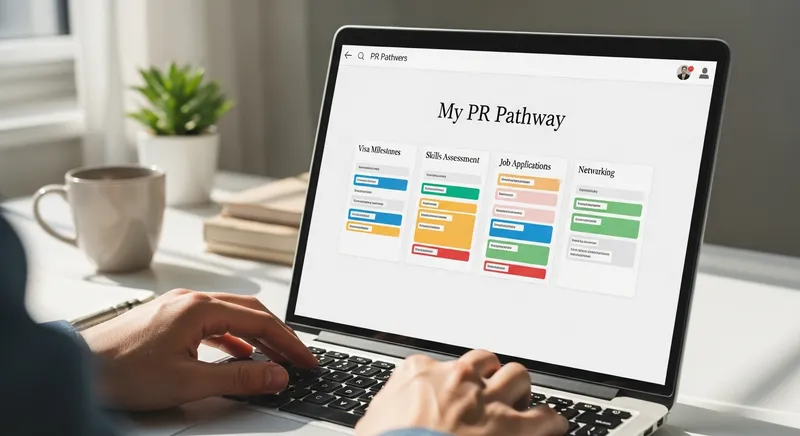
First, let's change your mindset. The 485 visa is not a passive waiting period; it's your single most valuable asset. It grants you full work rights and the time to prove your value to an Australian employer. According to the Australian Department of Home Affairs, whether you are on the Graduate Work or Post-Study Work stream, every month is an opportunity to build a compelling case for sponsorship and PR.
Don't let this time slip away. The biggest mistake graduates make is waiting until the last six months of their visa to get serious. Your strategy starts now.
Actionable Tip: Open a calendar and mark your visa expiry date. Working backward, set 3-month milestones for key goals:
- Months 1-3: Finalize your skills assessment documentation.
- Months 4-6: Create a target list of 50 companies and begin networking.
- Months 7-9: Secure your first professional interviews. This timeline is your new boss.
The Destination: Key PR Pathways from a 485 Visa
To plan your journey, you need to know the destination. While there are many visa subclasses, most 485 holders target one of two main routes:
- Employer-Sponsored Pathways: This is where an approved business sponsors you. The most common route is the Temporary Skill Shortage (TSS) visa (subclass 482), which can then lead to a permanent Employer Nomination Scheme (ENS) visa (subclass 186).
- Skilled Migration Pathways: This route is based on a points system. You apply independently and are invited by the government based on your score. Visas include the Skilled Independent visa (subclass 189), Skilled Nominated visa (subclass 190), and Skilled Work Regional visa (subclass 491). Gaining skilled work experience in Australia on your 485 visa is crucial for boosting your points.
Here's a simple breakdown:
| Pathway Type | Key Requirement | Control Factor |
|---|---|---|
| Employer-Sponsored (482/186) | A job offer from an eligible employer | Employer-dependent |
| Skilled Migration (189/190/491) | Achieving a high points score | Self-dependent |
For the employer-sponsored route, the requirements for a 186 visa often include having at least three years of relevant work experience, making the TSS 482 a common stepping stone.
Actionable Tip: Use the official government points calculator to get a baseline score. Be honest. This will tell you whether you should focus primarily on finding a sponsor or if the points-based route is a realistic option for you.
The 'Master Profile' Method: Documenting Experience for Skills Assessment & Jobs
Your most important career document isn't your resume; it's your Master Profile. This is a comprehensive, private document where you record every skill, project, achievement, and responsibility from your entire career and education. Think of it as your personal career database.
Why is this so critical? Because to get a skilled visa, you first need a positive skills assessment from a designated authority. As the Department of Home Affairs explains, this is a mandatory step. These authorities, like Engineers Australia or CPA Australia, have incredibly specific documentation requirements. You can't just submit a standard resume.
JobSparrow's Master Career Profile feature is built for this. It allows you to create a single source of truth for your career, storing and enhancing every detail. When it's time to apply for your skills assessment or a job, you're not starting from scratch; you're selecting the most relevant details from a rich, pre-built database.
Actionable Tip: For every role or major university project, document your experience using the STAR method (Situation, Task, Action, Result). For example:
- Situation: The company's monthly reporting process was manual and took 20 hours.
- Task: I was tasked with automating the reporting process.
- Action: I used my Python skills and the Pandas library to write a script that consolidated and cleaned the data from three different sources.
- Result: The reporting process was reduced from 20 hours to 15 minutes, saving the team over 18 hours per month and eliminating manual data entry errors.
This level of detail is exactly what skills assessors and hiring managers look for. If you're a nurse or doctor, our guide on AHPRA & MCNZ registration provides more field-specific insights.
Build Your Foundation in Minutes See how JobSparrow's Master Career Profile works. Upload your CV and get AI-enhanced descriptions in 60 seconds. Try it free and start building your Master Profile today.
The Sponsorship Hunt: A 3-Part Strategy for Finding a Sponsoring Company
"Just apply for jobs" is terrible advice for a 485 visa holder. You need a targeted strategy. Generic applications are a waste of your precious time. Here's how to hunt effectively.
Part 1: How to Find Companies with a History of Sponsorship
Instead of applying blindly, you need to find companies that are able and willing to sponsor. This requires detective work.
- Research the Official List: The Department of Home Affairs maintains a list of approved sponsors that are approved sponsors. While this list is large, you can use it to research companies in your industry.
- Become a LinkedIn Detective: Don't just search for jobs. Search for people. Find professionals in Australia who have your target job title and a similar international background. Where do they work? This is your primary list of potential targets.
- Analyze Job Postings: Look for clues. Phrases like "sponsorship may be available for the right candidate" are a green light. Conversely, phrases like "must have full, unrestricted working rights" or "only Australian citizens or permanent residents will be considered" are a clear red light. Don't waste your time.
Actionable Tip: Create a target list of 20 companies based on your research. Use a spreadsheet or a dedicated tool to track them. For a head start, download our free job application tracker template.
Part 2: Overcoming the 'No Local Experience' Barrier
This is the most painful rejection, and it's a real problem. The government-endorsed QILT Graduate Outcomes Survey shows that international graduates have a significantly lower full-time employment rate than domestic graduates shortly after graduation. You are not imagining this challenge.
The key is to reframe the conversation. Instead of letting them focus on what you don't have (local experience), you need to make them see what you do have (valuable skills).
This is where your Master Profile becomes your secret weapon. Go through the job description and your Master Profile side-by-side. JobSparrow's AI helps map your skills, projects, and quantifiable achievements directly to their requirements.
Actionable Tip: On your resume, create a "Key Skills" or "Professional Profile" section at the very top. Use 4-5 bullet points to directly mirror the language of the job description. If they need someone with "stakeholder management and financial modeling," your profile should state that you have "experience in stakeholder management and advanced financial modeling using Excel and Python." You are pre-empting their objection before they even have it. Learn more about crafting the perfect resume in our guide to Seek Profile vs Tailored Resume.
Part 3: Tailoring Your Application to Get Noticed
If you are a migrant job seeker, sending a generic resume is the fastest way to get ignored. Every single application must be tailored.
Manually tailoring your resume for every job is exhausting. This is where AI becomes your unfair advantage. JobSparrow's Job-Specific Resume Tailoring feature analyzes a job description and intelligently selects the most relevant experiences from your Master Profile. It rewrites bullet points to match the employer's keywords, ensuring your application gets past automated screening systems and impresses the human recruiter.
Actionable Tip: For every application, generate a tailored resume and a unique cover letter. JobSparrow's Intelligent Cover Letter Generator can create a compelling narrative that connects your specific experiences to the company's needs in minutes, not hours. See how to perfect your AI-generated letters in our guide to making an AI cover letter sound like you.
Nailing the Interview and Discussing Sponsorship
Once you get the interview, the goal is to prove you are the best candidate for the job, full stop. The visa is a secondary, logistical detail.
Do not bring up sponsorship in the first interview. Your focus is on demonstrating your skills, enthusiasm, and cultural fit. Make them want you. By the second or third interview, when they are clearly interested, the conversation about sponsorship becomes a simple question of "how do we make this happen?" rather than "should we even consider it?"
Actionable Tip: Prepare a confident, concise answer for the inevitable question: "What is your visa status?" Frame it positively and strategically. Try this:
"I'm currently on a Temporary Graduate visa with full, unrestricted working rights. I'm passionate about building a long-term career in this field, and my ultimate goal is to secure a permanent role with a great company like yours through sponsorship."
This answer is confident, honest, and shows you are a serious professional with a long-term plan. Practice this answer and get AI feedback on your delivery with JobSparrow's role-specific mock interviews to build confidence before the real thing. To manage the stress of this process, check out our guide on The Anti-Burnout Job Search.
Conclusion: Your Path to PR is a Marathon, Not a Sprint
Navigating the path from a 485 visa to a sponsored job and PR is one of the most challenging things you will ever do. It requires strategy, discipline, and resilience. But it is achievable.
Remember the playbook: use your 485 visa period strategically, build a detailed Master Profile, hunt for sponsor-friendly companies, and tailor every single application to prove your value. This is a marathon, not a sprint, and every step you take with a clear plan is a step closer to the finish line.
You don't have to run this marathon alone. Ready to build your Master Profile and start tailoring applications in minutes? JobSparrow can act as your personal AI career assistant, automating the most time-consuming parts of the process so you can focus on what truly matters: putting your best foot forward in every application and interview.
Frequently Asked Questions
Can I get PR directly with a 485 visa?
No, the 485 visa is a temporary visa and does not directly lead to Permanent Residency (PR). It is best understood as a crucial bridge. Its purpose is to provide you with time and full working rights to gain the skilled Australian work experience needed to qualify for a separate, permanent visa like the Employer Nomination Scheme (subclass 186) or a points-tested visa (subclass 189 or 190).
How much Australian work experience do I need for PR?
This depends entirely on your chosen visa pathway:
- For the Employer Sponsored (186) Direct Entry stream: You generally need at least three years of relevant, skilled work experience.
- For points-tested visas (189, 190, 491): There is no absolute minimum, but gaining skilled Australian work experience is one of the fastest ways to increase your points score. Even one year of experience can provide a significant boost, and three years provides even more.
What if my 485 visa is expiring and I don't have a sponsor?
This is a critical moment that requires a calm and immediate assessment of your options. You should:
- Check Your Points: Use the official points calculator to see if you have enough points to be competitive for a skilled migration visa (189, 190, 491).
- Consider Regional Options: Look into state and territory nomination programs, especially in regional areas, which may have more accessible criteria or occupation lists.
- Explore Other Visas: In some cases, you may be eligible for another temporary visa (such as a student visa for further study) to lawfully remain in Australia while you work on your PR strategy. Given the complexity, we strongly recommend speaking with a registered migration agent to get professional advice tailored to your specific situation.
Does a Professional Year Program guarantee PR?
No, it does not guarantee PR. A Professional Year Program is a structured professional development program that combines formal learning and an internship. While it does not guarantee a permanent visa, it is valuable for two key reasons: it can award you additional points for a skilled migration visa application, and it provides structured Australian workplace experience. Documenting this experience in your Master Profile can help you overcome the "no local experience" barrier when applying for jobs.
Can I work in any job on a 485 visa?
Legally, yes. Your 485 visa comes with unrestricted work rights, meaning you are allowed to work for any employer in any job. However, for your work to contribute to a future PR application, it must be strategic. The work must be in your nominated skilled occupation (or a closely related one) to be counted for skilled experience points or to meet the requirements for employer sponsorship. Working in an unrelated job is fine to pay the bills, but it will not help you secure a skilled or sponsored visa.
How do I know if my work experience will be counted for the skills assessment?
This is a vital question, as the criteria are strict. For work experience to be considered 'skilled' by an assessing authority, it generally must meet the following conditions:
- It must have taken place after you completed the qualification that makes you eligible for the skilled occupation.
- It must be paid at the market rate.
- It must be for a minimum of 20 hours per week.
- It must be highly relevant to your nominated occupation. Each assessing authority, such as CPA Australia for accountants, has its own specific guidelines. You must check their website for the definitive rules. Using a Master Profile to meticulously document your hours, pay, and duties for each role is the best way to prepare for this scrutiny.
Tags
Keep reading
Recommended articles.
interview prep · ai tools
Overcoming Interview Anxiety: Why Voice AI Mock Interviews Beat ChatGPT
Beat interview anxiety with voice AI mock interviews. Learn why typing in ChatGPT fails and how real-time audio practice builds genuine confidence.
internships · job search
The Ultimate Internship Application Tracker: Best Apps & Spreadsheets for Graduates in 2026
Build the ultimate internship tracker for 2026. Manage graduate applications, OA deadlines, and visas, plus get a free CV diagnosis from JobSparrow.
interview prep · career advice
How to Explain Being Fired in an Interview (With Scripts & Examples)
Learn how to explain being fired in an interview without panic. Get actionable scripts, recruiter insights, and tips to answer with total confidence.