
resume tips
Address on Resume in 2026: What Recruiters & ATS Actually Want
By Job Sparrow Team

Crafting the perfect resume in 2026 feels like a high-stakes game of precision. You've meticulously detailed your achievements, selected powerful action verbs, and tailored your skills to the job description. But then you arrive at the contact information section and hit a surprisingly complex question: should you put your address on your resume?
This single detail can feel trivial, but it has significant implications for everything from your personal safety to passing through the digital gates of an Applicant Tracking System (ATS). Let's clear up the confusion with a data-backed, definitive guide.
The 2026 Verdict on Putting Your Address on a Resume: A Clear Answer
For the vast majority of private-sector jobs in 2026, the answer is no, you should not include your full street address on your resume.
The modern, professional standard is to list only your City and State (e.g., "San Francisco, CA"). This approach provides recruiters and automated systems with the location information they need without compromising your privacy or introducing unconscious bias. Many HR professionals, including those represented by the Society for Human Resource Management (SHRM), now consider a full street address an outdated practice.
This guide will walk you through the pros and cons, how technology interprets your location, and provide clear templates for every scenario, whether you're a local candidate, a remote job seeker, or planning a cross-country move.
Pros and Cons: A Data-Driven Look at Including Your Address
While the trend is to omit your street address, understanding the reasoning behind the advice helps you make the most strategic choice for your situation. It's a balance of providing necessary information while protecting yourself.
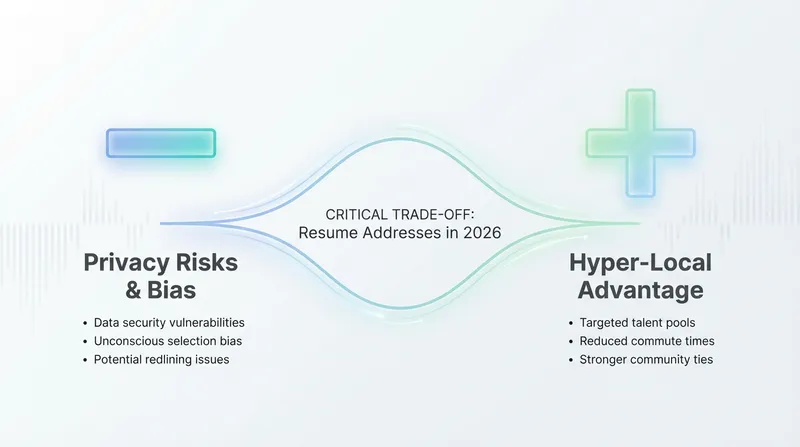
The (Few) Pros of Including a Full Address
In a few niche situations, a full address might offer a slight advantage:
- Hyper-Local Roles: For jobs where a very short commute is a critical benefit (e.g., a plant operator at a specific factory, an emergency responder), proving you live minutes away could be a selling point.
- Proving Local Residency: Some municipal or city-specific jobs may have residency requirements. While this is usually verified later in the hiring process, including an address can signal immediate eligibility.
- Extremely Traditional Industries: In some legacy fields that are slower to adopt modern hiring practices, a full address might align with an older, more traditional expectation of what a resume should contain.
The Major Cons: Why Experts Say to Leave Your Address Off Your Resume
The reasons to omit your street address are far more compelling and relevant for the modern job seeker. Protecting your personal information is paramount.
- Safety and Identity Theft: This is the most critical factor. When you upload your resume to job boards, you don't always know who has access to it. As the Georgia Attorney General's Consumer Protection Division warns job seekers, posting personal information online creates risks. Including your home address can make you a target for identity theft or other scams.
- Location Bias: Unconscious bias is a real factor in hiring. A recruiter might make assumptions based on your neighborhood, its perceived socioeconomic status, or a potentially long commute. As experts writing for publications like the Harvard Business Review note, removing details that can trigger bias helps create a more equitable process. Your application should be judged on your skills and experience, not your street name.
- Irrelevance for Remote & Hybrid Work: In an era where remote and hybrid roles are common, your physical street address is largely irrelevant. What matters is your eligibility to work in a specific state or country and your ability to coordinate across time zones.
- Appearing Outdated: Including a full address can signal that you aren't up-to-date with modern professional norms, a small but potentially impactful signal in a competitive job market.
How AI and ATS Filter Resumes by Location in 2026
To understand why "City, State" is the perfect compromise, you need to know how Applicant Tracking Systems (ATS) work. These are the software platforms that most companies use to manage and filter the thousands of applications they receive.
When you apply, the ATS scans your resume for key information, including location. Here's how it uses that data:
- Parsing: The software identifies terms that look like a location, primarily searching for a city, state, and ZIP code.
- Matching: It compares your location to the location specified in the job description.
- Filtering: If the job is for an in-person role in Austin, Texas, the ATS can be programmed with a "knockout filter" to automatically reject candidates whose location is identified as being in New York City. This is done to present recruiters with a manageable list of local or willing-to-relocate candidates.
Including just your City and State provides the ATS with exactly what it needs to correctly categorize you without oversharing. This is a core principle of resume optimization: give the system the data it needs to pass you through to a human reviewer. Mastering this is a key part of the strategy we advocate in our guide on the Master Resume vs. Tailored Resume. JobSparrow's Master Career Profile serves as your comprehensive hub, making tailoring for each job seamless.
What to Put for Location on Your Resume: Scenarios & Templates
Now for the practical application. Here are the clear, actionable templates for the most common job search scenarios you'll face. No more guessing—just follow the format that fits your situation.
Scenario 1: You're a Local Candidate
If you live in the same metropolitan area as the job you're applying for, your goal is to signal that you are a local candidate without giving away your home address.
- Recommendation: Use "City, State" or "City, ST".
- Example:
San Francisco, CA - What about the ZIP code? Including your ZIP code is generally unnecessary. However, in a large metropolitan area with many suburbs, a ZIP code can sometimes help an ATS more precisely confirm you are within the desired commute radius. It's a minor addition that is safe to include if you choose, but not required.
Scenario 2: You're Applying for Remote Jobs
For remote roles, your location still matters for legal and logistical reasons. Companies are often only registered to employ people in certain states, and your time zone is critical for team collaboration.
- Recommendation: Use your current "City, State" to indicate your time zone and work eligibility.
- Alternative: If you are fully flexible, you can broaden your statement. Consider adding a line in your resume summary like, "Seeking remote opportunities based in the United States."
- Example Header:
Maria GarciaDenver, CO | (555) 123-4567 | m.garcia@email.com | linkedin.com/in/mariagarcia
This approach gives employers the logistical information they need and is also a great way to present yourself if you're exploring how to list freelance work on your resume, as it focuses on your availability and skills over a physical location.
Scenario 3: You're Relocating for a Job
This is one of the most critical scenarios for career changers and migrators. Using your current address when applying for a job in another state is the fastest way to get rejected by an ATS filter. You must signal your intention to move.
- Option A (Definite Plans): If you have a set date for your move, state it clearly.
- Example:
Relocating to Austin, TX in March 2026
- Example:
- Option B (Open to Moving): If you are willing to move for the right role, make that clear.
- Example:
Open to Relocation to New York, NY
- Example:
Place this statement directly in your resume header where your address would normally go. This ensures the ATS and the human recruiter see it immediately. Planning a big move is a major step, and framing it correctly on your resume should be a key part of your 12-month career roadmap.
Explaining your relocation is a common interview question, and JobSparrow's AI Mock Interviews can help you practice your answer with confidence.
The Exception to the Rule: Address on a Resume for Government Jobs
While the private sector has moved away from full addresses, there's one important exception you should know about: federal government jobs.
When applying for positions through platforms like USAJOBS, you are often required to provide a full street address. According to guidance from federal agencies like USAJOBS, federal resumes are more detailed and serve as a basis for background checks, security clearances, and official correspondence. The application process is standardized and requires this information upfront.
Always read the job announcement carefully. If a federal job application asks for your full address, provide it exactly as requested.
Your Modern Resume Header for 2026: A Perfect Template
Pulling it all together, a modern, effective, and safe resume header for 2026 should be clean, scannable, and ATS-friendly. It focuses on how recruiters can contact you and where you are professionally located, not where you live.
Your header should include:
- Your Name
- City, State (or your relocation statement)
- Phone Number
- Professional Email Address
- LinkedIn Profile URL
- Portfolio or GitHub URL (if relevant to your field)
Here is a template in action:
Your Name
City, State | (555) 555-5555 | your.email@provider.com | linkedin.com/in/yourprofile | yourportfolio.com
Creating a perfectly formatted header is the first step. The next is tailoring the content of your resume to each specific job. JobSparrow's AI Resume Builder automates this entire process, ensuring your resume is always optimized to beat the bots and impress recruiters.
Land Your Next Role with Confidence
Deciding what to include in your resume header is no longer a mystery. By omitting your full street address and using "City, State," you protect your privacy, avoid unconscious bias, and provide all the information recruiters and applicant tracking systems need.
Remember to tailor your location based on your specific goal: confirm you're local, signal your remote availability, or state your intention to relocate. A modern resume is about presenting relevant information safely and strategically.
Now that your header is perfected, you can focus on what truly matters: showcasing your skills and experience. With a clear strategy and the right tools, you can navigate your job search with confidence. JobSparrow's AI-powered career assistant is here to help you tailor every application, practice for interviews, and land your dream job faster.
Frequently Asked Questions
Is it safe to put my address on my resume?
No, it's not recommended for safety and privacy reasons. Including your full street address, especially on resumes posted to public job boards, can expose you to identity theft and other privacy risks. To stay safe, stick to the modern standard of using only your "City, State."
Should I include my ZIP code on my resume in 2026?
This is generally optional. While "City, State" is sufficient, adding a ZIP code can sometimes help an Applicant Tracking System (ATS) confirm you are within a specific geographic radius for a local job. It's a safe but non-essential detail.
What should I put for my location on my resume if I want a remote job?
You should still list your current "City, State." This is important for employers to understand your time zone for team collaboration and to confirm you reside in a state where they are legally set up to hire employees. You can also add a line like "Seeking remote opportunities" to your resume summary to reinforce your preference.
How do I show I'm relocating on a resume without getting filtered out?
Never use your current address if you're applying for a job in a different state. Instead, replace your location in the header with a clear statement like "Relocating to [Target City, State]" or "Open to Relocation in [Target City, State]." This prevents an ATS from automatically rejecting your application based on a location mismatch.
What contact information is essential for a resume in 2026?
Your resume header should be concise and professional. The essential items are your Full Name, Phone Number, a Professional Email Address, your LinkedIn Profile URL, and your Location (City, State). If relevant to your industry, you should also include a link to your professional portfolio or GitHub profile.
Tags
Keep reading
Recommended articles.
job search · resume tips
Job Application Black Hole AU/NZ: 8 Reasons You're Not Hearing Back & How to Fix It
Getting ghosted by jobs in AU/NZ? We reveal 8 reasons your application is ignored and a framework to get seen. Get your free resume match score now.
job search · resume writing
Seek Profile vs Tailored Resume: Your 2026 Guide to Getting More Interviews in Australia
Stop guessing how to get interviews. Learn the 2026 AU/NZ strategy for using your Seek profile and tailored resume to get hired faster. Your guide to winning.
ats · resume writing
Beat the Bots: An AU/NZ Guide to ATS-Friendly Resumes with Keyword and Formatting Secrets
Tired of the resume black hole? Our expert AU/NZ guide reveals the exact formatting rules and keyword secrets for an ATS-friendly resume that beats the bots.