
ai interview prep
AI Interview Prep in New Zealand: Best Tools & How to Practice
By Job Sparrow Team

You've tailored your CV, written a strong cover letter, and landed the interview. Then the nerves hit. You sit across from the hiring manager (or stare into a video call camera) and your mind goes blank. The question was straightforward. You've answered it a hundred times in your head. But under pressure, the words come out jumbled, vague, or too long.
This is the most common and most painful gap in the job search process for Kiwi job seekers: the preparation gap between getting the interview and performing well in it. AI interview practice tools are changing that. Whether you're a recent graduate entering the NZ job market, a migrant building a new career in New Zealand, or an experienced professional making a career change, voice-based AI tools now let you rehearse real interview scenarios before you walk into the room.
If your interview is coming up this week, you can start practicing right now. JobSparrow's AI mock interview tool generates questions from your actual job description. Start with a free CV diagnosis to see your recruiter-lens score first.
This guide covers the Prepare stage of your job search, the step between submitting a strong, tailored application and walking into the room ready to perform. At JobSparrow, our team has sat on both sides of the table, collectively reviewing over 100,000 resumes and hiring across the New Zealand and Australian markets. We will cover the best AI interview practice tools available to New Zealand job seekers, how to use them effectively for behavioral and situational interviews, and what the NZ job market specifically expects from candidates.
Why interview preparation is a bigger problem than most Kiwi job seekers realise
Most people think they know how to interview. They've done it before. They know their own work history. But knowing your story and telling it well under pressure are two very different skills.
Research consistently shows that soft skills and communication ability are among the top factors hiring managers assess in interviews, yet they are the hardest to develop without deliberate practice. In New Zealand specifically, the job market is relationship-driven. Employers often hire for cultural fit as much as technical capability, which means how you present yourself matters enormously.
The traditional approach to interview prep has serious limitations:
- Practicing with a friend or family member rarely simulates real pressure
- Career coaches in New Zealand typically charge $150 or more per session, with full interview coaching programmes often exceeding $1,000
- Reading sample answers online does not build muscle memory for speaking
- Most people only practice once or twice before the real thing
AI interview practice tools solve all four of these problems. They are available 24/7, cost a fraction of a career coach, simulate real conversational pressure through voice interaction, and let you repeat sessions as many times as you need.
What to look for in an AI interview practice tool
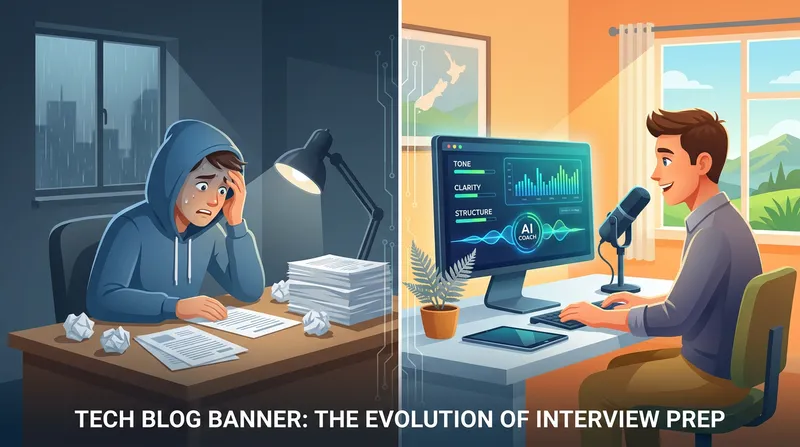
Not all AI interview tools are created equal. Before you commit to one, assess it against these criteria:
Voice interaction, not just text. Typing answers into a chatbox does not replicate the experience of speaking under pressure. Look for tools that use voice AI so you practice the actual act of speaking aloud, managing your pace, and controlling your tone.
Role-specific and industry-specific questions. Generic questions like "Tell me about yourself" are a starting point, but the best tools tailor questions to the specific job title and company context. A question for a project manager role in Wellington should feel different from one for a retail manager in Christchurch.
Behavioral and situational question formats. New Zealand employers heavily use behavioral interview questions ("Tell me about a time when...") and situational questions ("What would you do if..."). Your tool should cover both.
Actionable feedback. Practice without feedback is just repetition. The best tools analyze your answer quality, flag vague responses, assess clarity, and give you specific guidance on what to improve.
Accessibility for NZ users. Some tools are built primarily for US or UK markets. Check that the platform works well in New Zealand, supports relevant industries (like construction, healthcare, agriculture, and tech, which are all major NZ sectors), and does not assume US-specific norms.
The best AI interview practice tools for New Zealand job seekers
JobSparrow's AI mock interview feature
JobSparrow's AI mock interview tool is built specifically around the job you are applying for, not a generic question bank. The full Offer Path, including AI mock interviews for all three rounds, is a one-time $129 with no subscription or auto-renewal. Here is how it works:
- You link the mock interview to a specific job application (or paste a job description URL directly)
- The AI generates role-specific interview questions tailored to that exact position and company
- You respond using real-time audio recording
- The AI analyzes your answer quality, delivery tone, and clarity, then gives you instant feedback
JobSparrow covers three interview rounds: screening interviews, culture fit interviews, and technical interviews. This mirrors the actual hiring process at most New Zealand companies, where you will often face multiple rounds before an offer.
The platform also features a highly useful Instant Interview mode. If you do not have a specific application saved, you can paste a job description or URL and launch practice immediately. This is invaluable for spontaneous preparation when a recruiter calls and schedules an interview for the very next day.
For Kiwi job seekers who are also working on their CV, JobSparrow's full Offer Path connects your interview prep to your tailored CV, cover letter, and Master Career Profile in one place. All your applications, tailored documents, and mock interview sessions are tracked in a single dashboard.
ChatGPT for interview prep and its limitations
ChatGPT is a popular free option for generating interview questions and practicing written responses. Here is how to use it effectively for NZ interview prep:
Prompt template to generate behavioral questions:
"I am interviewing for a [job title] role at a [industry] company in New Zealand. Generate 10 behavioral interview questions using the STAR format that a hiring manager would likely ask."
Prompt template to get feedback on your answer:
"Here is my answer to the question 'Tell me about a time you handled a difficult stakeholder': [paste your answer]. Please give me specific feedback on clarity, structure, and whether I used the STAR method correctly."
The key limitation of ChatGPT for interview prep is that it is text-based. You type your answer rather than speak it. This means you are not actually practicing the skill you need on the day. As we cover in detail in our post on why voice AI mock interviews beat ChatGPT, the gap between writing a good answer and speaking one confidently is significant, especially under pressure.
Use ChatGPT to draft and refine your answers. Then use a voice AI tool to practice delivering them out loud.
Other types of AI tools worth knowing about
Several other types of platforms offer AI interview practice features that NZ job seekers may find useful:
- Free browser-based transcription tools: Some free tools record your spoken answers and highlight frequently used phrases and talking points. They cover common industries and are a solid starting point for beginners on a budget.
- Traditional university-focused video platforms: These paid platforms offer structured video-based mock interviews with AI scoring. They have strong libraries of behavioral questions and are often used by universities in Australia and New Zealand for graduate career preparation.
- AI-driven speech and pacing coaches: These tools focus specifically on communication skills, including filler word analysis, pacing, and eye contact reminders for video interviews. They are ideal if your primary challenge is delivery rather than content.
How to practice behavioral interviews using the STAR method
Behavioral interview questions are the dominant format in New Zealand hiring. Employers ask them because past behavior is the best predictor of future performance. Every behavioral question follows the same pattern: "Tell me about a time when you..."
Mapping out these stories is a critical part of the Diagnose and Position phases of your job search. The STAR method gives you a reliable structure for answering:
- Situation: Set the context. Where were you, what was the challenge?
- Task: What was your specific responsibility in that situation?
- Action: What did you do? (This should be the longest part of your answer, roughly 50 to 60% of the total time.)
- Result: What happened as a result of your actions? Quantify where possible.
From the hiring manager's side: What we actually notice is not whether your answer is perfect, it is whether you can recall a specific example quickly and tell it without rambling. Candidates who have practiced out loud sound different from candidates who have only thought about their answers. The difference is obvious within 30 seconds.
Common behavioral questions in NZ interviews:
- Tell me about a time you had to manage a difficult relationship with a colleague or client.
- Describe a situation where you had to meet a tight deadline under pressure.
- Give me an example of when you had to adapt quickly to an unexpected change.
- Tell me about a time you made a mistake and how you handled it.
- Describe a situation where you had to influence someone without direct authority.
How to practice these with AI:
- Pick one question from the list above.
- Open your voice AI tool of choice.
- Speak your answer out loud, aiming for 90 to 120 seconds.
- Review the feedback on structure and specificity.
- Repeat the same question at least three times until your answer flows naturally.
- Move to the next question only when you feel confident with the current one.
The goal is not to memorize a script. It is to internalize the STAR structure so it becomes automatic under pressure. Your STAR story bank can also be added to your Master Career Profile in JobSparrow, so they are available for every future application.
How to practice situational interviews for the NZ job market
Situational interview questions ask you to respond to a hypothetical scenario. They are common in management, customer service, healthcare, and public sector roles in New Zealand.
The format is: "What would you do if..."
Unlike behavioral questions, situational questions test your judgment and problem-solving approach rather than your past experience. This makes them particularly important for career changers and migrants who may not have direct NZ work experience to draw on.
Common situational questions in NZ interviews:
- What would you do if a customer became aggressive and refused to calm down?
- How would you handle a situation where your manager gave you conflicting priorities?
- What would you do if you discovered a colleague was not following health and safety procedures?
- If you were given a project with an unrealistic deadline, how would you approach it?
- What would you do if you disagreed with a decision made by senior leadership?
How to use AI to practice situational questions:
When practicing situational questions, your AI tool should push back on vague answers. If you say "I would communicate clearly with all stakeholders," a good AI coach should ask: "What specifically would you say? Who would you contact first?" Look for tools that probe your answers rather than just accepting them.
With ChatGPT, you can simulate this by adding to your prompt: "After I give my answer, ask me two follow-up questions to probe for more detail, as a real interviewer would."
Tailoring your interview prep to the NZ job market
New Zealand has specific cultural norms around workplace communication that differ from the UK, US, and even Australia. Understanding these will help you calibrate your interview style.
Key NZ interview culture points:
- Understatement is valued. Kiwi culture tends to be modest. Boasting or overselling yourself can read as arrogant. Frame your achievements in collaborative terms ("We achieved X, and my specific contribution was Y") rather than solo-hero narratives.
- Authenticity over polish. NZ hiring managers often respond better to genuine, slightly imperfect answers than to rehearsed-sounding scripts. Your goal is to sound prepared, not robotic.
- Health and safety awareness matters. In many NZ industries (construction, manufacturing, agriculture, hospitality), demonstrating awareness of health and safety responsibilities signals cultural fit.
- Te Tiriti o Waitangi context. For roles in the public sector, education, or healthcare, demonstrating some awareness of the Treaty of Waitangi and its relevance to your work is increasingly expected.
If you are new to New Zealand: For migrants preparing for NZ interviews, the New Zealand Immigration website provides useful context on workplace rights and cultural expectations. Situational questions are your best tool here. Be transparent about your background while connecting it to the role: "In my previous role overseas, I managed a similar situation, and the approach I would take here is..." Understanding these norms before your interview will help you answer questions about teamwork and values in a way that resonates locally.
How to prepare for AI-conducted virtual interviews in NZ
Some New Zealand employers, particularly large corporates and recruitment agencies, now use AI-powered video interview platforms as a first screening step. These platforms record your video responses to pre-set questions and use AI to analyze your answers before a human reviewer sees them.
What NZ recruiters actually see: From the hiring side, AI video screening platforms score for evidence-based responses, structured answers, and speaking pace. Candidates who use filler words heavily or who give vague answers without examples are typically scored lower before a human ever watches the recording.
If you receive an invitation to an AI video interview, here is how to prepare:
Before the interview:
- Test your camera, microphone, and internet connection. New Zealand's rural connectivity can be inconsistent, so test from the exact location you plan to use.
- Set up a neutral, well-lit background. Natural light from a window in front of you (not behind) is ideal.
- Practice speaking to a camera, not a screen. Most people instinctively look at the interviewer's face on screen rather than the camera lens, which reads as avoiding eye contact.
During the AI video interview:
- Speak at a measured pace. AI transcription systems can struggle with very fast speech or strong accents. Clear enunciation helps.
- Use the STAR structure even for short answers. AI scoring systems often look for evidence-based responses.
- Do not leave long silences. Most platforms give you a fixed response window. Fill it with substance.
After the interview:
- Treat it as seriously as a human interview. Your recorded responses are reviewed by real people.
- Send a follow-up email to the recruiter thanking them for the opportunity, even after an AI screening round.
For more on managing the emotional side of the job search process, including the burnout that comes from multiple rounds of applications and interviews, our post on how AI tools help prevent job search burnout covers practical strategies.
A practical 5-day AI interview prep plan for Kiwi job seekers
If your interview is one week away, here is a structured practice plan:
Day 1: Diagnose your starting point Record yourself answering "Tell me about yourself" without any preparation. Play it back. Note what feels vague, rushed, or unclear. This is your baseline.
Day 2: Build your STAR story bank Identify five to seven strong examples from your work history that can be adapted to multiple behavioral questions. Use ChatGPT to help structure each one into a clean STAR format.
Day 3: Voice practice with a behavioral focus Use a voice AI tool to practice five behavioral questions out loud. Focus on structure and timing. Aim for 90 to 120 seconds per answer.
Day 4: Situational and role-specific practice Research the specific company and role. Generate situational questions relevant to that industry using ChatGPT. Practice three to five of them using voice AI.
Day 5: Full mock interview simulation Run a complete mock interview using JobSparrow's AI mock interview tool linked to your actual job application. Treat it like the real thing: dress appropriately, sit at your desk, and do not pause or restart. Review the feedback and make final adjustments.
For career changers preparing for interviews in a new field, it is also worth reviewing how to frame your transferable experience. Our guide on career change resume summaries and objectives covers the positioning language that works well in NZ interviews when you are pivoting industries.
Common AI interview prep mistakes to avoid
Even with the right tools, these mistakes will limit your progress:
Practicing only once. One session builds awareness. Five sessions build confidence. Ten sessions build automatic recall. Repetition is the point.
Memorizing scripts word for word. If you forget a word, your whole answer collapses. Learn the structure and the key points, not the exact phrasing.
Ignoring the feedback. AI tools give you specific, actionable feedback. If you skip past it and go straight to the next question, you are wasting the tool's primary value.
Only practicing easy questions. The questions that make you uncomfortable are the ones you most need to practice. Do not avoid questions about weaknesses, failures, or conflict.
Not practicing out loud. Reading your answer silently is not practice. Speaking it aloud, in full, at real speed, is the only preparation that transfers to the interview room.
How JobSparrow connects interview prep to your full job search
Interview preparation does not exist in isolation. It is the Prepare stage of a complete job search strategy. The strongest candidates walk into interviews with a tailored CV that matches the job description, a cover letter that tells a coherent story, and interview answers that reinforce the same narrative.
JobSparrow's Offer Path connects all five stages: Diagnose, Position, Execute, Prepare, and Close. Your mock interview questions are generated from the same job description that shaped your tailored CV. Your AI feedback on interview answers reflects the same role-specific context.
This is different from using five separate tools that do not talk to each other. When your preparation is integrated, you walk into the interview already knowing the language of the role, the key requirements the employer cares about, and the specific examples from your history that are most relevant.
Start with a free CV diagnosis. It takes under two minutes and shows you your recruiter-lens score out of 100, plus the specific gaps costing you interviews. The full Offer Path, including AI mock interviews for all three rounds, is a one-time $129 with no subscription or auto-renewal.
Frequently asked questions
Is AI interview practice actually effective, or is it just a gimmick?
AI interview practice is genuinely effective when used correctly. The key is voice-based practice, not just text. Research on deliberate practice in skill development consistently shows that repetition with feedback accelerates improvement faster than repetition alone. AI tools provide both: unlimited repetition at zero marginal cost, plus structured feedback on your answers. The limitation is that AI cannot fully replicate the social pressure of a real interview, which is why combining AI practice with at least one human mock interview (a friend, mentor, or career coach) gives you the best results.
What are the best free AI interview practice tools available in New Zealand?
The best free options for NZ job seekers include browser-based voice transcription tools (which are great for beginners) and ChatGPT (excellent for generating questions and refining written answers). For a fully integrated experience that connects interview prep to your CV, Master Career Profile, and job applications, JobSparrow's AI mock interview feature is included in the Offer Path package.
How do I answer behavioral interview questions using the STAR method?
STAR stands for Situation, Task, Action, and Result. For each behavioral question, briefly set the context (Situation), explain your specific responsibility (Task), describe in detail what you did (Action), and share the measurable outcome (Result). Your Action section should take up roughly 50 to 60% of your answer. Aim for 90 to 120 seconds total. Practice delivering STAR answers out loud using a voice AI tool until the structure feels automatic rather than forced.
How is interviewing in New Zealand different from Australia, the UK, or the US?
New Zealand interview culture tends to be more understated and relationship-focused than the US, and slightly less formal than the UK. Kiwi hiring managers value authenticity and collaborative framing of achievements ("we" language alongside "I" language). In the public sector and many community-facing roles, awareness of Te Tiriti o Waitangi and bicultural values is increasingly expected. For migrants, demonstrating awareness of NZ workplace culture, including health and safety norms and flat organizational hierarchies, signals cultural fit.
Can I use AI to prepare for video interviews conducted by AI platforms?
Yes, and it is particularly important to do so. AI video interview platforms (used by some large NZ employers as a first screening step) analyze your spoken responses for structure, clarity, and evidence-based content. Practicing with voice AI tools trains you to give structured, clear answers within a fixed time window, which is exactly what these platforms reward. Focus on STAR structure, measured speaking pace, and looking directly at the camera rather than the screen.
How many times should I practice before a real interview?
For a role you genuinely want, aim for a minimum of three to five full mock interview sessions across several days. One session is not enough to build confidence under pressure. Spacing your practice across multiple days (rather than cramming the night before) allows your brain to consolidate the material. Each session should cover different questions, and at least one session should simulate the full interview from start to finish without stopping or restarting.
What should I do if I have no NZ work experience to draw on in interviews?
This is a common challenge for migrants and recent arrivals. The solution is to draw on transferable experience from your home country and frame it in terms of universal competencies: problem-solving, communication, teamwork, and adaptability. Use situational questions ("What would you do if...") to demonstrate your judgment when you lack local examples. Be transparent about your background while connecting it to the role: "In my previous role, I managed a similar situation, and the approach I would take here is..." AI interview practice is particularly valuable for this group because it lets you rehearse these framings until they feel natural.
Tags
Keep reading
Recommended articles.
behavioral interviews · star method
How to Master Behavioral Interviews in AU/NZ: Using AI for STAR Method Prep
Master the AU/NZ job market with STAR method interview prep. Reframe overseas experience, avoid Tall Poppy Syndrome, and ace your interview with AI.
job search tracker · ai interview prep
From Application to Offer: Integrating Your Job Search Tracker with an AI Interview Prep Tool
Integrate your job search tracker with an AI interview prep tool to land more offers. Build confidence and ace role-specific questions today.
interview prep · behavioural interviews
How to Practice Behavioural Interview Questions Alone (And Actually Improve with AI)
Learn how to practice behavioural interview questions alone. Use an AI mock interview tool to simulate pressure, get STAR feedback, and land the job.