
ai resume builder
AI Resume Strategies: Raw Prompting vs. Smart Resume Builders for Your 2026 Career Move
By Job Sparrow Team
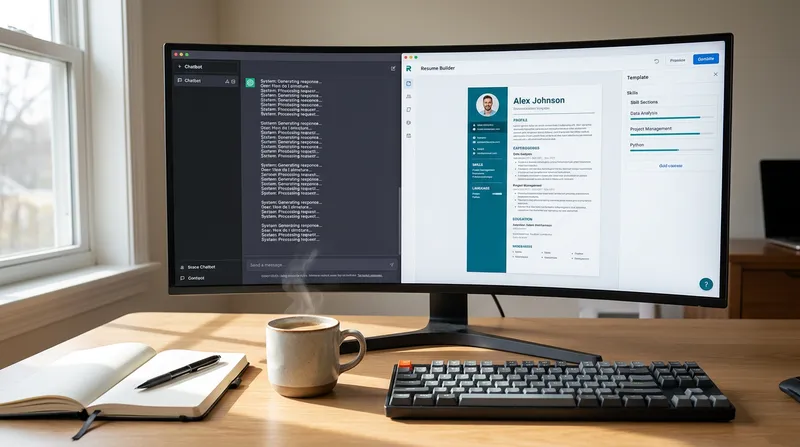
You have sent out 50 applications this month, and all you hear is radio silence. If the silence feels demoralizing, you are not alone, and the fix is more tactical than you think. The problem is rarely a lack of experience. Often, the issue lies in how that experience is presented.
Job seekers are increasingly turning to artificial intelligence for help, but many fall into a common trap. They paste their entire work history into a free language model, ask it to write a resume, and copy the result into Microsoft Word. This approach frequently results in robotic language, destroyed document formatting, and instant rejection by Applicant Tracking Systems (ATS). Furthermore, generic AI outputs fail to capture the nuance needed for complex situations like career changes, academic transitions, or localized migrant visa requirements.
Why Generic AI Outputs Fail the Modern Job Hunt
Using AI is no longer optional in the modern job hunt, but how you use it determines whether you get the interview or get ghosted. Let us explore the most effective AI resume writing strategies, compare raw prompting against structured builders, and outline the exact workflows you need to land your next role.
The 2026 job market is highly competitive. Recruiters are overwhelmed with applications, and technology is filtering candidates faster than ever. Job hunting is inherently stressful, making the promise of automated AI tools incredibly appealing.
However, simply generating a generic document is not enough. According to a recent update from the National Association of Colleges and Employers (NACE), more than one-third of entry-level jobs require AI skills in 2026. This means employers expect you to know how to use technology effectively, starting with your application materials.
The core debate for candidates today is deciding between raw language model prompting and using a structured, ATS-friendly AI resume builder. If you want to understand what software actually helps you pass the initial screening, you must review the 5 Tests the Best AI Resume Builder in 2026 Must Pass to Beat the ATS. The tool you choose will dictate the quality of your first impression.
Raw Prompting vs. AI Resume Builder: A Side-by-Side Comparison
When comparing raw AI prompting vs. an AI resume builder, you must understand the strengths and limitations of both approaches.
Raw language models are excellent for brainstorming. If you are staring at a blank page, a chatbot can help you generate ideas, suggest action verbs, and help you remember daily tasks you might have forgotten. However, these tools are not formatting engines. They do not understand the invisible margins, structural hierarchies, and file metadata required by enterprise screening software.
Dedicated AI resume builders work differently. They take your raw data and structure it specifically for recruiter readability and software compliance. They separate your contact information, skills, and work history into distinct, readable fields.
Guidelines from Harvard University emphasize that generative AI should not be the primary author of your application materials because the output will likely be very generic. Instead, AI should act as an editing partner to brainstorm revisions or incorporate keywords.
If you are confused about which software category fits your needs, read our guide on Job Tracker vs. ATS Scanner vs. AI Resume Generator: Which 2026 Tool Actually Writes Your Resume? to clarify the landscape.
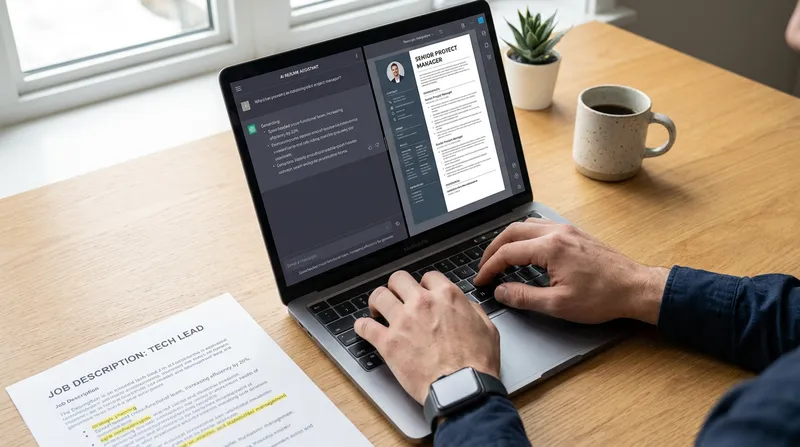
The Fatal Flaws of Using Raw AI to Rewrite Your Resume
Using raw AI to rewrite your resume entirely carries significant risks. The most obvious issue is the robotic AI voice. When an AI generates text without strict constraints, it relies on statistical averages, resulting in cliche corporate jargon. Words like "spearheaded", "orchestrated", and "delved" are immediate red flags for hiring managers.
Furthermore, copy-pasting text from a web browser into a document processor often brings along hidden HTML code. This invisible formatting can completely scramble your document when an ATS tries to parse it. This leads to instant rejection before a human ever sees your application.
Recruiters are highly sensitive to these issues. Research from Robert Half notes that while 51% of business leaders say their department's use of AI tools will drive additional hiring in 2026, recruiters warn that overreliance on AI undermines candidate credibility. If you want to refine your text without losing your authentic voice, check out AI Tools for Resume Writing: How to Avoid the Robotic Voice and Beat the ATS.
Scenario 1: Best AI Resume Tools for a Career Change
Career changers face a unique hurdle. You need to translate your past experience into a new industry without sounding unqualified or letting the AI invent experience you do not have. The best AI resume tools for a career change do not just rewrite sentences. Instead, they perform a comprehensive gap analysis.
To extract transferable skills effectively, you must guide the AI with specific prompts. Experts at the Massachusetts Institute of Technology (MIT) suggest job seekers use AI to identify gaps by asking the tool a direct question about missing experience.
Here is an actionable, transferable skills AI resume prompt you can use today:
"I am transitioning from [Current Industry] to [Target Industry]. Here is my current resume and a target job description. Do not write new bullet points yet. First, identify the top 3 transferable skills I possess that match this new role. Then, tell me which critical requirements I am missing so I can address them in my cover letter."
Once you understand your gaps, you can begin reframing your history using tools like the JobSparrow Gap Filler feature. For a deeper dive into this strategy, read How to Write a Resume for a Career Change: Translating Skills & Filling Gaps.
Scenario 2: AI Resume Optimization for Australia and Migrant Visas
If you are a migrant applying for roles in Australia or New Zealand, generic US-centric templates will hurt your chances. Australian resumes typically differ in length (often two to three pages for experienced professionals), spelling conventions (UK English), and specific structural expectations.
An AI resume for migrant visa applications must be meticulously formatted. Visa processing authorities and local recruiters look for specific terminology and clear evidence of local compliance. This is especially true for specific pathways like the Skilled Independent visa (Subclass 189) or the Employer Sponsored visa (Subclass 482). When using a generic tool, it will default to American standards, which can cause friction during formal skills assessments.
To achieve proper AI resume optimization for Australia, you must explicitly instruct your tools to localize the content. If you are using JobSparrow, our Master Career Profile allows you to target specific regional markets effortlessly. This ensures your documents are ready for local platforms like SEEK. You should also familiarize yourself with local compensation language, which you can learn about in What's Your Expected Annual Base Salary? Navigating Plus vs. Inclusive of Super in Australia.
Actionable tip for migrants facing skills assessments:
"Format this content using Australian English spelling conventions and ensure the terminology aligns with the Australian corporate market. Highlight skills relevant to a formal Recognition of Prior Learning (RPL) assessment."
Scenario 3: Handling Academic CVs and Employment Gaps
Academic CVs require an entirely different structure than standard corporate resumes. They must highlight publications, grants, speaking engagements, and research methodologies. Standard AI builders often try to compress this rich history into a single page, which is a massive mistake for academic transitions.
When figuring out how to use AI for an academic CV, treat the AI as an organizer rather than a writer. Feed the tool your messy list of citations and ask it to format them consistently (e.g., APA or MLA style). Use it to categorize your research projects logically. For examples of how to format complex work, see How to List Projects on Your Resume: Non-Tech & Corporate Examples.
Similarly, using an AI resume generator for career gaps requires a delicate touch. Do not ask the AI to hide the gap. Instead, use it to frame your time away constructively.
Actionable prompt for career gaps:
"I have a two-year employment gap where I was [caring for a family member / traveling / studying]. Help me write a professional, concise one-sentence explanation for my resume that focuses on the soft skills I developed during this time, without sounding defensive."
The Ultimate Hybrid Workflow: How to Tailor Your Resume with AI
The most successful job seekers in 2026 use a hybrid workflow. They use raw language models for micro-edits and a dedicated platform for the final document generation.
This approach is necessary because the labor market is shifting rapidly. A recent report from PwC highlights that the skills needed for the most AI-exposed jobs are changing more than twice as fast as those for the least exposed roles. You must be able to update your application materials in minutes, not hours.
Here is the exact step-by-step workflow to tailor your resume with AI:
- Centralize Your Data: Create your JobSparrow Master Career Profile. This securely stores every project, metric, and role you have ever held in one place.
- Analyze the Target: Paste the specific job description into your AI tool to identify the top five required skills.
- Select and Refine: Pull only the relevant experiences from your Master Profile. Use AI to rewrite your bullet points so they naturally incorporate the job description's keywords.
- Generate the Document: Use an ATS-friendly builder to export the final PDF, ensuring the hidden formatting is pristine.
- Connect the Narrative: Ensure your cover letter matches the exact tone and claims of your resume. Discover why this matters in The Consistency Rule: How an Integrated Resume and Cover Letter Creator Lands More Interviews.
Beyond the Resume: Why Consistency Matters
Getting your resume right is only step one. True career success requires a holistic approach from diagnosis to the final offer. Ensuring your verbal answers match your written claims is critical for passing recruiter screens.
Most career advice is written from one side of the table. JobSparrow's distinctive angle is that we speak from both. Our team has reviewed over 100,000 resumes and hired across four global markets. We built JobSparrow to fix substantive problems, like vague impact and seniority mismatches, rather than just stuffing documents with keywords.
Once your document is ready, you must prepare to defend it verbally. Our platform connects your tailored resume directly to AI mock interviews, helping you build real confidence. Learn more about this crucial next step in Why Good Answers Fail: How to Practice Mock Interviews Online with Voice AI.
Ready to land more interviews? Stop fighting with generic chatbots. Start with a free diagnosis at JobSparrow to see your recruiter-lens score and identify the exact gaps costing you interviews. Unlock the full Offer Path.
Frequently Asked Questions
Is raw AI prompting good enough for writing a resume?
While raw prompting is excellent for brainstorming and refining individual bullet points, it should never be used as a standalone resume builder. It suffers from formatting issues, ATS incompatibility, and often produces a highly recognizable robotic tone that recruiters reject.
What is the best AI resume builder for a career change?
The best tools for career changers offer specific gap analysis and transferable skill translation features. Look for platforms like JobSparrow that use a recruiter-lens approach to reposition your past experience for new industries without hallucinating qualifications.
How do I make an AI resume ATS-friendly?
To ensure ATS compatibility, you must use standard section headers (like "Work Experience" and "Education"), avoid complex tables or graphics, and export your document through a structured builder. Ensure exact keyword matching from the job description rather than relying on a generic AI template.
Can recruiters tell if I used AI to write my resume?
Yes. Recruiters can easily spot raw AI outputs by looking for repetitive sentence structures, overly complex vocabulary (such as "orchestrated" or "spearheaded"), and a distinct lack of quantifiable, personal metrics.
Does AI work for Australian format resumes and migrant visas?
It can, but only if you explicitly prompt the AI to follow Australian standards (which include specific length expectations and localized spelling). For the best results, use a builder designed for international localization to ensure your documents meet visa and corporate requirements.
Tags
Keep reading
Recommended articles.
job tracker · ai resume builder
Stop Manual Data Entry: Why the Best Job Tracker Apps Now Use AI Skill Matching
Stop manual data entry. Discover how the best job tracker app uses AI skill matching to optimize applications, beat the ATS, and land more interviews.
ats optimization · job search strategy
ATS Scanners vs Job Trackers: The $100/Month Trap (And Why You Are Still Rewriting Resumes at Midnight)
Stop paying for ATS scanners that leave you rewriting resumes at midnight. See why the manual approach fails and get a free recruiter-lens diagnosis today.
ai resume builder · ats optimization
Tailor Applications Fast with an AI Resume Creator
Stop choosing between time and quality. Use an AI resume and cover letter generator to tailor your applications fast. Try free with JobSparrow.