
ai resume
Beyond the PDF: Why Your 2026 Resume Must Be 'Agent-Readable' (And How to Do It)
By Job Sparrow Team
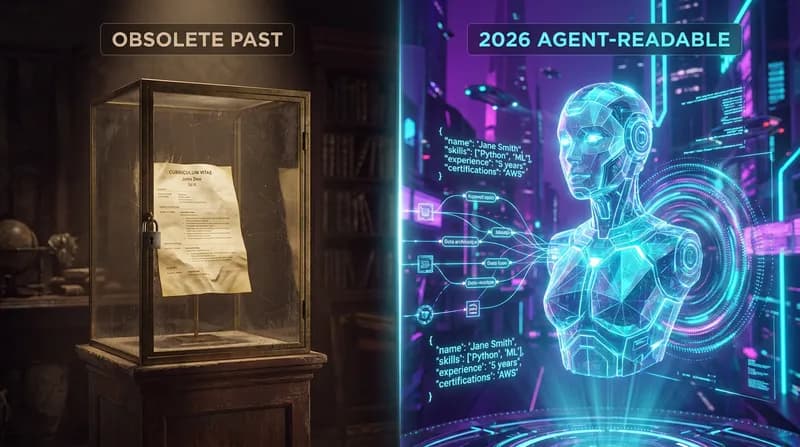
You spend hours manually tailoring static PDF resumes, only to hit submit and face total radio silence. The frustration is real. You feel your career history is trapped in dead documents, silently rejected by flawed parsers and AI screening bots that cannot read unstructured data.
Having reviewed over 100,000 resumes and hired across four markets, our team at JobSparrow knows exactly what modern recruiters, and their AI screeners, look for. This outdated approach prevents you from using modern AI agents to automate your job hunt and gain an edge in a hyper-competitive market. The problem is not your experience. The problem is your format.
In 2026, the first gatekeeper for your resume is increasingly an AI, not a human. To survive the modern job market across Australia, New Zealand, and beyond, you must transition from a static document to an API career profile. This guide will show you exactly how to build an agent-readable resume, create a career moat, and automate your applications with confidence.
The resume is dead, long live the API profile
For decades, job seekers have relied on the PDF as the ultimate career document. You design it, you export it, and you send it off into the void. But a PDF is essentially a digital piece of paper. It locks your career data away in a format that is incredibly difficult for software to interpret accurately.
Today, an ATS-friendly resume in 2026 looks fundamentally different. We have entered the era of the API career profile. An API (Application Programming Interface) profile makes your data mobile, structured, and instantly actionable by artificial intelligence.
Instead of forcing a recruiter's software to guess what your previous job title was by scanning visual text, an API profile explicitly hands the software your data in a neat, categorized package. By adopting agent-readable formats, you stop fighting against the algorithms and start using them to build an impenetrable career moat.
What is an agent-readable resume (and why PDFs fail)?
To understand why you need an agent-readable resume, you first have to understand how AI recruiter screening works.
Legacy Applicant Tracking Systems (ATS) rely on Optical Character Recognition (OCR). OCR technology tries to "read" the visual layout of your PDF to extract text. If you use columns, complex tables, or unique fonts, the OCR gets confused. It might read your dates of employment as your phone number, or completely skip your most impressive achievements.
The industry has moved on. According to SQ Magazine data, nearly half (43%) of organizations use AI in HR tasks, and 82% of companies that use AI in hiring apply it directly to resume review. These modern AI systems do not want to parse a PDF. They want structured data.
From the recruiter's side of the table, receiving a structured data profile rather than a misformatted PDF is genuinely faster to process. When a candidate's role, tenure, and key metrics are immediately queryable, shortlisting decisions happen in seconds rather than minutes.
An agent-readable resume stores your career history in a format that software can read natively. When you learn how to tailor your resume to any job description (& beat the ATS in 60 seconds), the first step is ensuring the underlying data is accessible. If the AI screening tool cannot read your PDF, your tailored keywords will never even register.
The rise of AI job application automation
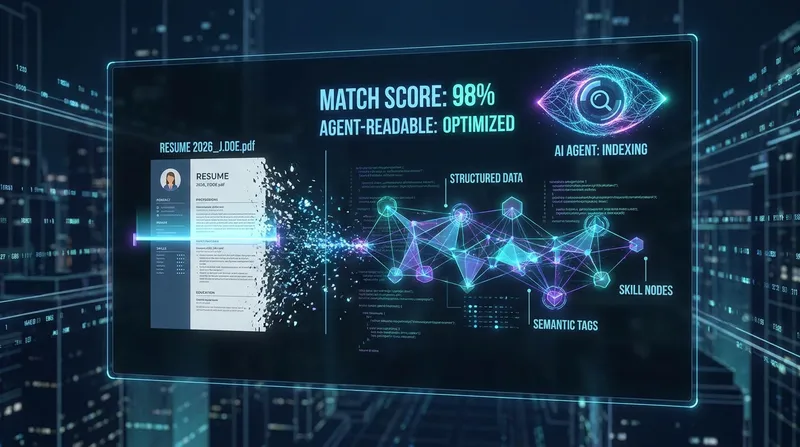
Corporate recruiters are using AI to screen you out. The most successful candidates in 2026 are using AI job application automation to level the playing field.
We are seeing a massive shift toward candidates deploying auto-apply AI bots to scale their job search without sacrificing quality. Research from arXiv at Cornell University highlights this trend, noting that domain workers express positive attitudes toward AI agent automation for 46.1% of tasks (particularly repetitive, low-value tasks like filling out application forms).
When you have structured career data, you can authorize an AI agent to read your profile, analyze a job description, write a highly targeted cover letter, and submit the application on your behalf. This is no longer science fiction. It is a strategic advantage. If you want to know how to list agentic AI and automation skills on your resume: 2026 guide for tech & business roles, start by actually using these tools to run your own job search.
How semantic resume formatting actually works
For non-developers, terms like "JSON resume format" or "SKILL.md" can sound intimidating. But semantic resume formatting is actually a very simple concept.
Semantic formatting simply means tagging your data with specific labels. Instead of writing a paragraph of text and hoping the AI knows which part is your job title, you use a structured format.
For example, a JSON (JavaScript Object Notation) resume looks like a simple text list with clear labels:
- "Job Title": "Marketing Manager"
- "Company": "TechCorp"
- "Impact Metric": "Increased ROI by 40%"
As explained by the developers behind cvjson.com, an agent-readable resume stores career data as structured, named fields that software can read directly. This prevents good candidates from being silently dropped by flawed PDF parsing.
This structured approach is especially powerful for career pivots. When you clearly label your achievements, AI matching algorithms can easily map your transferable skills to new industries. You can see this in action by reviewing 5 career change resume examples (and why recruiters love them), which all rely on clear, semantic structuring to tell a compelling story.
The Agent Resume Standard: owning your career data
If you want to run an AI agent job search, you need to own your data. Right now, your career history is likely trapped inside walled gardens like LinkedIn or Seek (the dominant job board in the ANZ market).
One emerging framework worth exploring is the Agent Resume Standard (heyitworks.tech). While still early-stage, it represents the direction the industry is moving. It is an open protocol designed specifically for AI recruiters and talent-matching bots. Unlike traditional resumes that rely on natural language processing (which often loses structure), an Agent Resume Standard provides explicit, queryable fields.
By adopting this standard, you create a Master Profile that you control. You can include specific fields for your target compensation, your remote work preferences, and even specific instructions for AI agents reading your profile. This gives you total data mobility and ensures you are never at the mercy of a single platform's algorithm.
Step-by-step: how to make your resume agent-readable today
You do not need to be a software engineer to create structured career data. Follow these three actionable steps to make your resume agent-readable today.
Step 1: Extract your current PDF into plain text Open your current PDF resume, copy all the text, and paste it into a plain text editor like Notepad or TextEdit. Strip away all the columns, bold fonts, and formatting.
Step 2: Use AI to structure your history Take that plain text and paste it into a generative AI tool (like ChatGPT or Claude). Use this exact prompt: "Please take my resume text and convert it into a structured JSON resume format. Ensure all job titles, dates, companies, and bullet points are clearly labeled in standard JSON schema."
Step 3: Store your Master Profile Save this output as a text file. This is your new Master Profile. You can now feed this clean, structured data into automation tools to generate perfectly tailored applications.
Employers love this format. According to Daily.dev, AI resume parsing can significantly reduce time-to-hire and improve matching accuracy. When you provide structured data, you make the recruiter's job easier. For a seamless experience, learn how to use an AI resume and cover letter creator to apply in under 5 minutes using your new Master Profile, or start your free diagnosis today.
Common mistakes to avoid when structuring your career data
Transitioning to an agent-readable format is powerful, but there are a few common pitfalls to avoid:
- Using non-standard JSON schemas: If you invent your own formatting rules, AI agents will struggle to read your file. Stick to standard, recognizable schemas.
- Automating without reviewing: Never let an AI bot submit an application without human oversight. Always review the output to ensure accuracy and tone.
- Treating your profile as a static document: Your Master Profile should be a living document. Update your structured data every time you achieve a new metric or complete a major project.
Building your own auto-apply workflow with Claude Desktop
Once you have your structured Master Profile, you can unlock true Claude Desktop job automation. Local AI agents are incredibly powerful when fed the right data. Do not let the technical terms scare you. This process is as simple as copying and pasting text, and the AI does the heavy lifting.
Here is a simple workflow you can use today:
- Open Claude Desktop on your computer.
- Upload your JSON resume or SKILL.md file.
- Paste the URL or text of a target job description.
- Ask Claude: "Using my structured career data, write a highly tailored resume and cover letter for this specific role. Highlight my metrics that align with their requirements."
One important note: always review AI-generated applications before submitting. Automated tools work best as a first draft. Your judgment and personal voice are what make the final application genuinely yours.
Because Claude is reading structured data rather than guessing at a PDF layout, the output will be incredibly precise. However, when you scale this approach, organization becomes critical. You must track your automated efforts to avoid chaos. We highly recommend using the smart job search tracker: organize applications & predict match scores to manage your workflow and maintain a high standard of quality.
How JobSparrow bridges the gap to the offer
While JSON formats and API profiles are the future of job hunting, raw data alone will not win you the interview. You still need a recruiter-lens to diagnose substantive problems in your career data (like vague impact metrics or missing evidence).
This is where JobSparrow comes in. We bridge the gap between technical automation and human hiring psychology. Our platform acts as your structured Master Profile, handling all the complex AI tailoring for you.
JobSparrow's method is a five-stage journey: Diagnose, Position, Execute, Prepare, and Close. We do not just reformat your text. Our AI analyzes your Master Profile, identifies the gaps costing you interviews, and guides you to fix them before you apply. Our Gap Filler walks you through targeted questions to surface achievements you may have forgotten to include. Once your profile is ready, our AI Mock Interviews prepare you for the specific role with real-time feedback on your answers. If you are comparing tools, read our breakdown on ChatGPT vs. AI resume builders: choosing the best AI tool for resume writing.
Ready to land more interviews? Start with a free diagnosis. See your recruiter-lens score and the exact gaps in your profile in minutes. When you are ready to automate your success, unlock the full Offer Path for a one-time flat fee of $129 (no hidden subscriptions, no auto-renewal).
Frequently asked questions
What exactly is an ATS-friendly resume in 2026?
Modern ATS friendliness goes far beyond simple keyword stuffing. It requires semantic formatting and structured data (like JSON or SKILL.md) that AI recruiter screening tools can instantly parse without relying on outdated OCR guessing technology.
How do I convert my PDF resume to a JSON resume format?
You can easily extract the plain text from your static PDF and use generative AI tools (like ChatGPT, Claude, or JobSparrow) to reformat it into a structured JSON schema. This creates a machine-readable Master Profile that software can understand natively.
Can AI agents apply to jobs for me automatically?
Yes, using auto-apply AI bots and local tools like Claude Desktop. However, the success of these agents depends entirely on feeding them a highly structured, API-ready career profile rather than a messy, generic PDF.
Will an agent-readable resume help me change careers?
Absolutely. Structured career data allows AI matching algorithms to clearly identify your transferable skills and map them directly to new industries. This helps bypass human biases that often hinder career changers during the initial screening phase.
Is it safe to use auto-apply AI bots for job hunting?
Auto-apply tools are safe to use when you maintain control over what is submitted. We recommend reviewing every application your AI agent generates before it goes out. Automation handles the heavy lifting, but your judgment ensures quality and accuracy.
Tags
Keep reading
Recommended articles.
resume tips · job hopping
Should I Include a 2-Month Job on My Resume? (How to Avoid the 'Job Hopper' Label)
Stressing over a 2-month job? Learn whether to include short stints on your resume, how to format contracts, and the best interview scripts to use.
workday ats · resume formatting
Workday Illuminate 2026: The Exact Resume Format to Pass Parsers and Semantic AI
Fix Workday auto-fill errors and pass Illuminate's semantic AI with the exact resume format. Start with a free diagnosis, no subscription. JobSparrow.
new zealand cv · resume formatting
NZ CV Format 2026: What Kiwi Employers Want | JobSparrow
Master the New Zealand CV format for 2026. Pass ATS filters, highlight visa status, and land Kiwi jobs faster with JobSparrow's AI templates.