
interview tips
Data from 1,000+ AI Interviews Reveals the Top 5 Delivery Mistakes Costing Aussies & Kiwis the Job
By Job Sparrow Team

You're qualified. You know your stuff. You leave the interview feeling like you answered every question correctly. Then, the email arrives: "Thank you for your interest, but we've decided to move forward with other candidates." It's a frustrating experience that too many job seekers in Australia and New Zealand face.
But what if the problem isn't what you said, but how you said it?
You might be the perfect candidate on paper, but research shows interviewers are often more influenced by communication style than the substance of your answers. We wanted to know exactly which delivery mistakes were most common. So, we analyzed data from over 1,000 anonymous AI mock interviews on the JobSparrow platform.
This isn't another generic list. This is a data-driven look at the top 5 communication pitfalls costing Australian and New Zealand job seekers the job—and how you can fix them.
How We Collected This Data We analyzed over 1,000 anonymous practice interviews conducted on the JobSparrow platform. Our AI measured quantitative metrics like words per minute, filler word frequency, and vocal pitch variation. It then correlated these delivery factors with our AI's scoring for clarity, confidence, and engagement to identify the most common patterns among candidates.
Why Your Delivery Matters More Than Your Answers
In our analysis of 1,000+ interviews, we found that candidates with similar answer content scored up to 40% differently based solely on delivery factors like pace, tone, and confidence. Perfectly crafted answers fall flat if their delivery doesn't project engagement.
In the age of remote work, this is even more critical. In a video or phone interview, your voice carries almost the entire weight of that impression. An interviewer can't see your confident posture if you're on the phone, so they rely on your vocal energy. Even on a video call, looking at the camera to simulate eye contact is a delivery skill that, as The University of Sydney advises, makes a huge difference.
Knowing the 100+ common interview questions for AU & NZ is the first step. Mastering how you deliver the answers is the step that gets you hired.
The Top 5 Interview Delivery Mistakes (Exclusive Data)
After analyzing over a thousand practice interviews, we identified clear patterns. These aren't personal failings; they are common, fixable habits that appear when we're under pressure. Here are the top five, backed by our data.
Mistake #1: Overusing Filler Words ('Um', 'Ah', 'Like')
The Data: Our analysis shows that over 60% of candidates use more than five filler words per minute. While a few are natural, frequent use can signal a lack of confidence to recruiters.
The Impact: As the public speaking experts at Toastmasters International explain, excessive filler words reduce a speaker's credibility and distract the listener from the core message. It makes you sound hesitant and unsure of your own expertise.
- Actionable Tip: Train yourself to embrace the pause. When asked a tough question, take a silent second or two to gather your thoughts. A moment of silence sounds far more thoughtful and confident than filling the gap with "um" or "ah."
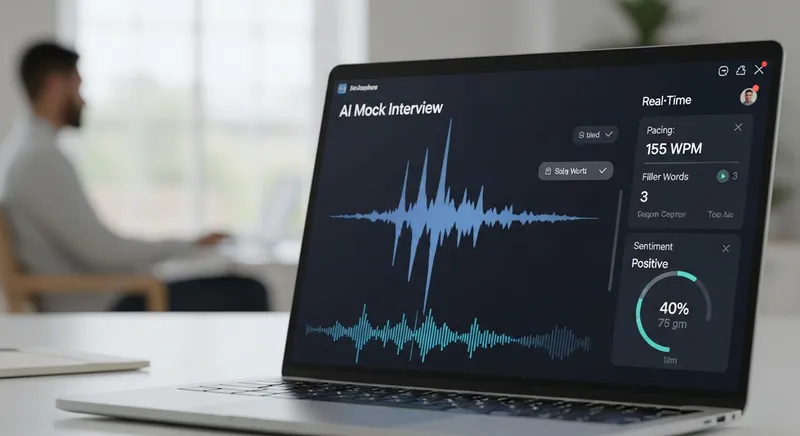
- Tool Tip: JobSparrow's ai mock interview provides a full transcript of your answers and highlights every filler word. You get an immediate, visual count, helping you become aware of the habit and track your improvement over practice sessions.
Mistake #2: Inconsistent Pacing (Speaking Too Fast)
The Data: The ideal speaking pace for comprehension is between 140-160 words per minute (WPM). Our data shows that nervous candidates in Australia and NZ often speed up to an average of 185 WPM.
The Impact: Rushing through your answers makes you sound anxious and can make your points difficult for the interviewer to follow. According to career advisors, speaking slowly and enunciating clearly is especially vital in phone interviews where there are no visual cues.
- Actionable Tip: Before you begin to answer, take a calm, silent breath. This simple action interrupts the adrenaline rush and helps you start your sentence at a more deliberate, controlled pace.
- Tool Tip: During your practice interview, JobSparrow's live pace meter shows your WPM in real-time. You can watch the meter and adjust your speed on the fly, training yourself to stay within that ideal 140-160 WPM range.
Want to see your own pacing stats? Try a free practice session now.
Mistake #3: Monotone Delivery
The Data: In our analysis, candidates who received low 'engagement' scores from our AI showed minimal pitch variation, often staying within a flat 20 Hz range. Top-scoring candidates, by contrast, varied their pitch by 40-60 Hz, sounding more dynamic and engaging.
The Impact: A flat, monotone voice signals disinterest, boredom, or a lack of energy. It fails to engage the listener, making it difficult to build the rapport that is crucial for a successful interview.
As a Harvard Business Review guide on confident speaking points out, your 'Tone, Tempo, and Timing' are essential non-verbal cues that build connection.
- Actionable Tip: Smile while you speak, even if you're on a phone call. It naturally adds warmth and positivity to your voice, creating subtle but powerful tonal shifts that make you sound more approachable and enthusiastic.
- Tool Tip: After each practice answer, JobSparrow's tone analysis gives you feedback on whether you sounded engaging, confident, or neutral, helping you understand how you're coming across to others.
Mistake #4: Rambling and Unstructured Answers
The Data: Our analysis revealed a clear trend: for behavioural questions, answers that went on for longer than two minutes saw a significant drop-off in our AI's 'clarity' and 'engagement' scores.
The Impact: Rambling makes you seem unprepared and suggests you can't communicate complex ideas concisely—a critical soft skill in any role. You risk losing the interviewer's attention and burying your key achievements in a wall of words.
- Actionable Tip: Use the STAR method (Situation, Task, Action, Result) to structure your answers to behavioural questions. This framework forces you to be concise and ensures you cover the key points. You can find great examples in our guide to the STAR method and common interview questions.
- Tool Tip: Practice answering questions in the JobSparrow mock interview and watch the clock. Aim to deliver a complete STAR-method answer in under two minutes. Our AI will also give you feedback on the clarity and conciseness of your response.
Mistake #5: Weak or Apologetic Language
The Data: Phrases like "I guess," "I'm not really an expert but," or "This might be a bad example" appeared 3x more frequently in lower-scoring interviews compared to high-scoring ones.
The Impact: This hedging language undermines your own expertise and projects a lack of confidence. You have the experience; don't water it down with words that introduce doubt.
- Actionable Tip: Review your accomplishments and practice stating them directly. Instead of "I guess I sort of helped with the project," practice saying, "I was responsible for delivering the project." This is especially crucial for those navigating a career change in AU/NZ who need to project confidence in their transferable skills.
- Tool Tip: JobSparrow's AI flags weak or uncertain phrases in your interview transcript. Seeing them written down helps you identify your personal crutch words so you can consciously eliminate them.
The Solution: How to Master Your Interview Delivery
The first step to fixing these mistakes is knowing they exist. The second, and most important, is deliberate practice with objective feedback. You can't fix what you can't measure.
This is where JobSparrow's ai mock interview tool becomes your personal communication coach. It's designed to give you the private, data-driven feedback you need to turn these common mistakes into strengths. It's not just about practicing; it's about practicing with purpose.
By starting an interview from a job you've saved, our AI asks you relevant questions and then provides an instant, confidential report on your performance. It analyzes:
- Pacing: Are you in the 140-160 WPM sweet spot?
- Filler Words: How many 'ums' and 'ahs' are creeping in?
- Tone of Voice: Do you sound confident and engaging?
- Clarity: Is your message clear and easy to follow?
This is the kind of specific, actionable feedback that, according to the Society for Human Resource Management (SHRM), helps candidates develop the high-level communication skills that HR professionals look for. Before you update your LinkedIn profile with our checklist, make sure your spoken delivery matches your professional image.
Frequently Asked Questions
How can I reduce my anxiety before a job interview?
Confidence comes from preparation, but it has to be the right kind of preparation. Instead of just memorizing answers, focus on practicing your delivery. The more you simulate the real interview environment, the more comfortable and in control you'll feel under pressure. Use an ai mock interview tool to get used to speaking your answers out loud and receiving objective feedback. This targeted practice is the most effective way to turn nervous energy into confident communication.
Is using filler words like 'um' always bad in an interview?
An occasional 'um' or 'ah' is perfectly natural and won't cost you the job. It shows you're thinking. However, when they become a frequent habit (more than 5-6 per minute), they can be distracting and make you sound hesitant or unprepared. The goal isn't to eliminate them completely, but to reduce them significantly. A powerful, thoughtful pause is always more impressive to an interviewer than a filler word.
How can I avoid sounding defensive when answering tough questions like 'what are your weaknesses'?
The key is in your delivery. When addressing a challenging question, your tone and pacing are critical. First, take a brief, thoughtful pause—this shows you're considering the question seriously, not reacting defensively. Speak calmly and at a measured pace. Frame your answer around self-awareness and growth, not excuses. For example, use a confident, even tone to say, "In the past, I've focused heavily on project details... I'm now actively working on..." This delivery transforms a potential negative into a story of professional development.
How can I practice my interview body language for a video call?
For video interviews, your digital body language is key. The most critical action is to look directly at your computer's camera lens when you're speaking, not at the interviewer's face or your own image on the screen. This simulates direct eye contact and creates a powerful sense of connection. Additionally, sit up straight, lean slightly forward to show you're engaged, and use natural hand gestures as you would in a face-to-face conversation.
How do I know if I'm talking too fast in an interview?
It's almost impossible to accurately judge your own speaking pace when you're nervous, as everything feels faster. The only way to know for sure is to get objective feedback. The most effective method is to record yourself during a practice session. Aim for a conversational pace between 140 and 160 words per minute (WPM). An ai interview tool can track your WPM in real-time, providing a live guide to help you find and maintain that ideal speed.
Fix Your Delivery, Win the Job
Great candidates get rejected for bad delivery every single day. The good news is that communication is not a fixed trait—it's a skill. Our data shows that these five mistakes are incredibly common, so if you recognize yourself in this list, know that you are not alone.
Moving from a prepared candidate to a polished one means focusing on the how. It means turning rambling into structured stories and transforming nervous energy into confident enthusiasm.
Stop guessing what went wrong in your last interview. Get the data-driven feedback you need to walk into your next one with unshakeable confidence. Practice your next interview now with JobSparrow's ai coach.
Tags
Keep reading
Recommended articles.
career change · resume writing
How to Write a Career Change Resume in 2026: The Ultimate AU/NZ Guide
Struggling with your career change resume in AU/NZ? Our 2026 guide covers transferable skills, combination formats, migrant advice, and AI tools to land interviews.
job interview · career advice
Are You Talking Yourself Out of the Job? Perfect Your Interview Tone for AU/NZ Roles with AI
Learn how to perfect your interview tone for AU/NZ roles. Use AI feedback to eliminate filler words, improve clarity, and build confidence for your next job interview.
resume builder · cover letter
Stop Juggling Documents: Why An Integrated Resume & Cover Letter Builder is Your Secret Weapon
Stop juggling documents. Learn why an integrated resume & cover letter builder is essential for job seekers, migrants, and career changers in AU & NZ.