
portfolio career
How to Build and Manage a Portfolio Career in 2026 (With AI Tools)
By Job Sparrow Team

Introduction: The Future of Work is a Portfolio
The traditional career ladder—a steady climb within a single company—is being redesigned. For many professionals, the future of work doesn't look like a ladder at all; it looks like a web of interconnected projects, roles, and income streams. This emerging model is known as a portfolio career. It's driven by a desire for greater flexibility, skill diversity, and personal autonomy.
If you're a career changer, a seasoned professional, or a recent graduate, managing multiple roles might seem daunting. But what if you could strategically build a career that aligns perfectly with your passions and financial goals? The shift is already underway. Analysis from McKinsey & Company predicts that generative AI will accelerate significant workforce transitions, making adaptability more valuable than ever.
This guide provides a clear roadmap for building a successful portfolio career in 2026. We'll show you how to leverage your unique skills and, crucially, how to use modern AI tools to manage the complexity. And unlike traditional career tools that charge upfront, we'll introduce you to a platform built on a Pay for Result model—you only pay if you land a job offer.
What is a Portfolio Career (and How Is It Different from a 'Slash Career')?
A portfolio career is the strategic and simultaneous management of multiple, often overlapping jobs and income streams. According to research published in Artivate: A Journal of Entrepreneurship in the Arts, it is a deliberate professional path chosen for its advantages over a single role. This isn't just about a side hustle; it's about curating a collection of part-time, freelance, and contract roles that form a cohesive professional life.
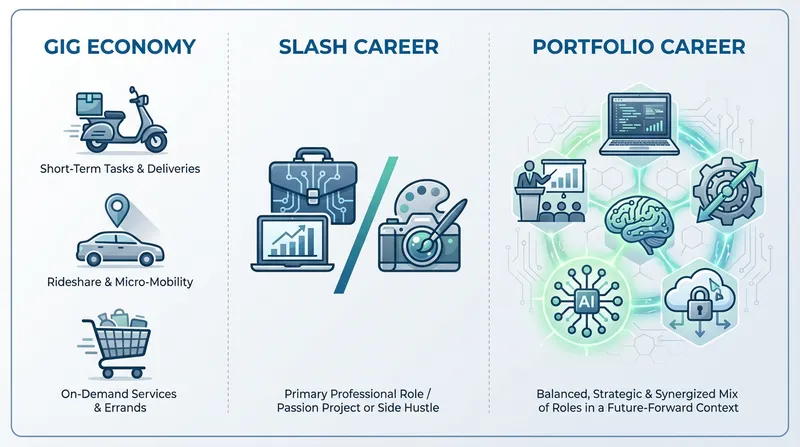
It's important to distinguish this from similar concepts:
- Gig Economy: Often refers to a series of short-term, task-based jobs (e.g., driving for a rideshare app). It's typically less focused on strategic, long-term career building.
- Slash Career: This term usually describes having a primary job alongside a passion project (e.g., an accountant/photographer). The main job provides the primary income.
A portfolio career, in contrast, is the main event. You are the CEO of 'You, Inc.,' and each role is a division of your personal enterprise.
The Benefits of a Portfolio Career: Why More Professionals Are Making the Switch
The move toward independent work is a global phenomenon. A 2022 survey highlighted by the World Economic Forum found that 36% of the employed US workforce identified as independent workers. This shift is driven by the significant advantages this model offers.
- Income Diversification and Security: Relying on a single employer is a risk. A portfolio career spreads that risk across multiple clients. If one contract ends, you still have other income streams, creating a more resilient financial foundation.
- Accelerated Skill Development: Working across different roles and industries exposes you to a much wider range of challenges than a single job ever could. This continuous learning makes you more adaptable and valuable.
- Unmatched Autonomy and Flexibility: You are in control. You choose the projects, the clients, and how you structure your schedule. This autonomy is a powerful driver of job satisfaction.
- Increased Fulfillment and Purpose: A portfolio career allows you to blend your passions with your professional skills. You can pursue lucrative corporate contracts while also working with a non-profit, all in the same week.
- Higher Earning Potential: By combining multiple income streams, many portfolio careerists earn more than they would in a single role. This also gives you more opportunities to practice your skills, for example, by learning how to negotiate a higher salary for each new contract.
Ready to simplify your portfolio career? Upload your CV to JobSparrow and create your Master Profile in under 2 minutes.
How to Build Your Portfolio Career: A Step-by-Step Guide
Transitioning to a portfolio career is a deliberate process. This step-by-step guide will help you lay a strong foundation for success.
Step 1: Conduct a Personal Skills & Passion Audit
Before you can build your portfolio, you need to know what's in your inventory. Create three lists:
- Core Professional Skills: What are you an expert in? (e.g., data analysis, project management, graphic design).
- Transferable & Soft Skills: What skills apply anywhere? (e.g., communication, leadership, problem-solving).
- Passions & Interests: What do you enjoy that could be monetized? (e.g., photography, public speaking, mentoring).
This exercise is especially helpful if you're trying to figure out how to write a resume with no experience in a new field; it helps you see the valuable assets you already possess.
Step 2: Define Your Personal Brand
As a portfolio careerist, you are a business. Your personal brand is how you communicate your unique value.
- Find Your Niche: Instead of a generic "consultant," you might be "a project management consultant for early-stage tech startups."
- Craft Your Value Proposition: In one sentence, what problem do you solve and for whom? (e.g., "I help small businesses create compelling marketing content that drives growth.")
- Update Your Profiles: Your LinkedIn headline should reflect your portfolio, like: "Marketing Strategist | Freelance Writer | Corporate Workshop Facilitator." Ensure your summary tells a cohesive story.
Step 3: Create Your Master Career Profile in JobSparrow
This is your most critical organizational step. A Master Career Profile is a single, private, and comprehensive database in JobSparrow that lists every skill, project, role, and quantifiable result from your entire career.
This isn't a resume you send out; it's your source of truth. It includes everything: big wins, small projects, specific metrics, and detailed descriptions. Maintaining this profile in a central hub like JobSparrow is the first step in turning your vast experience from a messy history into a strategic asset. By keeping all your data in one place, you can begin to turn your job application data into a career roadmap, identifying patterns and opportunities for growth.
Step 4: Find & Secure Diverse Opportunities
With your brand defined and master profile ready, it's time to find the components of your portfolio. Look for a mix of roles—perhaps one stable, long-term "anchor client" and several smaller projects.
Platforms like Upwork and Toptal are excellent places to start. According to a report from Upwork, 66% of hiring managers who use independent talent plan to increase their reliance on it. Don't be afraid to network and pitch directly. And remember, you can learn how to apply for a job you're not 100% qualified for by emphasizing your transferable skills.
The Portfolio Careerist's Secret Weapon: A Complete AI Toolkit
Here's the central challenge: how do you market yourself for wildly different roles? Manually creating unique, optimized applications for every opportunity is exhausting. This is where AI becomes your personal career assistant, handling repetitive tasks so you can focus on high-value work.
An integrated platform like JobSparrow is built for this exact problem. Here's how it works:
-
AI Resume & Cover Letter Generation: The biggest game-changer. JobSparrow uses your Master Career Profile as its database. When you find a job, the AI analyzes the description and instantly generates a perfectly tailored, keyword-optimized resume and cover letter. It pulls only the most relevant skills and experiences, turning an hour of work into seconds.
-
AI-Powered Mock Interviews: How do you practice interviewing for a consulting gig one day and a creative role the next? JobSparrow's AI mock interviews generate role-specific questions and provide instant feedback on your answers, delivery, and confidence, helping you prepare for any opportunity in your portfolio.
-
Intelligent Job Application Tracking: Managing applications for multiple roles is complex. AI-powered tracking helps you monitor every opportunity, follow up at the right time, and analyze which parts of your portfolio are getting the most traction, so you can refine your strategy.
By adopting an AI resume builder over a static template, you're not just saving time; you're creating a scalable system for career growth.
Real-World Portfolio Career Examples
What does this look like in practice? Here's how two professionals use AI to manage their portfolio careers:
-
The Creative Professional: Meet Sarah, a graphic designer. Her portfolio consists of a 20-hour/week contract as a brand designer (her anchor), freelance photography gigs, and a passive income course. Sarah uses JobSparrow to maintain one Master Profile, then generates three different tailored resumes—one emphasizing brand design, one for photography clients, and one for her course marketing—all in under 5 minutes.
-
The Technical Expert: This is David, a software developer. He works a three-day week on a long-term contract, provides paid technical consulting, and co-hosts a sponsored podcast. David uses JobSparrow's AI mock interviews to switch gears, practicing for a high-level corporate consulting interview one day and a startup advisory role the next.
Future-Proofing Your Career with a Portfolio Mindset
Adopting a portfolio career is a mindset shift. You are the architect of your professional journey. This requires a commitment to continuous learning and resilience.
As the world of work evolves, this model offers a path to long-term security. Research from the Stanford Digital Economy Lab emphasizes that AI will transform occupations, making adaptability essential. A portfolio career, by its nature, forces you to do just that.
By embracing human-AI collaboration to future-proof your career, you're not just preparing for the future of work—you're actively building it on your own terms.
Your All-in-One Portfolio Career Assistant
JobSparrow is your AI-powered partner, designed specifically for the modern professional. It helps you:
- Consolidate your entire career into one dynamic Master Profile.
- Generate tailored resumes and cover letters in seconds for every role.
- Prepare for any interview with role-specific AI mock interviews.
- Track all your applications and analyze your performance.
Ready to take control? Start your free trial of JobSparrow today. Build your Master Career Profile, generate tailored applications, and practice for interviews. You only pay a success fee if you land a job offer.
Frequently Asked Questions
How do I show a portfolio career on my resume or LinkedIn?
On LinkedIn, use your headline to summarize your key roles (e.g., "Marketing Consultant | Project Manager | Corporate Trainer"). In your experience section, create separate, concurrent entries for each major role. For a resume, tailor it aggressively to the specific job, including only the most relevant roles from your portfolio.
Is a portfolio career financially stable?
While income can fluctuate, a portfolio career can offer greater financial security through diversification. Relying on a single employer is a risk; layoffs can eliminate 100% of your income. With multiple income streams, you create a safety net so the end of one contract doesn't derail you financially.
What are the first three steps to starting a portfolio career?
- Conduct a Skills Audit: Identify your top 3-5 marketable skills.
- Create a 'Master Career Profile': Consolidate every project, role, and accomplishment into a single, private document. This will be your database for all future applications.
- Secure Your First Small Project: Start with one manageable freelance or contract gig to build momentum and gain a testimonial.
Can I build a portfolio career with no freelance experience?
Yes. Start by leveraging your existing skills for a small project. You can also reframe significant internal projects at past jobs as standalone experiences, detailing the challenge, actions, and results to demonstrate your ability to manage work independently.
How does an AI career platform help with a portfolio career specifically?
Standard tools are inefficient for someone with diverse roles. An AI platform like JobSparrow is built for this challenge. It allows you to store all your varied experiences in a Master Career Profile. When you apply for a job, the AI analyzes the description and instantly generates a tailored resume, cover letter, and even helps you practice for the specific interview. This transforms a time-consuming manual process into a quick, strategic action.
Tags
Keep reading
Recommended articles.
interview preparation · career advice
Ace Your AU & NZ Interview: 5 Signs You Need an AI Prep Tool
Beat interview anxiety with AI mock interviews for AU & NZ. Practice role-specific questions, get instant feedback, and build real confidence. Try free.
job search · resume writing
Beat the Bots: How JobSparrow's AI Tailoring Gets Your Resume Seen by Hiring Managers
JobSparrow's AI creates tailored, ATS-optimized resumes in minutes. Try it risk-free for 30 days—pay only if you land a job offer. Beat the bots and get noticed.
resume tips · job search
AI Resume Builder vs. Template: The Modern Guide to Getting Hired
Stop choosing between AI resume builders and templates. Discover the hybrid approach that beats ATS systems and impresses recruiters. Try it risk-free today.