
ai mock interview platform
How to Practise for a Job Interview Online: Choosing the Best AI Mock Interview Platform
By Job Sparrow Team

You know exactly what you want to say in your head. You have read the behavioural question lists, mapped out your career achievements, and reviewed the job description twice. Yet the moment a hiring manager on a video call asks an unexpected follow-up question, your mind goes blank. You either freeze up or start rambling for four minutes, hoping you eventually land on a point.
If you are looking for an AI mock interview platform to help you practise a job interview online, you have likely run into a frustrating wall. Today's market is crowded with generic text chatbots that know nothing about your resume (or CV) and risky "live interview copilots" that promise to feed you scripted answers during a call (a shortcut that can damage your credibility if detected).
At JobSparrow, our team and advisors have collectively reviewed over 100,000 resumes and bring more than 10 years of hands-on recruiting and hiring experience across Australia, New Zealand, the United States, Singapore, and Hong Kong. Having sat on both sides of the hiring table, we have seen what separates a good application from an actual offer. In our experience, many strong candidates lose ground not because they lack qualifications, but because of the gap between silent reading and spoken delivery under pressure.
In this guide, we will walk you through how to practise for a job interview online effectively, how to evaluate a virtual interview practice tool using a six-point buyer's rubric, and how to adapt your spoken answers for hiring managers in the United States, the United Kingdom, Australia, and New Zealand.
Before you jump into spoken interview drills, make sure the document sitting in front of your interviewer is setting you up to win. You can start with a free diagnosis to get an instant recruiter-lens score out of 100, spot the hidden gaps costing you interviews, and map your full Offer Path.
What is an AI mock interview platform (and how does it work)?
An AI mock interview platform is an interactive job interview simulator that uses voice recognition, natural language processing, and hiring rubrics to replicate a live conversation with a recruiter or hiring manager. Instead of showing you static flashcards, a true AI interview coach listens to you speak out loud, transcribes your response in real time, and grades both what you said and how you said it.
When you practise a job interview online with a modern voice simulator, the system performs three tasks simultaneously:
- Contextual question generation: It cross-references your target job description against your resume to ask role-specific screening, behavioural, and technical questions.
- Spoken delivery analysis: It tracks your vocal pacing, filler words, tone, and answer length to ensure you sound clear and composed.
- Substantive rubric scoring: It checks whether your spoken story actually answers the prompt with concrete evidence, measurable results, and logical structure.
The post-Google Interview Warmup landscape in 2026
For several years, many job seekers started their preparation on Google Interview Warmup. However, since Google quietly retired Interview Warmup in April 2026, many candidates have been searching for a reliable Google Interview Warmup alternative.
While Google's retired tool was helpful for getting comfortable hearing your own voice, it had a major limitation: it only highlighted repeated words and basic talking points without grading the actual quality of your answer. In 2026, hiring managers expect deeper specificity. A modern replacement must do more than count how many times you said "manage." It needs to tell you whether your example actually proved leadership at the seniority level the role requires.
Why practising out loud beats reading interview tips (the spoken transfer gap)
Most candidates prepare for interviews silently. They open a document, type out bullet points for common questions, and read them over in their heads until the stories feel familiar.
From the hiring manager's side of the table, this creates what we call the spoken transfer gap. When you try to translate silent bullet points into speech for the first time during a real interview, two things happen:
- Your answers often double in length: Without spoken boundaries, many candidates over-explain background context and rush through the actual result at the end.
- Your delivery sounds flat or memorised: If you try to recall written sentences word for word, your eyes dart across the screen and your voice loses its natural conversational warmth.
Practising how to summarise your core experience in a tight 30-to-60-second window, directly matching past achievements from your application to the target position while monitoring your vocal tone, makes a clear difference. You can only build that internal clock through spoken interview practice out loud.
Actionable step: Stop editing written scripts after you have three bullet points per story. Switch immediately to speaking those three points out loud into an audio recorder or AI simulator without looking at your notes.
AI mock interview simulators vs. live AI interview copilots
When searching for a virtual interview practice tool, you will encounter two completely different categories of software that often get confused in search results: pre-interview AI mock interview simulators and live AI interview copilots.
Understanding the difference is critical for your career reputation.
- AI mock interview simulators (ethical skill building): Tools you use before your interview to rehearse out loud, receive a mock interview with instant feedback, and refine your stories so you walk into the real call genuinely prepared.
- Live AI interview copilots (real-time cheating overlays): Apps that run covertly on your screen during a live Zoom or Microsoft Teams interview, listening to the interviewer and generating teleprompter scripts for you to read aloud.
Having hired across international markets, we strongly advise against using live copilots. Hiring managers and recruiters can notice when a candidate is stalling for two seconds while waiting for an AI screen prompt to load, or when their eye focus locks onto a scrolling text box.
Employers are also evaluating skills AI cannot replicate in real time: reading social cues, reasoning through complex ideas on the spot, and adapting when the conversation shifts in an unexpected direction. Even if you use autopilot job application apps that get you ghosted or live screen overlays, they fall apart the moment a human interviewer interrupts with, "Walk me through why you made that specific decision instead of the alternative."
Real confidence comes from owning your stories before the call begins.
Key features to look for in a virtual interview practice tool (the 6-point buyer's rubric)
Not all free mock interview websites or paid platforms are built with a recruiter's lens. Before you invest your preparation time into a platform, evaluate it against these six criteria:
- Voice-to-voice simulation vs. text chat wrappers: Many basic tools are just text chat boxes in disguise. If you are typing your interview answers, you are practising essay writing, not interviewing. Look for real-time audio recording that forces you to speak out loud.
- Tailored mock interview from job description + resume: Generic question banks only take you so far. The best platform analyses the target job posting so it can probe the exact requirements of the role.
- Multi-round stage coverage: A 15-minute recruiter phone screen requires completely different pacing than a 45-minute technical deep dive or a final executive culture-fit round. Your simulator should let you select the exact interview stage.
- Substantive rubric scoring (not just speech metrics): Counting "ums" and words per minute is useful, but hiring decisions are made on substance. Ensure the tool evaluates answer clarity, relevance to the prompt, and impact evidence.
- Company-specific context and prep notes: Look for a tool that generates prep notes and company-specific questions alongside the audio simulation so you understand why a question is being asked.
- Transparent access and clear pricing: Check exactly what is free and what is paid before you invest time, and look for a transparent platform that connects interview prep to your whole job hunt.
If you are also preparing for automated one-way video assessments used by major employers, check out our dedicated guide on how to pass a HireVue interview in 2026 and beat AI transcript scoring.
Mastering behavioural questions with the STAR method (without sounding robotic)
Whether you are interviewing in Chicago, London, Sydney, or Auckland, behavioural mock interview practice is the backbone of modern hiring. Employers operate on a simple premise: past behaviour is a reliable indicator of how you operate at work.
To evaluate this, interviewers rely on the STAR framework (Situation, Task, Action, Result). Preparing specific examples of your individual role, rather than relying on vague generalisations, helps you show how you handled real situations in the past.
However, many candidates fall into a trap during STAR method interview practice: they memorise a rigid script that makes them sound like a robot reading a press release.
Effective STAR interview practice requires getting your points across in a natural, conversational way so you do not sound overly rehearsed, while preparing for unplanned follow-up questions on every example.
The 20 / 50 / 30 time-allocation rule
When recruiters tune out during a candidate's answer, a common cause is a long Situation and a rushed Result. When you practise on an AI mock interview platform, aim for this spoken ratio:
- 20% Situation & Task (20 to 25 seconds): Set the scene quickly. State the company context, the specific challenge, and what was at stake.
- 50% Action (45 to 60 seconds): Walk through the two or three decisive steps you took. Explain your reasoning: why you chose Path A over Path B.
- 30% Result & Takeaway (25 to 35 seconds): Share the measurable outcome (revenue saved, time reduced, error rate dropped, stakeholder satisfaction) and what you learned.
Anna Papalia, author of Interviewology: The New Science of Interviewing, told AARP that the STAR structure is especially helpful for people who struggle to stay on track, and suggests checking whether a 12-year-old would understand your story. Jessica Hardeman, global head of attraction and engagement at Indeed, adds that employers like STAR because it produces a clear story with a beginning, middle, and end. For role-specific examples of how this sounds in practice, see our breakdown of behavioural interview questions for sales with STAR scripts and rubrics.
How to practise for a job interview online step-by-step (the 15-minute 2-take drill)
One of the biggest mistakes job seekers make on a job interview simulator is running a 45-minute marathon session, answering 12 questions in a row, glancing at the final score, and closing the laptop. That approach reinforces bad habits because you never correct the mistake in the moment.
Instead, use our 15-minute 2-take drill to build your spoken confidence:
- Map your core story bank first: Rather than inventing 30 separate answers, prepare three to five adaptable stories using "I" statements that can be flexed across multiple themes like leadership, conflict resolution, and problem-solving.
- Load the exact job description: Paste the job URL or description into your AI mock interview platform so the questions reflect the real role requirements.
- Record Take 1 cold (2 minutes): Pick one question and answer it out loud in a single take without pausing or restarting, just as you would in a live interview.
- Audit the instant AI feedback (2 minutes): Check the transcript and AI analysis. Did you bury the result? Did your tone drop off at the end? Did you miss a core competency mentioned in the job ad?
- Record Take 2 immediately (2 minutes): Within 60 seconds of reading the critique, answer the exact same question out loud a second time, applying the fix while the feedback is fresh.
- Repeat for just 3 questions per day: Three focused two-take loops take about 15 minutes and are easier to sustain than an exhausting hour-long cram session the night before your interview.
The cross-market and migrant playbook: adapting your practice for the US, UK, AU, and NZ
If you are a migrant, international graduate, or professional relocating across borders, practising for an interview requires more than good grammar. What sounds confident to a hiring manager in New York can easily sound arrogant to a panel in Melbourne or Wellington. Conversely, what sounds appropriately modest in Auckland can sound underwhelming in San Francisco.
Use your English interview practice for non-native speakers and regional mock sessions to calibrate for these local norms:
United States: individual ownership and ROI velocity
US interviewers expect high vocal energy and clear personal accountability. When practising on an AI simulator for US roles, lead with "I drove" or "I architected," and anchor every STAR story in commercial metrics (percentages, dollar figures, or hours saved).
United Kingdom: structured competency grids and measured evidence
UK hiring in many corporate and finance roles uses structured, criteria-based scoring, while the Civil Service assesses candidates through Success Profiles (behaviours, strengths, experience, and technical skills) and NHS interviews are often values-based. Keep your tone measured and factual. Focus on methodical process, governance, and stakeholder alignment rather than hype.
Australia and New Zealand: commercial impact balanced with humility
In both Australia and New Zealand, hiring managers evaluate capability alongside "team fit" and cultural humility (often shaped by sensitivity to "tall poppy syndrome"). If you take 100% of the credit for a team project without acknowledging collaborators, it raises a red flag.
Actionable step for AU/NZ candidates: Use the "We-to-I Bridge" during your mock practice. Start by acknowledging the collective effort ("As a cross-functional team of four, our goal was to migrate the platform..."), then pivot cleanly to your specific contribution ("My specific responsibility within that team was designing the testing protocol, where I reduced deployment errors by 32%").
If you are navigating work rights or credential checks in these markets, make sure your written profile matches your spoken pitch. You can review our guides on how to list visa status and work rights on your resume across the US, UK, AU, and NZ, aligning your profile with SEEK Pass and verified credentials in Australia, or tailoring your CV for New Zealand NOL and AEWV roles.
How career changers and technical candidates should customise AI interview practice
Standard mock interview advice assumes you are moving linearly from one identical job title to the next. If you are pivoting careers or preparing on a technical mock interview platform, you need a different strategy.
For career changers: training yourself to bridge the vocabulary gap
When you change industries, interviewers worry that you will need six months of hand-holding to learn their environment. Re-read the target job description before practising so you can map concrete stories of initiative and problem-solving, while proactively preparing spoken strategies to address skills you are still developing.
When you practise out loud, strip out the insider jargon of your old industry and replace it with the target industry's language. For example, if you are moving from hospitality or academia into corporate operations, practise translating "shift floor supervision" into "real-time resource allocation and SLA management." For deeper help on reframing your background before the interview, explore our guides on translating hospitality and retail management skills for corporate roles and converting an academic CV to an industry resume.
For technical candidates: verbalising trade-offs out loud
In engineering, data, IT, and architecture interviews, getting the right answer silently is only half the test. Senior interviewers want to hear how you think through constraints, edge cases, and business trade-offs. Use a technical mock interview round on your AI simulator to practise explaining complex technical decisions clearly to both technical leads and non-technical product stakeholders.
Top tips for acing your virtual video interview setup
Even the sharpest spoken STAR stories lose impact if your virtual delivery feels distracted. Before your live video call, run one final mock session using the exact hardware setup you will use on interview day:
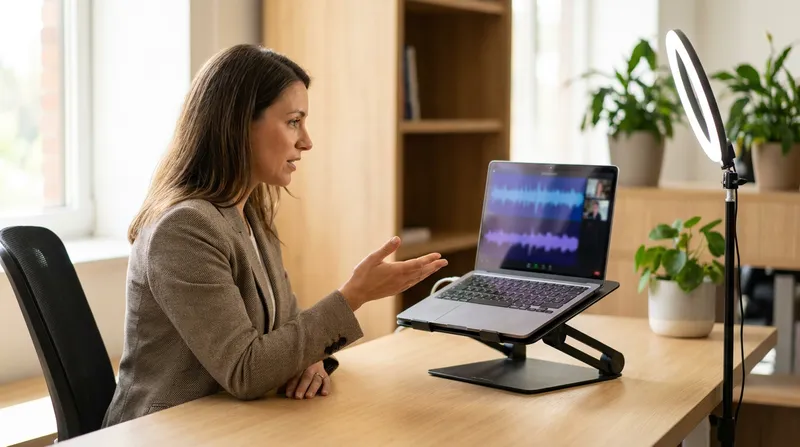
- Lock in eye-level camera framing: Prop your laptop so the webcam lens sits at eye level. Practise looking at the camera lens when delivering your key Result sentences, rather than staring down at the interviewer's video tile at the bottom of your screen.
- Test microphone clarity over room echo: Built-in laptop microphones often pick up keyboard clicks and room echo. Use a clean headset or dedicated microphone, and run a 30-second audio check inside your mock interview tool to hear how your voice actually sounds on the other end.
- Use a 3-word sticky note, never a full script: If you want a safety net for your stories, place one sticky note right next to your webcam lens with three trigger words per story (for example: "Q3 Outage / Python Patch / 40% Faster"). This triggers your memory instantly without making your eyes scan across a document.
- Plan your post-interview close: Great interview preparation includes what happens right after you hang up. Have your closing questions ready, and follow our templates and timing rules for sending a follow-up email across the US, UK, AU, and NZ.
How JobSparrow coaches you through the Prepare stage (and the full Offer Path)
Most standalone mock interview websites treat interview practice as an isolated mini-game. They do not know how your resume was positioned, which skill gaps you addressed in your application, or how to coach you once an offer lands on the table.
JobSparrow is built as your AI career advisor across the entire five-stage Offer Path: Diagnose -> Position -> Execute -> Prepare -> Close.
When you reach the Prepare stage inside JobSparrow, our AI mock interviews connect directly to the rest of your job hunt:
- Two seamless ways to launch: Start a mock interview directly from any saved job application inside your tracker for maximum relevance to the role, or launch an Instant Interview anytime by pasting a job description or job URL.
- Real-time audio recording and AI analysis: Speak your answers out loud and get instant, actionable feedback on answer quality, structural clarity, and vocal delivery tone.
- Full-stage coverage plus company prep notes: Practise specifically for Screening, Culture Fit, or Technical rounds, supported by tailored company-specific questions and preparation notes.
Transparent pricing built for your whole search
Whereas a traditional career consultant charges around US$300 for one resume and around US$2,000 for a coaching program, JobSparrow gives you access to the complete Offer Path (including unlimited tailored resumes and cover letters, unlimited AI mock interviews, positioning, smart job matches, and offer negotiation coaching) under one transparent Land the Job membership:
- Free entry point: Start with a free CV diagnosis to see your recruiter-lens score out of 100, uncover the specific gaps costing you interviews, and view your mapped Offer Path.
- 7-day paid trial (for first-time payers on the monthly plan): Try the full Offer Path for 7 days for US$5.99, then US$45 a month (or £4.99 today then £35/month in the UK, A$8.99 today then A$59/month in Australia, NZ$9.99 today then NZ$59/month in New Zealand) unless cancelled before day 8.
- Flexible membership options: Billed monthly or every three months (US$99 every three months in the US, £69 in the UK, A$129 in Australia, or NZ$129 in New Zealand). Cancel anytime in one click and keep full access until your paid period ends.
Frequently asked questions
What is the best alternative to Google Interview Warmup in 2026?
Since Google quietly retired Interview Warmup in April 2026, the best alternative is a voice-enabled AI mock interview platform that connects directly to your target job description. Look for a simulator like JobSparrow that grades the actual substance, clarity, and delivery tone of your spoken answers across Screening, Culture Fit, and Technical rounds, rather than simply counting repeated words.
What is the difference between an AI mock interview simulator and a live AI interview copilot?
An AI mock interview simulator is an ethical pre-interview training tool that helps you rehearse your spoken answers out loud, receive instant feedback on your structure and vocal delivery, and build genuine confidence before your interview takes place. A live AI interview copilot, by contrast, is a real-time screen overlay designed to listen in on an active Zoom or Teams interview and feed you scripted answers to read aloud. Interviewers may notice response lag or fixed eye movement, and many employers treat undisclosed real-time AI assistance as a breach of interview integrity. Practising ahead of time with a mock interview simulator builds real skill that holds up when interviewers ask unscripted follow-up questions.
Can AI mock interviews help non-native English speakers and migrants prepare for local job markets?
Yes. Speaking out loud to an AI interview coach in a private, judgement-free environment is one of the fastest ways for non-native English speakers to reduce vocal hesitation, refine professional idioms, and practise pacing. It also allows migrants moving to the US, UK, Australia, or New Zealand to practise framing their past international experience to match local hiring expectations.
Do AI interview coaches work for technical and career-changer interviews, or just standard behavioural questions?
Modern AI interview coaches are highly effective for both technical rounds and career transitions when they are tailored to a specific job description. For technical candidates, a role-specific simulator lets you practise explaining complex system architecture, debugging steps, and business trade-offs out loud before facing a senior panel. For career changers, practising with a simulator loaded with the target job description trains you to translate past achievements from your previous field into the exact terminology and competency expectations of your new industry.
How many mock interviews should I practise before a real job interview?
Quality and immediate iteration matter far more than sheer volume. Rather than doing 10 rushed sessions, aim for three to four focused 15-minute sessions across the three days leading up to your interview. Use the 2-take drill (answering a question out loud, reviewing the instant AI feedback, and immediately recording a second improved take) to lock in your core stories without burning out.
Is it better to practise mock interviews with video on or audio-only?
Both modes serve an important purpose at different stages of your preparation. Starting with audio-only recording is ideal for your daily 15-minute drills because it lowers performance anxiety and lets you focus 100% on vocal clarity, pacing, tone, and tightening your STAR story structure. Once your spoken stories feel natural, you should run at least one final practice session with your webcam turned on to check your eye-level framing, lighting, posture, and habit of looking directly into the camera lens when delivering key takeaways.
How do I tailor an AI mock interview to a specific company and job description?
Instead of using generic question banks, choose an AI mock interview platform that allows you to paste the target job description or URL. In JobSparrow, you can launch a mock interview directly from any saved application in your job tracker or start an Instant Interview from a job description or URL, and you get role-specific questions for Screening, Culture Fit, and Technical rounds, plus company-specific questions and preparation notes.
How do I stop sounding robotic or overly rehearsed when using AI interview feedback?
Never write out full paragraphs or try to memorise sentences word for word. Instead, use the AI feedback to refine the structure of your story (ensuring you state a clear Situation, specific Actions, and a measurable Result), and rely on three-word memory triggers so your actual spoken phrasing stays fresh and conversational every time you tell the story.
Can practising with an AI interview simulator help me pass automated one-way video interviews like HireVue?
Yes. One-way video interviews require you to speak clearly to a camera under strict countdown timers (the time limit per question is set by the employer, often a few minutes) with no human feedback cues on the screen. Rehearsing out loud on an AI mock interview platform builds your internal 60-to-90-second pacing clock and trains you to include clear, measurable evidence in every answer, which is essential for scoring well on both AI transcript evaluations and human recruiter reviews.
Ready to walk into your next interview with genuine spoken confidence?
Do not wait until a live interviewer asks a tough question to hear yourself explain your experience out loud for the first time. Start with a free diagnosis today to see your recruiter-lens score out of 100, fix the gaps holding you back, and unlock role-specific AI mock interviews when you are ready to practise out loud.
Tags
Keep reading
Recommended articles.
resume review · cv checker
How to Review Your Resume (or CV): The 10-Second Recruiter Diagnosis Checklist (+ Free Online Checker)
Use our free CV diagnosis and 10-second recruiter review checklist for US, UK, AU & NZ job seekers. Diagnose your CV score out of 100 free.
job application follow-up · follow-up email templates
Follow-Up Email After Sending a Resume: Templates & Timing Rules (US, UK, AU & NZ)
Send a great follow-up email after applying for a job. Get customizable templates, LinkedIn scripts & timing rules for the US, UK, AU & NZ. Start free.
new zealand cv format · accredited employer work visa
NZ NOL vs. ANZSCO CV Guide (2026): How to Tailor Your Resume for AEWV & National Occupation List Roles | JobSparrow
Master the New Zealand CV format for Accredited Employer Work Visa roles in 2026. Dual-optimize your resume for NOL & ANZSCO. Start free.