
career change resume
Resume for Career Change With No Experience Sample (+ Before & After Bullet Examples) | JobSparrow
By Job Sparrow Team

Looking at career change resume with no experience examples often feels discouraging when you already have years of hard-earned professional history. You know how to lead teams, solve crisis-level problems, and hit strict deadlines. Yet the moment you apply for roles in a new field, your resume makes you look like a total beginner. Your past job titles and old-industry jargon trigger rejections from Applicant Tracking Systems (ATS) and quick recruiter scans (an eye-tracking study by Ladders found recruiters spend an average of about 7.4 seconds on an initial resume review). You are stuck wondering how to translate your real-world work into a new industry's language without lying or sounding generic.
At JobSparrow, our team and advisors have collectively reviewed more than 100,000 resumes and bring over 10 years of hands-on recruiting and hiring experience across four markets: Australia/New Zealand, the United States, Singapore, and Hong Kong. Having sat on both sides of the hiring table, we know that recruiters rarely reject career changers because they lack potential. They reject them because they do not have the time to translate an unfamiliar resume (or CV) into their own hiring criteria.
If you are pivoting careers, you are far from alone. According to the U.S. Bureau of Labor Statistics, Americans born in the late baby boom (1957-64) held an average of 12.9 jobs between ages 18 and 58, and even among jobs they started between ages 45 and 54, 56% ended in fewer than five years. Similarly, workforce guidance from The University of Queensland notes that the average worker transitions through three to seven distinct careers before retiring.
In this guide, we will walk you through how to write a resume for a career change with no relevant experience. You will get our Jargon Translation Matrix, six side-by-side before-and-after bullet point makeovers, a Split Experience blueprint, and a complete copy-and-paste sample.
Want to see how a hiring manager in your target industry reads your current resume right now? Start with a free diagnosis to get your recruiter-lens score out of 100 and see the exact gaps costing you interviews.
Why a traditional resume fails when you pivot industries
A standard chronological resume is built to prove linear progression. It assumes that your most recent job title is a stepping stone to your next job title. When you are making a career pivot, that structure works against you in two ways.
First, automated filters screen by titles and domain keywords. A Harvard Business School and Accenture study (Hidden Workers: Untapped Talent, 2021) found that 88% of employers agree qualified high-skills candidates are screened out because they do not exactly match the criteria in the job description. Separately, LinkedIn Economic Graph research found that a skills-first approach expands eligible talent pools by 9.4x compared with hiring on direct job experience alone.
Second, hiring managers suffer from cognitive overload. When a corporate recruiter screening for a Customer Success Manager sees "High School Department Head" or "Hospitality Duty Manager" at the top of your work history, their brain immediately categorizes you as an outsider. If your bullet points are filled with classroom or restaurant terminology, you force the recruiter to do mental translation work. Most will simply move on to the next applicant.
What to do right now:
- Stop organizing your resume around your old identity. Your headline and top third must name the exact target role you are applying for.
- Audit your top five bullet points. If they describe daily duties unique to your old profession rather than business outcomes, mark them for a rewrite.
- Check that your document file itself is clean and machine-readable by reviewing our guide on why built-in Word and Google Docs templates fail modern ATS parsers.
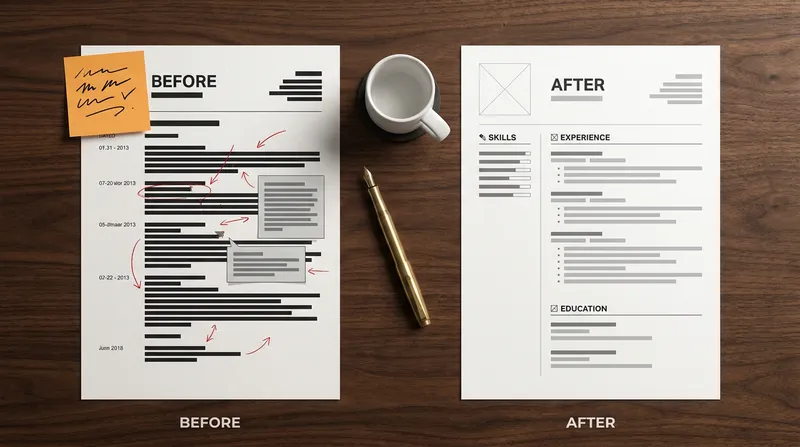
Best resume format for a career change: functional vs. combination vs. split experience
One of the biggest traps in career change advice is the recommendation to use a pure functional (or strictly skills-based) resume format. Let us look at why that backfires from the hiring manager's side of the table, and which layout you should use instead.
Why recruiters reject pure functional resumes
A functional resume groups all of your bullet points under skill categories at the top of the page and hides your job titles, company names, and employment dates at the very bottom. While standard resume sites often promote this layout, recruiters strongly dislike it.
When a recruiter cannot see where or when you used a skill, they assume you are hiding a multi-year employment gap, a recent termination, or exaggerated seniority. Furthermore, modern ATS parsers struggle to connect detached skill bullets to your timeline, which can break your candidate profile during import. If you have ever wondered why an application portal scrambled your history, read our breakdown on how to fix Workday resume autofill errors.
The combination resume format for career changers
Instead of hiding your timeline, use a combination resume format for career changers (also called a hybrid format). Wharton Online (University of Pennsylvania) recommends the combination format for career switchers because it places equal emphasis on skills and experience. It also cites iHire's 2020 Talent Retention Report, which found 66% of respondents had recently considered changing careers.
In a combination layout, you lead with a targeted Summary and a grouped "Core Competencies & Transferable Skills" section right at the top of page one. Immediately below that, you provide a transparent, reverse-chronological work history where every bullet point is reframed to prove those exact skills.
The split experience section secret (relevant vs. additional experience)
What if you have completed a bootcamp, a university capstone, volunteer work, or freelance projects in your new field, while working a day job in an unrelated industry? If you use a single chronological list, your relevant project work gets buried under your unrelated day job.
The solution is a split experience section:
- Section 1: Relevant Projects & Experience. Place this immediately below your skills section. Include bootcamps, contract assignments, pro-bono consulting, or hybrid responsibilities from your day job.
- Section 2: Professional Work History (or Additional Experience). Place your full-time chronological jobs here, using two to three concise bullets per role that highlight leadership, stakeholder management, and measurable operational results.
| Resume Format | How It Works | Recruiter & ATS Verdict |
|---|---|---|
| Chronological | Lists jobs strictly by date from newest to oldest. | Poor for pivots. Highlights unrelated job titles first and buries transferable skills. |
| Pure Functional | Lists skill buckets at the top; strips dates and companies to the bottom. | High rejection risk. Raises red flags with recruiters and confuses ATS timeline parsers. |
| Combination (Hybrid) | Leads with a targeted skill matrix, followed by reframed chronological work history. | Strong choice. Connects target keywords directly to verified employment dates. |
| Split Experience Hybrid | Separates "Relevant Projects/Training" from "Previous Work History." | Best for zero paid experience. Puts new-industry proof at the top of page one without hiding past jobs. |
What to do right now:
- Never strip dates or company names off your work history.
- If you have completed any projects, certifications, or volunteer work in your target field, create a dedicated "Relevant Projects & Experience" heading above your main work history.
How to write a career change resume summary with no experience (+ examples)
Your summary (called a Personal Profile in the UK, Australia, and New Zealand) is the bridge between your past and your future. The biggest mistake career changers make here is using apologetic language like, "Although I have no formal experience in tech, I am a fast learner seeking an entry-level role." Never highlight what you lack in the first sentence a recruiter reads.
Use this three-part formula instead: [Target Title / Identity] + [Years of Experience in Core Transferable Function + Quantified Proof] + [New Industry Credential/Skill Applied to Target Company Goal].
4 career change resume summary examples (no direct experience)
-
Teacher to Corporate Learning & Development (L&D) / Project Coordinator:
"Project & Learning Coordinator with six-plus years of experience designing curriculum, managing multi-stakeholder schedules, and facilitating training for groups of up to 120 participants. Proven track record of improving program completion rates by 22% through data-driven tracking. Recently earned the Certified Associate in Project Management (CAPM) credential, bringing strong instructional design and workflow coordination skills to enterprise onboarding teams."
-
Hospitality / Retail Manager to Customer Success Manager (SaaS):
"Customer-focused operations leader with five-plus years of experience managing high-volume client relationships, resolving complex escalations, and driving repeat revenue in fast-paced retail environments. Increased customer retention metrics by 18% and led onboarding for a team of 15 staff. Proficient in HubSpot CRM, Zendesk, and lifecycle retention workflows, ready to drive account expansion and reduce churn for B2B SaaS clients."
-
Healthcare Nurse / Clinician to Health-Tech Operations or Business Analyst:
"Clinical operations specialist transitioning into Health-Tech Business Analysis, backed by seven years of frontline experience optimizing patient triage workflows and electronic health record (EHR) compliance. Reduced department documentation errors by 30% by standardizing intake protocols across three hospital shifts. Skilled in SQL, Tableau, and process mapping to bridge the gap between clinical end-users and software product teams."
-
Finance / Admin Assistant to Junior Data Analyst:
"Detail-oriented operations and financial administrator with four years of experience reconciling budgets, auditing vendor data, and building automated Excel reporting dashboards for leadership. Saved 12 hours of manual data entry per week by redesigning monthly reconciliation templates. Completed the Google Data Analytics Certificate with hands-on project experience in SQL, R, and Tableau."
What to do right now:
- Delete words like "aspiring," "hoping to transition," or "entry-level seeker" from your summary.
- Put your target job title in bold right below your name at the top of the document.
The jargon translation matrix: how to list transferable skills on a resume
When you wonder how to list transferable skills on a resume, the secret is vocabulary translation. Every industry uses different labels for the exact same underlying human and operational activities. If you leave your resume in your old industry's dialect, neither the ATS nor the hiring manager will recognize your competence.
Use this Jargon Translation Matrix to convert your past duties into corporate, tech, and operations keywords:
| Your Old Industry Term | What It Actually Is (Target Industry Keyword) | How to Frame the Impact |
|---|---|---|
| Teaching: Lesson plans, classroom management, parent-teacher conferences | Instructional design, curriculum development, stakeholder communication, performance tracking | Communicating complex concepts to diverse audiences and tracking milestone adoption. |
| Hospitality / F&B: Waiting tables, handling angry guests, shift scheduling, upselling specials | Client relationship management, escalation resolution, resource allocation, revenue expansion | Maintaining high CSAT/NPS scores under pressure and increasing average order value. |
| Retail: Cash register reconciliation, floor merchandising, training seasonal hires | Financial auditing, inventory optimization, staff onboarding, point-of-sale (POS) operations | Protecting profit margins, reducing shrinkage, and ramping up new team members quickly. |
| Healthcare: Patient charting, triage, care coordination, shift handovers | Regulatory compliance (HIPAA/GDPR), risk assessment, cross-functional workflow coordination | Managing high-stakes data accuracy and coordinating multi-disciplinary teams under tight SLAs. |
| Military / Trades: Equipment maintenance, squad leadership, safety inspections | Asset management, team supervision, quality assurance (QA), standard operating procedures (SOPs) | Minimizing operational downtime and enforcing zero-defect safety and compliance standards. |
What to do right now:
- Open three job descriptions for your target role and highlight the top eight recurring skills or nouns.
- Match each requirement to an equivalent activity from your past using the table above, and use the target industry's phrasing in your Skills section.
Before and after career change resume bullet points (6 makeovers)
Listing transferable skills in a top summary is only half the battle. You must prove those skills inside your work experience bullets. As the National Careers Service advises, structuring your work history bullets in two to three concise lines using the STAR method (Situation, Task, Action, Result) is the clearest way to demonstrate how your actions created measurable value.
For a deeper dive into how hiring managers grade these bullets, see our guide on STAR method rubrics used by Google and data analyst teams, or learn how to use AI to turn job duties into measurable achievements.
Here are six side-by-side before and after career change resume bullet points showing how to reframe work experience for a career transition:
1. High school teacher to project manager
- Before (Old Industry Duty): Taught five classes of 10th-grade biology, graded exams, and held meetings with parents and school administrators.
- After (Reframed Target Impact): Managed end-to-end delivery of a 36-week instructional program for 150+ participants, tracking weekly performance metrics and aligning 12 internal and external stakeholders to achieve a 94% pass rate.
2. Restaurant shift supervisor to customer success manager
- Before (Old Industry Duty): Supervised waitstaff during busy dinner shifts, handled customer complaints about food orders, and trained new servers on the menu.
- After (Reframed Target Impact): Led frontline service delivery and escalation resolution for 200+ daily accounts in a high-volume environment, onboarding 14 new team members and improving guest satisfaction scores from 4.1 to 4.7 stars over six months.
3. Retail store associate to human resources (HR) / recruiting coordinator
- Before (Old Industry Duty): Helped manager interview seasonal cashiers, scheduled weekly shifts for 20 employees, and explained store policies to new hires.
- After (Reframed Target Impact): Coordinated full-cycle seasonal recruitment and onboarding for 20+ staff members, managing interview scheduling, policy compliance training, and shift rostering to reduce first-month turnover by 25%.
4. Registered nurse to tech product operations / QA specialist
- Before (Old Industry Duty): Entered patient vitals into the hospital computer system, trained new nurses on charting rules, and reported software bugs to IT.
- After (Reframed Target Impact): Audited electronic record workflows across a 40-bed unit, identifying user-interface bottlenecks in clinical software and partnering with IT to roll out updated intake protocols that cut data entry errors by 28%.
5. Administrative assistant to junior data / business analyst
- Before (Old Industry Duty): Kept track of office supply budgets in Excel, paid monthly vendor invoices, and made slide decks for the regional director.
- After (Reframed Target Impact): Consolidated monthly expense data across eight vendor accounts using advanced Excel (XLOOKUP, Pivot Tables), identifying $14,000 in annual recurring billing discrepancies and automating executive KPI reporting.
6. Hair stylist / beauty retail advisor to B2B account executive
- Before (Old Industry Duty): Cut and colored hair for regular clients, recommended salon shampoos, and booked repeat appointments at the front desk.
- After (Reframed Target Impact): Built and retained a book of 120+ recurring client accounts through consultative needs analysis, exceeding monthly retail cross-sell targets by 32% and maintaining an 85% client rebooking rate.
What to do right now:
- Pick two bullets under your most recent job and strip out industry-specific nouns (such as "students," "patients," "diners," or "shoppers"). Replace them with universal business terms ("stakeholders," "clients," "end-users," or "accounts").
- Add at least one number to every bullet: volume handled, percentage improved, hours saved, or team size supported.
Complete career change resume with no experience sample (copy & paste template)
Below is a complete, ATS-friendly pivoting into a new industry resume template using the Split Experience Hybrid layout. Notice how it puts new-industry training and projects at the top of page one while reframing past work history right underneath.
JORDAN TAYLOR
Austin, TX (Open to Remote) | jordan.taylor@email.com | (555) 234-5678 | linkedin.com/in/jordantaylor

TARGET ROLE: JUNIOR CUSTOMER SUCCESS & ACCOUNT OPERATIONS MANAGER

PROFESSIONAL SUMMARY
Client-focused operations professional with 5+ years of experience managing high-volume stakeholder relationships, resolving complex service escalations, and leading team onboarding. Proven track record of increasing repeat client retention by 19% and improving team workflow efficiency. Recently completed HubSpot Revenue Operations Certification and hands-on CRM implementation projects, combining frontline service empathy with structured SaaS account management.

CORE COMPETENCIES & TRANSFERABLE SKILLS
- Client Success & Retention: Account Onboarding, Escalation Resolution, Quarterly Business Reviews (QBRs), Churn Mitigation, CSAT/NPS Tracking
- Operations & Process: Workflow Standardization, Cross-Functional Coordination, Staff Training, SLA Compliance
- Technical & Tools: HubSpot CRM, Salesforce (Trailhead Explorer), Zendesk, Jira, Microsoft Excel (Pivot Tables, XLOOKUP), Slack

RELEVANT PROJECTS & TECHNICAL TRAINING

SaaS Customer Onboarding & Churn Analysis Capstone | Career Pivot Bootcamp
January 2026 - March 2026
- Built an automated 30-60-90 day customer onboarding workflow in HubSpot CRM for a simulated B2B SaaS product, including automated health-score triggers and renewal reminders.
- Analyzed a dataset of 1,200 customer support tickets in Excel to identify top churn drivers, presenting a 3-step self-service knowledge base strategy projected to deflect 22% of Tier-1 tickets.

Volunteer CRM & Donor Operations Coordinator | Austin Community Animal Rescue
September 2025 - Present
- Migrated 850+ donor and volunteer records from manual spreadsheets into a cloud CRM database, eliminating duplicate entries and improving email campaign segmentation.
- Designed a standardized onboarding checklist for 30+ new volunteers, cutting orientation scheduling time by 4 hours per week.

PROFESSIONAL WORK HISTORY

Assistant Operations & Guest Relations Manager | The Magnolia Hospitality Group
May 2022 - Present
- Directed daily frontline operations and client experience for a venue serving 300+ daily accounts, maintaining a 4.8/5.0 customer satisfaction rating across 600+ public reviews.
- Resolved 15-20 weekly service escalations in real time, implementing a root-cause tracking log with kitchen and floor leads that reduced comped order costs by 24% in 12 months.
- Onboarded, trained, and coached 22 staff members on POS software and consultative upselling techniques, driving a 19% increase in repeat VIP bookings.

Lead Client Services Associate | Luxe Beauty & Retail Co.
June 2020 - April 2022
- Conducted consultative needs assessments for 40+ daily clients, achieving 118% of quarterly sales quotas and ranking in the top 10% of regional associates.
- Managed inventory audits and digital point-of-sale reconciliations for $450K in annual merchandise with 99.4% accuracy.

EDUCATION & CERTIFICATIONS
- HubSpot Revenue Operations & Service Hub Certified (2026)
- Salesforce Trailhead: Admin & Customer Success Fundamentals (18 Badges Completed, 2026)
- Bachelor of Arts in Communications | University of Texas (2020)
Regional guide: US resumes vs. UK, Australian, and New Zealand career change CVs
Whether you are applying locally or relocating across borders, formatting expectations vary significantly between markets. A layout that passes in New York may look too brief in Sydney or London.
- United States: Aim for a crisp one-page resume if you have under seven to 10 years of experience, or a maximum of two pages for senior pivots. Use US spelling (optimize, analyze) and call the top section a "Professional Summary."
- United Kingdom: When writing a CV for career change no experience UK employers expect a maximum two-page CV. Call your top section a "Personal Profile" or "Personal Statement." In line with official National Careers Service guidelines, do not include your age, date of birth, marital status, or nationality. A photo is also not expected on a UK CV. Use British spelling (optimise, analyse, programme).
- Australia & New Zealand: A two- to three-page CV or resume is standard, as hiring managers in AU and NZ prefer slightly more context on your projects and key achievements under each role. Use British/Commonwealth spelling. Including "References available upon request" at the bottom is optional, though listing two referees is still common in public sector roles.
- Skilled Migrants Changing Careers: If you recently moved to Australia, New Zealand, the UK, or the US and are pivoting industries or stepping into an adjacent role because of local licensing barriers, recruiters often stumble over unfamiliar overseas company names. Add a one-line company descriptor under your past employer (e.g., "Leading Southeast Asian telecommunications provider with 4,000+ staff") so local recruiters immediately grasp the scale of your experience. For a complete breakdown of visa and local market framing, read our guide on how to translate overseas experience for Australian and NZ resumes.
How to use an AI career coach to tailor your pivot resume without fabricating experience
Many career changers turn to generic AI tools to rewrite their resumes, only to fall into the AI hallucination trap. When you paste a target job description into a basic prompt or a low-grade template builder, the tool often invents fake budgets, fabricates software proficiency you do not have, or rewrites your past job titles into roles you never held. As we highlight in our review of the best free resume builders according to Reddit, fake ATS scores and fabricated bullet points fall apart the moment a recruiter asks a follow-up question in a screening call.
At JobSparrow, we take an advisor-first approach across our five-stage Offer Path: Diagnose, Position, Execute, Prepare, and Close.
Instead of guessing or inventing history, here is how an ethical AI career coach resume builder helps you pivot:
- Diagnose (free CV diagnosis): Upload your current resume to see a recruiter-lens score out of 100 and identify the substantive problems holding you back, such as vague impact, old-industry jargon, or missing evidence.
- Position (master career profile & gap filler): Import your history into your master career profile. Our interactive gap filler acts like a human career coach: it spots where your bullets lack metrics or transferable context and walks you through targeted Q&A questions to uncover real numbers you forgot you achieved. From there, positioning & instant resume recommends a shortlist of best-fit bridge roles you are actually qualified for right now.
- Execute (job-specific tailoring & tracking): For every job you target, JobSparrow selects the most relevant projects and roles from your master career profile and reframes your real bullets into the target job's vocabulary, paired with a tailored cover letter that explains the "why" behind your pivot. You can also organize every application in one dashboard instead of relying on a manual spreadsheet (or compare options in our free Excel job application tracker template guide).
- Prepare & Close (AI mock interviews & offer coaching): Getting the interview is only step one. Once your reframed resume lands you a screening call, our role-specific AI mock interviews let you practice defending your career transition out loud with real-time feedback on your delivery and clarity. If your new industry uses group hiring exercises or case studies, you can also prepare using our guides on how to pass an assessment centre and consulting behavioral and fit interview questions.
Whereas a traditional career consultant charges around US$300 for a single resume rewrite and around US$2,000 for a full coaching program, JobSparrow coaches you through the entire Offer Path. You can start with a free CV diagnosis, or try the full Offer Path for seven days for US$5.99, then US$45 a month (or £4.99 today then £35/month in the UK, A$8.99 today then A$59/month in Australia, and NZ$9.99 today then NZ$59/month in New Zealand). Cancel anytime in one click.
Frequently asked questions about career change resumes
How do I write a resume for a career change with zero experience in the new field?
Use a Split Experience Hybrid resume format. Lead with a targeted summary and core transferable skills section, followed by a "Relevant Projects & Training" section that highlights bootcamps, certifications, volunteer work, or freelance projects in your new field. Below that, list your chronological work history with every bullet rewritten to emphasize universal business outcomes like client retention, process improvement, or budget accuracy.
Should I use a functional or combination resume format for a career pivot?
You should always choose a combination (hybrid) or Split Experience format over a pure functional resume. While pure functional resumes group skills at the top and hide employment dates at the bottom, recruiters and hiring managers often view them with suspicion because they obscure where and when you used those skills. A combination format highlights your transferable skills and relevant training right at the top of page one while still keeping your chronological work history transparent and easy for Applicant Tracking Systems (ATS) to parse.
Can I change my past job titles on my resume to match the new industry?
Never falsify an official job title, as employment background checks verify your HR title of record. However, you can add a clarifying functional translation in parentheses next to an obscure internal title. For example, if your retail title was "Cast Member Level 3," you can write: Cast Member Level 3 (Client Service & Floor Operations Lead).
Should I leave unrelated jobs off my career change resume?
Do not delete recent full-time jobs if doing so creates an unexplained multi-year employment gap on your timeline. Recruiters prefer seeing steady work history over mysterious gaps. Instead, keep the job on your resume but condense it to two or three high-impact bullets focused strictly on leadership, reliability, problem-solving, and measurable targets.
How far back should my work history go on a career change resume?
Focus your detailed work history on the last 10 to 15 years. For roles held within the past five to seven years, include three to five bullet points reframed around transferable business outcomes such as stakeholder management, revenue growth, or process efficiency. If you have older roles from 10+ years ago that are unrelated to your new field, you can group them under a brief "Earlier Career History" section listing only the job title, company name, and dates to show career stability without cluttering page one.
How do I explain a career change in my resume summary without sounding apologetic?
Focus on what you bring to the table rather than what you lack. State your target job title, summarize your years of experience in a core transferable function (such as stakeholder communication, data analysis, or operations management), cite one quantified achievement from your past, and name the specific new certification or technical skill you are bringing to the target role.
What is the difference between a career change resume in the US vs. a career change CV in the UK, Australia, or New Zealand?
In the United States, a career change resume should typically be one page (or up to two pages for candidates with 10+ years of experience), use US English spelling, and open with a "Professional Summary." In the United Kingdom, employers expect a two-page CV that opens with a "Personal Profile" and uses British spelling, without any personal details like age, date of birth, marital status, or nationality. In Australia and New Zealand, a two- to three-page CV or resume is standard, giving career switchers extra room to include a "Key Achievements" or "Relevant Projects" section alongside their work history.
How can I use an AI resume builder for a career change without it making up fake experience?
Avoid generic one-click AI generators that rewrite your resume solely from the job description, as they frequently hallucinate fake budgets, tools, or job titles. Instead, use an advisor-led platform like JobSparrow that builds from a verified master career profile. JobSparrow's interactive gap filler asks you targeted coaching questions to extract real metrics and transferable achievements from your past, and then translates those verified facts into the target industry's keywords without inventing experience.
Do I need a cover letter when applying for a career change with no experience?
Yes, a tailored cover letter is one of your strongest assets during a career pivot. While your resume proves what you have achieved using target-industry keywords, your cover letter explains why you are making the transition and connects the dots for the hiring manager before they even look at your work timeline. Keep it to three short paragraphs: why you are pivoting into their specific company, how two of your past quantified achievements solve their core role requirements, and how your recent training or projects prepare you to hit the ground running.
What if I am switching careers through an internship or returnship?
Mid-career internships, returnships, and apprenticeship programs are excellent bridges into tech, finance, and corporate operations. Treat academic projects and micro-internships just like paid work experience at the top of your resume, and keep your applications organized using our guide to the best internship application trackers and tools.
Ready to translate your experience into job offers?
You do not have to start from scratch to start a new career. You already have the track record; you just need your resume to speak the language hiring managers in your new industry expect to read.
Start with a free diagnosis at JobSparrow to get your recruiter-lens score out of 100 and see the exact gaps between your current resume and your target role in minutes. When you are ready for unlimited tailored resumes, cover letters, interactive gap filling, and AI mock interviews, try the full Offer Path for seven days for US$5.99, then US$45 a month. Cancel anytime.
Tags
Keep reading
Recommended articles.
career change · transferable skills
Pivoting with Purpose: How to Frame Your Experience for a Successful Career Change
Ready for a career change? Learn how to reframe your experience, identify transferable skills, and craft a compelling narrative for a successful career pivot.
career change resume · functional vs chronological resume
The Functional Resume for a Career Change is Dead: Do This Instead (With Examples)
Weighing a functional vs chronological resume for career change? Functional resumes weaken ATS scans. Use this hybrid chronological format instead.
career change · resume format
The Best Career Change Resume Format for 2026 (Section-by-Section Guide & Templates)
Discover the best career change resume format for 2026. Learn how to highlight transferable skills, beat ATS bots, and confidently land your new dream job.