
ats resume
ATS Friendly Resume Builder vs. Recruiter Reality: How to Pass Both Filters [Free CV Check]
By Job Sparrow Team

You ran your resume (or CV) through an online keyword scanner. You tweaked every line until your match score hit 88%. You uploaded the file, clicked submit, and waited. Two weeks later, you are still staring at an empty inbox.
When you compare an ATS vs. human resume review, you uncover the biggest trap in the 2026 job market. Most automated resume tools train you to chase an algorithm score. In the process, they turn your career history into generic, keyword-stuffed corporate jargon. You pass the software parser, only to fail the human hiring manager in seconds.
To pass ATS filters and impress recruiters, your document has to survive two completely different evaluations. First, it must clear machine extraction. Second, it must win a human judgment call on your impact, scope of ownership, and seniority.
At JobSparrow, our team and advisors have collectively reviewed more than 100,000 resumes and bring over 10 years of hands-on recruiting and hiring experience across four markets: Australia/New Zealand, the United States, Singapore, and Hong Kong. We have sat on both sides of the hiring table. We know why high-scoring resumes get rejected, and how to fix them.
If you want to know how your application reads to a real hiring manager right now, start with our free ATS CV checker and recruiter-lens diagnosis. You will get an instant score out of 100 and see the exact gaps costing you interviews.
What is an ATS-friendly resume and how do parsers actually work?
An Applicant Tracking System (ATS) is not an autonomous robot designed to delete your application in the middle of the night. According to enterprise documentation from Workday, an ATS acts as a central database whose parsing engine extracts text from your file and maps it into structured digital profile fields: contact details, work history, education, and skills.
Similarly, modern hiring platforms like Greenhouse Software organize candidates around structured scorecards so human recruiters and hiring managers can evaluate verified skills. Even newer AI-assisted platforms evaluate criteria systematically rather than randomly discarding files, which we break down in our guide on how to pass Ashby ATS in 2026.
However, automated filtering is still a massive hurdle. Research from Harvard Business School and Accenture's 2021 Hidden Workers report found that over 90% of employers use recruiting software to filter or rank candidates, and 88% agreed that qualified high-skills candidates are vetted out because they do not match the exact criteria set by the job description.
What to do right now:
- Stop treating the ATS like an enemy to trick with invisible white text or keyword blocks.
- Treat the ATS like a strict database importer. Your goal is 100% applicant tracking system parser readability so every word you write lands in the right database field.
- Pair exact terminology from the job posting with clear chronological dates so the system calculates your years of experience accurately.
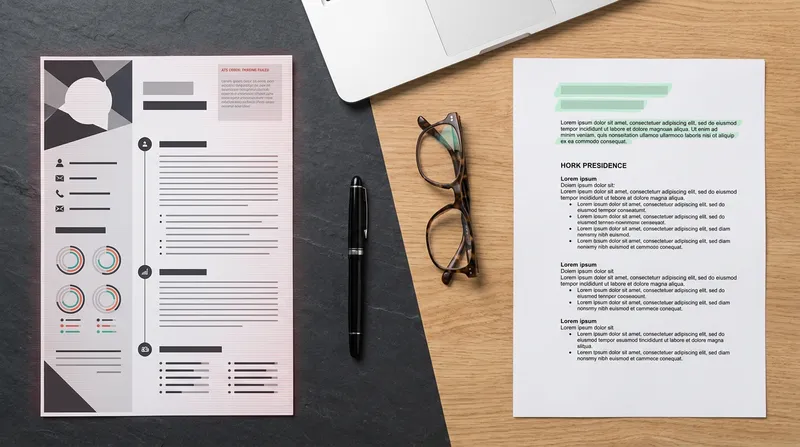
The dual-filter framework: ATS parser logic vs. the recruiter 7-second scan
Most standard CV templates optimize for one filter at the expense of the other. Graphic-heavy templates look creative to the untrained eye but scramble database parsers. Keyword-stuffed templates score high in automated checkers but read like robotic spam to hiring managers.
Once your file clears the parser and surfaces in a recruiter search, a completely different test begins: the recruiter 7-second resume scan. A 2018 eye-tracking study by Ladders, reported by HR Dive, found that recruiters spend an average of just 7.4 seconds on their initial scan of a resume. They read in a rapid E-pattern or F-pattern, looking at current and previous job titles, company names, employment dates, and the top third of page one.
The same 2018 Ladders study found that recruiters engaged longer with resumes that had simple layouts, clear section headings, and text that flows down the page.
Here is how the machine filter and the human filter evaluate the exact same document differently:
- Headings and structure: The ATS parser looks for standard section headings (
Experience,Education,Skills) to sort your data. The human recruiter looks for clean visual hierarchy and generous white space so their eyes do not get fatigued. - Job titles: The ATS checks for exact or close title matches against the target requisition. The human recruiter checks for career trajectory (did you get promoted, or have you made lateral moves for 6 years?).
- Keywords and skills: The ATS counts term frequency and proximity to dates to calculate years of experience per skill. The human recruiter looks for impact evidence alongside your keywords (did you just list "Python" and "Stakeholder Management" in a sidebar, or did you prove how you used them to ship a product?).
- Dates and tenure: The ATS runs date math (
MM/YYYY - MM/YYYY) to check if you meet minimum tenure thresholds. The human recruiter scans right-aligned dates to spot short stints, unexplained gaps, or overlapping roles.
You can run a manual self-check using our 10-second recruiter diagnosis checklist to see if your top third passes the F-pattern scan.
Why a high ATS score gets no interviews (the 85% score trap)
One of the most common questions we hear from frustrated professionals is why a high ATS score gets no interviews. You use an automated resume tool, hit an 85% or 95% match rate, and still get rejected within 48 hours.
When we review resumes on the hiring side, high-scoring rejections often come down to three human dealbreakers.
1. Keyword stuffing without impact evidence
Other AI tools often advise you to copy every noun from the job advertisement into a massive "Core Competencies" grid at the top of page one. That boosts your third-party scanner score immediately.
When a human recruiter opens your file, however, a 30-word block of buzzwords pushes your actual work history to the bottom of the page. Worse, recruiters tend to discount skill lists that aren't backed by evidence. If "Cross-Functional Leadership" or "P&L Ownership" appears in your skills box, but does not appear inside a quantified work history bullet point, a recruiter treats the claim as empty filler.
2. Missing seniority signals on your resume
Every role has a hidden seniority signature. Junior candidates write about tasks they were assigned. Mid-level candidates write about execution and outputs. Senior, Lead, and Director candidates write about strategy, trade-offs, budget ownership, and business outcomes.
If you apply for a Senior Product Manager role with a resume full of senior keywords, you will score 90% in the ATS. Yet if your verbs say "Assisted with roadmap updates" or "Participated in sprint planning," you are flashing junior seniority signals on your resume bullets. The hiring manager is likely to reject you for lacking scope of ownership.
3. The generic AI voice
In 2026, recruiters can spot raw, unedited LLM output immediately. Phrases like "Spearheaded synergistic initiatives to foster operational excellence" tell a hiring manager that you clicked "Rewrite with AI" without thinking critically about your actual accomplishments.
De-botting your bullet points: before and after examples
To pass both filters, every bullet point must combine exact search terms for the parser with hard evidence and seniority framing for the recruiter. Look at how the same experience transforms across three versions:
1. The Unoptimized Bullet (Fails ATS, Fails Recruiter):
Responsible for managing client accounts and helping the sales team hit quarterly targets.
- Why it fails: Contains zero hard tool keywords or methodologies for the ATS, and describes passive duties rather than results for the recruiter.
2. The Over-Optimized AI Keyword Salad (Passes ATS, Fails Recruiter):
Leveraged Salesforce CRM, B2B SaaS account management, stakeholder engagement, churn mitigation, and cross-functional collaboration to optimize enterprise client retention strategies.
- Why it fails: An automated keyword checker will give this 100%. A human hiring manager will roll their eyes because there is zero proof of scale, budget, or actual achievement.
3. The Dual-Optimized Impact Bullet (Passes Both Filters):
Retained US$4.2M in annual B2B SaaS recurring revenue across 18 enterprise accounts by deploying automated churn-risk triggers in Salesforce CRM, cutting annual logo churn from 14% to 6%.
- Why it wins: The ATS parser extracts
B2B SaaS,Enterprise Accounts,Churn, andSalesforce CRMright alongside your employment dates. The human recruiter immediately sees the revenue scope (US$4.2M) and the measurable business outcome (14% to 6%).
What to do right now: Audit the top three bullet points of your two most recent roles. Ensure each one follows the formula: Strong Ownership Verb + Quantified Business Outcome + Specific Keyword/Tool Used to Achieve It.
How to format your resume for 100% ATS parseability (PDF vs. DOCX)
Even the best bullet points fail if the parser cannot read your file structure. Improving your ATS resume format parseability requires stripping out invisible formatting traps that confuse text-extraction engines.
Guidance from the University of Illinois Chicago Office of Career Services highlights several technical parsing failures that still trip up job seekers:
- Headers and footers: Many ATS parsers completely ignore text placed inside Microsoft Word document headers and footers. If your phone number, email address, and LinkedIn URL live inside the header tag, your profile may import with blank contact fields.
- Special characters and accents: Non-standard bullet icons (diamonds, arrows, checkboxes) and accented characters often corrupt during text extraction. A parser may read the word "résumé" as "r?sum?". Stick to standard round bullets and plain ASCII text.
- Multi-column tables and text boxes: Older parsers read across the page from left to right, line by line. If you use an uncalibrated two-column table, the parser may merge line one of your left column with line one of your right column, turning your work history into gibberish.
Best file format: ATS-compliant PDF and DOCX templates
Job seekers constantly debate whether to upload a PDF or a Word document. The truth in 2026 depends on how your file was generated:
- Text-based PDF: Modern systems like Greenhouse, Lever, Ashby, and Workday parse text-based PDFs cleanly. A PDF locks in your typography and margins so the human recruiter sees the exact layout you designed. However, never upload an image-based or flattened PDF (common with graphic design tools), as the ATS sees a blank picture.
- DOCX (Microsoft Word): Legacy enterprise configurations (such as some older Taleo configurations) and external recruitment agencies across the UK, Australia, and New Zealand frequently prefer
.docxfiles. Agency recruiters often need to remove your contact details and add their agency cover sheet before forwarding your CV to a client.
When you use a tailored resume builder for job description alignment like JobSparrow, you do not have to guess. Our platform lets you export PDF and DOCX files in five templates (Professional, Two Column, Elegant, Colorful, and Contemporary), with content optimised for ATS and smart filenames (Name_JobTitle_Resume.pdf).
The global playbook: UK, AU, and NZ CV to US resume converter
If you are relocating, applying for remote international roles, or migrating across borders, formatting rules change dramatically. A document that wins interviews in London, Sydney, or Auckland can get you rejected in New York or San Francisco.
Use this regional breakdown to convert your UK, AU, or NZ CV to a US resume so your application respects local hiring norms:
United States (the US resume)
- Length: Strictly 1 page for early-career professionals (under 7-8 years of experience) and a maximum of 2 pages for senior, executive, or technical leaders.
- Spelling and tone: American English (
optimize,analyze,program). Heavy emphasis on rapid metric density, dollar impact, and percentage gains. - Structure: No long narrative paragraphs. Use a 3-line executive hook, followed immediately by reverse-chronological work experience.
United Kingdom (the UK CV)
- Length: Standard 2 pages (3 pages is acceptable for senior technical, medical, or academic contractors).
- Spelling and tone: British English (
optimise,analyse,programme). Include a structured 4-line Personal Profile at the top summarizing your sector background and core value proposition. - Structure: Omit high school grades (GCSEs/A-Levels) once you have a university degree and 3+ years of commercial experience. Remove the outdated "References available upon request" line to save space.
Australia and New Zealand (the AU/NZ CV or resume)
- Length: Typically 2 to 4 pages for experienced professionals. Australian and Kiwi hiring managers expect slightly more context around project environments, team size, and stakeholder delivery than US recruiters.
- Market specifics: For a detailed visual breakdown of local expectations, see our guide on New Zealand CV examples and templates. If you are migrating to Australia, your bullet points must also align with official occupation codes. Read our breakdown of OSCA vs. ANZSCO in 2026 for Australian skills assessments. Additionally, many Australian public sector roles ask you to address selection criteria or capability frameworks. Victorian Public Service roles are covered in our Victorian Government Key Selection Criteria guide.
- Referees: While US and UK resumes omit references entirely, some traditional AU and NZ employers still look for a "Referees" section at the bottom of the final page (listing "Available upon request" is standard unless the job ad specifically requests two named referees up front).
JobSparrow natively supports the United States, United Kingdom, Australia, and New Zealand, automatically adapting spelling conventions, terminology, and length rules to match your target market.
The Master Profile resume strategy: tailoring in 60 seconds without losing your voice
When job seekers realize that generic resumes fail, they usually make a fatal workflow mistake. They start duplicating Word files on their desktop: Resume_Marketing_Final.docx, Resume_Product_v4_New.docx, CV_Tech_Updated.pdf.
Within three weeks, your achievements are scattered across 15 different files. You spend two hours manually cutting and pasting bullet points for every job posting, or you get exhausted and start spamming one generic file again.
A better approach is the master profile resume strategy. Instead of editing individual single-page documents, you build one centralized career database that holds every role, project, metric, skill, and qualification you have ever earned.
How JobSparrow's Offer Path solves the dual-filter problem
JobSparrow is an AI career advisor built around a structured five-stage Offer Path: Diagnose -> Position -> Execute -> Prepare -> Close.
- Diagnose (Free CV Diagnosis): Upload your current resume or CV at jobsparrow.ai/free-cv-review. On the very same screen, with no demo or waitlist, you receive a recruiter-lens score out of 100, a breakdown of the exact substantive gaps costing you interviews (vague impact, seniority mismatch, missing evidence), and your personalized Offer Path map.
- Build Your Master Career Profile & Fill the Gaps: Import your existing PDF or DOCX to create your Master Profile. Then, our interactive Gap Filler AI coach analyzes your history for missing metrics or vague descriptions and walks you through targeted Q&A to uncover the hard numbers you forgot to include. Your answers are woven directly back into your Master Profile.
- Position & Tailor Per Application: If you do not have a job listing yet, our Positioning & Instant Resume tool recommends best-fit roles and generates a sharp, ready-to-go resume in seconds. When you find a specific job URL, Job-Specific Resume Tailoring selects the most relevant experience from your Master Profile and rewrites your bullets to align with both ATS keywords and human recruiter impact expectations, alongside an intelligent cover letter.
- Execute & Track: Aggregate and rank jobs from LinkedIn, Indeed, and Seek in one dashboard with Smart Job Search, or use our public AI Agent Skill & API (compatible with Claude Desktop, Claude Code, and OpenClaw, which we compare in our guide on Claude Code and OpenClaw for job hunting).
- Prepare & Close: Passing the resume screen is only half the battle. Once you land the interview, recruiters will test every claim on your resume using structured behavioral rubrics like those in our Amazon and Microsoft STAR+L interview guide. Rather than relying on risky on-screen scripts that get candidates rejected, you can practise for a job interview online using JobSparrow's role-specific AI Mock Interviews with real-time audio recording and AI analysis, followed by Offer & Negotiation Coaching to close strong.
A traditional career consultant charges around US$300 for a single resume rewrite and around US$2,000 for a full coaching program. With JobSparrow, your initial CV diagnosis is completely free. When you are ready to unlock the full Offer Path (unlimited tailored resumes and cover letters, unlimited mock interviews, positioning, job matches, and negotiation coaching), you can try the full Offer Path for 7 days for US$5.99, then US$45 a month (or £4.99 today then £35/month in the UK, A$8.99 today then A$59/month in Australia, and NZ$9.99 today then NZ$59/month in New Zealand), with three-monthly plans also available. You can cancel anytime in one click.
Frequently asked questions: passing ATS and human review
Why is my ATS score high (80%+) but I am still getting no interviews?
Most free keyword scanners only measure whether words from the job description appear on your page. They do not measure whether you proved those skills with quantified business outcomes or whether your bullet points reflect the right seniority level. If you stuff keywords into a skills list without proving them in your work history, human recruiters will reject your application during their 7-second scan.
Do Applicant Tracking Systems automatically reject resumes below a certain score?
In most companies, no. Unless you fail a mandatory knock-out question on the application form (such as work authorization, required licenses, or location requirements), the ATS parses your file into a searchable database and ranks it. Recruiters then filter that database by keywords, job titles, and location. Low-scoring resumes are not deleted. They simply sit on page 10 of the recruiter's search results where nobody sees them.
Where should I put keywords so both the ATS parser and human recruiter see them?
Place your highest-priority keywords in three places: your 3-line executive summary at the top of page one, inside the first three bullet points of your two most recent roles (paired with metrics), and in a clean, concise skills section at the bottom of your document.
How do career changers pass ATS filters without direct industry job titles?
If your past job titles do not match your target role, add a targeted headline directly underneath your name (for example: Operations Lead | Transitioning to Technical Project Management (PMP)). Inside your work history, translate industry-specific jargon into universal functional skills that match the target job description, and use JobSparrow's Gap Filler to surface transferable project outcomes.
Is PDF or DOCX better for ATS resume parseability in 2026?
Both text-based PDFs and Microsoft Word (.docx) files parse accurately in modern platforms like Greenhouse, Workday, Ashby, and Lever, provided the PDF is exported from a text processor rather than flattened as an image. However, if you are applying through older legacy portals (such as some older Taleo configurations) or submitting your CV to external recruitment agencies in the UK, Australia, or New Zealand, DOCX is often preferred because agency recruiters frequently strip contact details and attach cover sheets before forwarding your file to hiring managers.
Can recruiters tell if I used an AI resume builder to write my bullet points?
Yes, when candidates use generic one-click AI rewriters without grounding the output in real metrics. Recruiters immediately spot repetitive AI buzzwords like "spearheaded synergistic initiatives" or "fostered cross-functional operational excellence." To avoid the robotic AI tone, always anchor your bullet points in specific scope data (team size, revenue, budget, or timeframes) extracted from your actual career history via a Master Profile.
How do I convert a UK, Australian, or New Zealand CV into a US resume format?
To convert a UK, Australian, or New Zealand CV into a US resume, cut your page length down from 3-4 pages to a strict 1 page (for under 8 years of experience) or 2 pages maximum (for senior leaders). Switch British spelling (optimise, programme) to American English (optimize, program), replace your narrative Personal Profile with a punchy 3-line executive summary, remove high school qualifications and referee sections completely, and rewrite duty-focused lines into rapid, metric-heavy achievement bullets.
What is the plain-text test for applicant tracking system parser readability?
The plain-text test is a 30-second diagnostic you can run on your computer before uploading a resume. Copy all the text from your PDF or DOCX file and paste it into a plain-text editor like Notepad or TextEdit. If your job titles, company names, and employment dates appear scrambled, merged together on the same line, or missing entirely, an ATS parser will also fail to read your layout.
How do I show seniority signals on a resume without sounding arrogant?
Seniority is communicated through scope of ownership and business impact rather than inflated adjectives. Instead of calling yourself a "visionary leader," replace passive support verbs (assisted, helped, participated in) with ownership verbs (architected, owned, negotiated, delivered), and explicitly state the scale of your decisions, such as P&L responsibility, headcount managed, architectural complexity, or strategic trade-offs resolved.
Why does a Master Profile resume strategy work better than editing old PDFs?
Editing an existing 1-page or 2-page resume for every new job causes "resume drift," where you gradually delete valuable achievements from past roles to make room for new keywords. Maintaining a comprehensive Master Profile preserves every project, metric, and skill in one central repository, allowing an AI career advisor like JobSparrow to select only the highest-impact evidence for each specific job description in under 60 seconds.
Stop guessing why your applications are ignored
You do not need to choose between writing for a software parser and writing for a human hiring manager. When you build from a strong Master Profile, format for clean text extraction, and anchor every keyword to a measurable outcome, your resume sails through both filters.
Ready to see what a real recruiter sees when they open your file? Start with a free diagnosis today to get your recruiter-lens score out of 100, uncover the hidden gaps costing you interviews, and map your path to the offer.
Tags
Keep reading
Recommended articles.
ats resume · google docs resume
Google Docs vs. MS Word for Resumes: Why Built-In Templates Fail 2026 ATS Parsers (After 100k+ Reviews) | JobSparrow
Are Google Docs resume templates ATS friendly? After 100k+ reviews, see why Google Docs and MS Word templates fail 2026 ATS parsers and how to fix yours.
workday ats · resume parsing
Workday Messed Up My Resume? How to Fix Autofill Errors
Workday messed up my resume? Fix scrambled autofill, swapped job titles, and parsing errors in 2026 with our single-column ATS rules and free diagnosis.
ashby ats · resume formatting
How to Pass Ashby ATS in 2026: Formatting for AI Application Review & Criteria Evaluations
Learn how to pass Ashby ATS in 2026. Understand AI citation evidence, optimize your resume format under 16MB, and earn a 'Meets' rating on AI reviews.