
resume tips
How to Tailor Your Resume When You're 'Overqualified' (Without Dumbing It Down)
By Job Sparrow Team

You have years of experience, advanced degrees, and a track record of success. Yet, you are getting rejected for roles you could do in your sleep. The problem is not your lack of experience. The problem is that you have too much experience on your resume.
The advice you usually hear in this situation is to "dumb down" your resume. Well-meaning friends and generic internet forums tell you to hide your degrees, erase your senior titles, and pretend you have less experience than you actually do. But doing this feels dishonest, creates unexplainable career gaps, and triggers massive anxiety about failing automated background checks.
There is a better way. At JobSparrow, our team of former recruiters has reviewed over 100,000 resumes and hired across four global markets. We have seen firsthand how quickly the overqualified label gets applied, and how rarely it reflects a candidate's actual risk. Our Offer Path methodology (Diagnose, Position, Execute, Prepare, Close) coaches you to reframe your extensive experience as a stabilizing asset instead of a flight risk.
If you want to skip ahead, start with a free CV diagnosis to see how your current resume reads through a recruiter's eyes. In this guide, we will show you exactly how to write a resume when you are overqualified, how to explain your motivations in a cover letter, and how to prove you are a safe, long-term fit without lying about your past.
What does it mean to be overqualified?
At its core, being overqualified means your skills, education, or experience level exceed the baseline requirements of the job description. If a role asks for three years of experience and a bachelor's degree, and you have ten years of experience and a master's degree, you fit the definition. One practical first step is to use JobSparrow's Smart Job Search to filter roles by experience level across LinkedIn, Indeed, and Seek simultaneously. This helps you identify positions where your background is a genuine match rather than a mismatch.
However, in the recruitment world, the term carries hidden baggage. According to Forbes, the term "overqualified" is often used as a euphemism by employers who have underlying concerns about salary expectations, age discrimination, or adaptability. It is a label that masks the interviewer's anxiety. They are not worried that you cannot do the job. They are worried about what happens after you are hired.
Why employers hesitate to hire overqualified candidates
To beat the overqualified label, you must first understand the psychology of the hiring manager. Employers typically harbor four specific fears when reviewing an overqualified candidate:
- The Flight Risk Fear: They assume you are just parking here until a better, higher-paying job comes along.
- The Boredom Factor: They worry you will quickly become disengaged with routine tasks.
- The Salary Threat: They fear they cannot afford you, or that you will demand a raise within six months.
- The Management Challenge: They worry you will not take direction well, especially from a manager who has less experience than you.
These fears are deeply ingrained in hiring culture. Research from Harvard University shows that evaluators perceive highly capable job candidates as less committed to the job and more likely to exit shortly after being hired.
Furthermore, a study in the INFORMS Management Science Journal highlights the "competence-commitment double bind." This occurs when showing too much capability accidentally signals that a candidate is highly mobile and likely to leave.
This bias has a massive impact on the labor market. Recent labor market data reveals that overqualification drives 12.2% of candidate rejections, statistically outranking being formally "not qualified" (12.0%).
To overcome this, you must adopt the de-risking strategy. Your goal is no longer to prove you are qualified. Your goal is to prove you are a safe, committed, and stable choice.
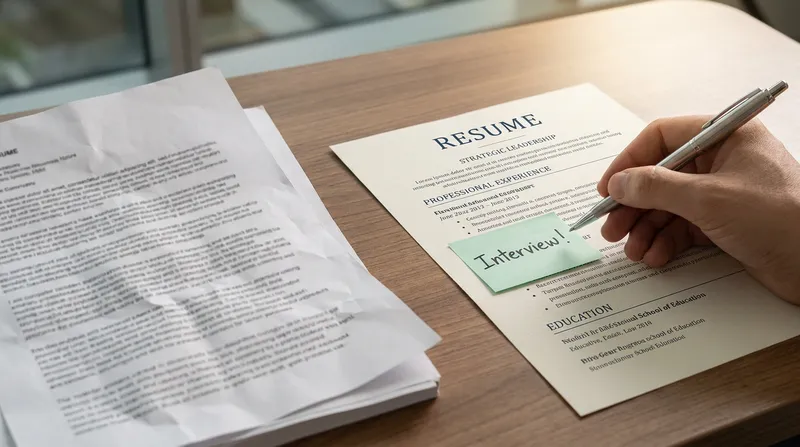
Should you hide your education or experience?
When applying for a lower-level job on purpose, many candidates wonder if they should remove degrees from their resume or change their past job titles.
The short answer is no. Dumbing down your resume for a part-time job or a junior role is a dangerous trap.
First, it creates unexplainable employment gaps. If you delete a three-year stint as a director, you now have a massive hole in your work history that looks far worse than being overqualified.
Second, it sets you up for failure during automated background checks. Modern companies use third-party verification services to check dates, titles, and education. If you omit a master's degree but your employment dates overlap with your time in graduate school, it raises red flags. If you change a "Vice President" title to "Specialist" to look less threatening, the background check will flag a title discrepancy. You will look dishonest, and you will lose the offer.
Instead of deleting your history, you need to manage it. This is why managing 50 resume versions is sabotaging your job search. With JobSparrow's Master Career Profile, you keep a single source of truth for everything you have ever done. When you are ready to apply, you do not delete facts. You simply instruct our AI to change the emphasis, highlighting the hands-on skills the new job requires while downplaying the executive leadership traits that might scare them off.
How to tailor your resume for a lower-level job
Tailoring a resume for a lower position requires a strategic shift in narrative. You must connect the dots for the recruiter so they do not have to guess your intentions.
1. Honest downshifting in the professional summary
The professional summary at the top of your resume is your prime real estate. Do not leave it generic. Use this section to explicitly state why you want this specific role. We call this "honest downshifting."
If you are applying for a junior role when senior, explain your motivation clearly. Are you seeking a return to hands-on technical work? Are you prioritizing work-life balance? Are you pivoting to a new industry where you need to learn the ropes?
Example Summary: "Senior marketing professional with 10 years of experience shifting focus back to hands-on content creation. After successfully leading large teams, I am deliberately seeking an individual contributor role to focus entirely on my passion for copywriting and digital strategy. Committed to bringing high-level strategic thinking to daily execution."
2. Transitioning from management to individual contributor
If you are moving from a management role back to an individual contributor role, hiring managers will worry you will try to boss the team around. You must reframe your leadership experience as a stabilizing asset.
Instead of bullet points that say, "Directed a team of 15 employees," change the focus to mentorship and collaboration: "Mentored junior team members and collaborated across departments to ensure project delivery." This shows you are a team player, not a dictator.
3. Focus on tactical skills, not executive strategy
When dealing with too much experience on a resume, you must adjust the lens. A director of IT might spend their days managing budgets and vendor contracts, but if they are applying for a systems administrator role, the resume needs to highlight their hands-on server maintenance and troubleshooting skills.
JobSparrow's Job-Specific Resume Tailoring feature does this automatically. Our AI analyzes the specific job description and intelligently selects the most relevant, tactical experience from your Master Career Profile. It rewrites your bullet points to match the job requirements perfectly, ensuring you pass the initial screen without triggering the ATS score trap.
Not sure which of your experiences to highlight? JobSparrow's Gap Analysis shows you exactly what the job description requires and what your profile is missing. See your Match Score today. Before you apply, the Match Score shows how well your profile aligns with the specific role, helping you identify whether a position is genuinely a good fit or a stretch that may trigger the overqualified filter.
4. Choose the right resume format
The best resume format for overqualified candidates is a targeted chronological format. Functional resumes (which hide dates) are universally disliked by recruiters and often fail parsing software. Instead, use a clean, modern chronological format but strictly limit your work history to the last 10 to 15 years. JobSparrow provides five ATS-optimized templates that ensure your formatting passes modern parsers, as detailed in our guide on passing semantic AI parsers.
Navigating the overqualified label as a migrant
For migrants relocating to Australia, New Zealand, the UK, or the US, the overqualified label is a common hurdle. Many highly skilled migrants apply for lower-level jobs on purpose to gain local market experience, understand local business culture, and build a localized network.
However, local employers often view this with suspicion. In markets like Australia and New Zealand, "Tall Poppy Syndrome" can make employers hesitant to hire someone whose international credentials dwarf the local team's experience.
The key is to frame your step back as a strategic, humble choice. In your resume and cover letter, emphasize your desire to learn the local landscape. Frame your extensive international experience as a bonus you bring to the table, while making it clear you are eager to adapt to local standards.
JobSparrow's AI can help you adjust your tone to match regional expectations. Learn more about how to navigate these specific cultural nuances in our guide on resume localization for AU/NZ.
How to address being overqualified in your cover letter
Your cover letter is your best tool for providing an overqualified flight risk explanation. A resume tells them what you have done. A cover letter tells them why you are doing it now.
Do not ignore the elephant in the room. Address it head-on in the second paragraph of your letter.
The De-risking Cover Letter Formula:
- Acknowledge the experience: "You will notice from my resume that I have held senior leadership titles in the past."
- State the 'Why': "I am intentionally seeking a role like this one because I want to step away from administrative management and return to the hands-on client work that I truly love."
- Provide the Guarantee: "I am looking for a long-term home where I can contribute my deep industry knowledge while executing the daily tasks required to make this team successful."
Writing a unique cover letter for every single application is mentally draining. If you struggle to find the right words, JobSparrow's Intelligent Cover Letter Generator solves resume blank page syndrome. Our AI generates personalized cover letters specifically written for the target role, weaving your honest motivations into a compelling, professional narrative in seconds.
Nailing the interview: proving you are not a flight risk
Getting the interview is only half the battle. Once you are in the room, the hiring manager will test your commitment. They will ask questions like, "Why do you want this job when you could easily do my job?" or "Where do you see yourself in five years?"
Your answers must project stability, enthusiasm, and humility. You need to practice these answers until they sound completely natural.
JobSparrow's AI Mock Interviews allow you to practice role-specific questions in a safe environment with real-time audio recording. The AI analyzes your delivery tone, ensuring you sound confident rather than arrogant, and enthusiastic rather than desperate. Proper preparation builds the natural confidence you need to ace the real thing. Read more about interview preparation in our guide on how to pass a one-way video interview.
Frequently asked questions
Is it illegal to leave a degree off your resume? While not strictly illegal, omitting a degree or past job titles is considered resume falsification by many employers. If a background check reveals overlapping dates or discrepancies, it destroys trust and can result in a rescinded offer. It is always better to reframe your experience rather than hide it.
How do I explain applying for a lower-level job on purpose? Honesty is the best policy. Frame your decision around lifestyle choices, career pivoting, or a desire to return to hands-on work. Employers respect candidates who know what they want, provided your goals align with staying in the role long-term. Address this directly in your professional summary and cover letter.
Will being overqualified hurt my chances of getting hired? Yes, if left unaddressed. Hiring managers often view highly capable candidates as flight risks, and having too much experience is a leading cause of candidate rejection. However, if you proactively de-risk yourself by explaining your motivations and highlighting your commitment to the role, you can transform your extensive experience from a threat into a massive competitive advantage.
How do I avoid looking like a flight risk to employers? You must explicitly state your long-term intentions. Use your cover letter to explain why this specific role appeals to you right now. Focus your resume bullet points on tactical execution rather than executive strategy, proving you are ready and willing to do the daily work required.
How do I format my resume if I have too much experience? Stick to a standard chronological format, but strictly limit your work history to the last 10 to 15 years. For older roles, group them under a brief "Previous Relevant Experience" section without dates, or simply omit roles that are decades old and no longer relevant to your current target. Never use a functional resume to hide dates.
Stop dumbing down your career. Start positioning it.
You worked hard for your experience. You should never have to hide it to get a job. The key to landing a role when you are overqualified is not subtraction. It is translation. You must translate your senior experience into language that proves you are the safest, most reliable candidate on the market.
Ready to stop being filtered out? Start with a free CV diagnosis to get your recruiter-lens score and see the exact gaps costing you interviews in minutes. Then unlock the full Offer Path with the Land the Job membership, cancel anytime.
Take control of your narrative today. Let JobSparrow coach you all the way to the offer.
Tags
Keep reading
Recommended articles.
career advice · resume tips
How to Explain Taking a Step Back in Your Career
Applying for a lower-level job? Learn how to explain a career step back in an interview, format your resume for a hands-on role, and control your narrative.
resume tips · layoff
Resume After Layoff: How to Explain Redundancy (Without Looking Like a Hiring Risk)
Learn how to write a resume after layoff and explain redundancy confidently. Get ATS-friendly examples and proven tips to handle employment gaps.
personal ats · job application tracker
Beyond Spreadsheets: How to Build a Personal ATS (Job Application Tracker)
Ditch your job search spreadsheet. Build a personal ATS to track applications, manage tailored resume versions, and land more interviews with less burnout.