
resume writing
The Ultimate 2026 Guide to Your Internal Promotion Resume (AU/NZ): From CV to C-Suite
By Job Sparrow Team
You are a known quantity in your company. Your boss trusts you, your colleagues respect you, and your performance reviews are solid. So why does the thought of writing a resume for an internal promotion fill you with a unique sense of dread?
Perhaps it's the frustration of watching external candidates, who don't know the systems or the stakeholders, get interviews for roles you could do in your sleep. You know the unwritten rules and the real priorities, yet your application risks feeling invisible. This is the 'Curse of Knowledge', the core challenge every internal applicant faces.
You wrongly assume the hiring manager and HR already know the full context and impact of your work. You hesitate to spell out your achievements, worried you'll sound arrogant or that you're stating the obvious. The result is often a generic, underwhelming document that fails to make a compelling case for your advancement.
An internal application is not a formality; it is a formal argument for why you are the best and safest choice for the new role. This guide will teach you how to overcome the Curse of Knowledge and leverage your unique 'Insider Advantage'. We will walk you through, step-by-step, how to transform your existing CV into a powerful tool for any internal move in Australia or New Zealand, from a simple promotion to a strategic leap towards the C-suite.
The Insider's Dilemma: Why an Internal Resume is Radically Different
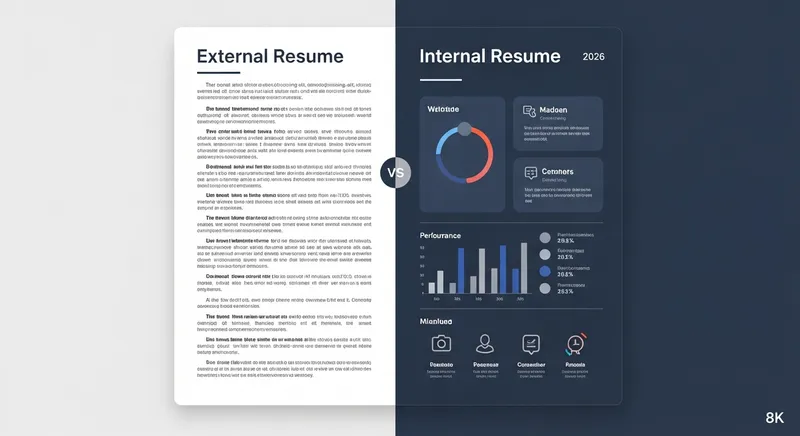
An external resume is a broad introduction. An internal resume is a targeted closing argument. You are not just another applicant; you are a known investment with a proven track record. However, as recruitment experts at Robert Half point out, this means you are often held to a higher standard. You are expected to have a deeper understanding of the company's goals and challenges. Moreover, as internal HR tech in 2026 increasingly uses AI to scan for talent within the company, keyword optimization and data-driven achievements are just as crucial for internal moves as they are for external ones.
The entire focus of your document must shift from introducing your skills to proving your future value based on your past performance within the company culture. You have a powerful 'insider advantage': the ability to use internal language, project codenames, and specific KPIs that no external candidate can match.
Here's how the focus shifts:
| Aspect | External Resume Focus | Internal Resume Focus |
|---|---|---|
| Audience | Someone who knows nothing about you or your work. | A hiring manager who knows you, but not the full impact of your work. |
| Goal | Get a first interview; prove you meet the basic criteria. | Secure the promotion; prove you are the best and lowest-risk choice. |
| Language | General industry terms and keywords. | Company-specific acronyms, project names, and internal metrics. |
| Achievements | Broadly showcase impact on a previous company. | Directly link your past achievements to the future goals of the new role. |
| Tone | Formal introduction. | Confident, evidence-based argument. |
Structuring Your Internal Promotion Resume: An AU/NZ Framework
While the core principles are universal, the presentation can differ slightly between Australia and New Zealand. The key is to present a professional, easy-to-read document that respects the hiring manager's time. A reverse-chronological format is almost always the best choice.
Key Sections for an Internal Promotion Resume:
- Contact Information: Name, phone, email, and a link to your updated LinkedIn profile.
- Promotion Profile / Summary: A 3-4 line introductory pitch tailored to the new role.
- Key Achievements: A bulleted list of your most impactful, quantifiable results relevant to the promotion.
- Professional Experience (at This Company): Detail your roles, focusing on growth and accomplishments.
- Previous Experience (if relevant): Briefly summarize earlier career history.
- Education & Professional Development: Include degrees and any internal training courses.
For a detailed breakdown of local formatting, our Australian Resume Format 2026 Guide is an excellent resource. As leading Australian job board SEEK advises, resumes in Australia can be longer than two pages if the experience adds significant value, which is often the case for long-serving internal candidates.
From Doer to Leader: Crafting a Powerful Promotion Summary
Your summary is the first thing the hiring manager reads. It must immediately re-frame you from your current role to the one you want. Avoid simply describing what you do now; instead, state what you offer for the future.
Before (Typical Summary):
Dedicated Marketing Coordinator with 5 years of experience at [Company Name], skilled in campaign execution, social media management, and content creation. Seeking to leverage my skills in a more senior role.
This is passive and focused on past duties. It doesn't scream 'manager material'.
After (Promotion-Focused Summary):
Results-driven marketing professional with a 5-year track record of driving 15%+ YoY lead growth at [Company Name]. Seeking to apply my deep understanding of our brand and market to a Marketing Manager role, leading the team to exceed our H2 targets for Project Phoenix.
This is active, quantified, and forward-looking. It uses an internal project name ('Project Phoenix') to demonstrate insider knowledge and aligns personal ambition with company goals.
The Art of Quantifying Your 'Insider' Achievements
This is where you truly leverage your insider advantage. Go beyond generic metrics and dig into company-specific data that only you would know. Frame your accomplishments using the Problem-Action-Result (PAR) formula where possible, and always aim to transform vague duties into specific, metric-driven outcomes.
Here are some real-world examples of this transformation:
Example 1: Social Media Management
- Before: Responsible for managing social media accounts.
- After: Grew our primary Instagram channel from 10k to 25k followers in 12 months with zero ad spend, increasing organic engagement by 45% and driving 500+ qualified leads for the 'Project Elevate' launch.
Example 2: Event Organisation
- Before: Helped organize the annual conference.
- After: Co-led logistics for 'Innovate 2025,' managing a $50k budget and coordinating 30+ vendors. Achieved a 9.2/10 attendee satisfaction score, a 15% increase from the previous year.
Example 3: Process Improvement
- Before: Improved team efficiency.
- After: Initiated and led the transition from Jira to a new Asana workflow, creating standardized templates that eliminated deadline slippage for two consecutive quarters and reduced average time-to-launch by 25%.
Struggling to remember these details? It's a common problem. JobSparrow's Master Career Profile lets you store every project and metric in one place. Then, use the Gap Filler feature, which asks targeted questions to uncover the exact numbers and impact you might have forgotten, transforming vague duties into powerful, quantified achievements.
From Team Member to Manager: Proving Your Leadership Readiness
Moving from contributor to manager is one of the hardest jumps to articulate on a resume. You need to prove you can lead, not just do. Scour your experience for examples of informal leadership.
Instead of this:
- "Collaborated with junior team members on projects."
Reframe it to show leadership:
- "Mentored two junior marketing coordinators, providing onboarding support and ongoing guidance that contributed to a 10% improvement in their campaign performance metrics."
- "Acted as project lead for the Q4 Website Redevelopment, coordinating a cross-functional team of 5 to deliver the project on time and 8% under budget."
This is especially crucial for technical experts moving into leadership. You must show you can multiply your impact through others.
Before (Technical IC):
- Senior developer on the payments team.
After (Emerging Leader):
- Served as the technical lead for the 'One-Click Checkout' feature, mentoring 3 mid-level engineers in React best practices and conducting code reviews that reduced production bugs by 22%. The feature processed $1.2M in its first quarter.
If you're targeting a management role, like a Project Manager, your resume needs to reflect this shift from execution to oversight. Our guide on crafting a Project Manager Resume for Australia & NZ can provide more specific examples.
Beyond Vertical Promotions: Secondments & Lateral Moves
Not all career progression is upwards. Secondments and lateral moves are powerful tools for building new skills and expanding your internal network, but your resume needs a different strategic approach.
The Australian Public Service Commission provides excellent formal definitions, highlighting the formal nature of these moves and the need for a strong business case.
How to frame your resume for a secondment or lateral move:
- Objective: Clearly state your goal, e.g., "Seeking a 12-month secondment to the Data Analytics team to apply my project management skills to a data-driven environment and develop expertise in Power BI."
- Focus on Transferable Skills: If you're a Project Manager moving to a Product team, highlight your skills in stakeholder management, budget tracking, and roadmap delivery, not just the specifics of your past projects. You may need to upskill to land these roles, focusing on Australia's future job market skills.
- Show Your Research: Mention a specific project or challenge in the target department that you're excited to contribute to. This shows genuine interest and initiative.
Don't Forget the Cover Letter: Your Narrative Partner
Your resume provides the evidence. Your cover letter tells the story. For an internal role, a cover letter is not optional; it's your primary tool for connecting the dots and explaining the 'why' behind your application. It's where you can add the context and personality that a formal resume lacks.
Use it to:
- Express genuine passion for the new role and department.
- Explain why you want this move and how it fits your long-term career goals within the company.
- Address any potential concerns head-on (e.g., a non-traditional career path).
For a complete walkthrough, see our dedicated guide on How to Write a Cover Letter for an Internal Promotion. JobSparrow's Intelligent Cover Letter Generator can create a tailored first draft in seconds, weaving your specific experiences into a compelling narrative that complements your new resume.
Common Mistakes to Avoid on Your Internal Application
Internal candidates often make unique mistakes born from over-familiarity. Avoid these common pitfalls.
- Being Too Casual: This is a formal application. Maintain a professional tone in your resume and all communications. Consequence: It signals you aren't taking the process seriously. For example, writing 'As you know, I fixed the reporting dashboard' is weak. Better: 'Overhauled the executive sales dashboard in Tableau, reducing data load time by 80% and adding three new KPIs now used in all weekly leadership meetings.'
- Relying on Your Reputation: Don't assume the hiring manager knows or remembers the details of your work. Your reputation gets you considered; your resume gets you the interview. Consequence: The hiring manager, comparing your vague resume to a detailed external one, may wrongly conclude the external candidate has more quantifiable impact.
- Submitting a Generic Resume: You must tailor your resume to the new role's requirements, not your current one's. Consequence: It shows a lack of effort and a poor understanding of what the new role requires, making you seem less suitable than a candidate who has clearly done their homework.
- Ignoring Internal Politics: As a personal account on Medium highlights, navigating when and how to tell your current manager is crucial and depends heavily on your workplace culture. Be strategic. Consequence: Telling the wrong person at the wrong time could jeopardize your application or damage your relationship with your current team.
Navigating the Salary Conversation
This is a common concern: how do you negotiate when they know your current salary? The key is to shift the focus from your current role to the value and responsibilities of the new role. Research the market rate for the new position. In your conversations, frame your request around the industry benchmark for that role's responsibilities, not as an increment on your current pay. Highlight the new leadership, budget, or revenue responsibilities you will be taking on. This frames the discussion about the value of the job, not just your personal salary history.
"Using JobSparrow helped reframe my internal achievements — I went from feeling undervalued to confidently negotiating a senior role with a meaningful pay increase because I could finally prove my impact with hard data."
Your Internal Promotion Resume Checklist
Before you hit submit, run through this final checklist:
- Reframe: Does my summary position me for the future role, not my current one?
- Quantify: Have I replaced vague duties with specific, metric-driven achievements?
- Insider Language: Have I used internal project names and KPIs to show my unique knowledge?
- Prove Leadership: Have I included examples of mentoring, project leadership, or cross-functional coordination?
- Tailor: Is every bullet point relevant to the new job description?
- Partner Up: Have I written a compelling cover letter to tell the story behind the data?
Streamline Your Internal Application with JobSparrow
Crafting the perfect internal resume is a strategic exercise, and JobSparrow is designed to be your personal AI career assistant through the entire process.
- Build Your Foundation: Start with your Master Career Profile. Import your existing resume and let our AI help you enhance it. Use the Gap Filler to ensure you've captured every quantifiable achievement from your time at the company.
- Tailor with Precision: Paste the internal job description into our Job-Specific Resume Tailoring tool. Our AI will analyze the requirements and intelligently select the most relevant achievements from your Master Profile, rewriting bullet points to match the new role's keywords.
- Prepare to Win the Interview: Internal candidates are held to a higher standard. Use our AI Mock Interviews, tailored to the specific role, to practice your answers and build the confidence to prove you're ready for the next step.
Ready to build a resume that proves your worth? Tailor Your First CV in 60 Seconds with JobSparrow.
Frequently Asked Questions
Do I really need a resume for an internal promotion in Australia?
Yes, absolutely. Even if the process feels informal, providing a professional resume is non-negotiable. It shows you are taking the opportunity seriously, provides HR with a formal document for compliance, and forces you to articulate your value clearly.
How is a CV for an internal job in NZ different from a standard CV?
The core format is similar, but the content strategy is different. A standard CV introduces your skills to strangers. An internal CV for a New Zealand company must prove your deep understanding of the company's unique culture, values, and strategic goals. It should be less about what you've done and more about how your accomplishments have directly contributed to the company's success.
Should I tell my current manager I am applying for another role in the company?
This is highly dependent on your relationship and workplace culture. If you have a supportive manager who is invested in your growth, telling them can be a huge advantage as they can become your advocate. However, if your relationship is strained or the culture is competitive, it may be wiser to wait until you have secured an interview. Use your insider knowledge to make this judgement call.
How do I write a resume for a secondment or lateral move in Australia?
Your resume's focus shifts from 'promotion' to 'skill acquisition and contribution'. Your professional summary should clearly state your objective, mentioning the specific skills you want to develop and how your current skills can benefit the new team. Emphasize transferable skills like project management and stakeholder communication over role-specific duties.
What's the best resume format for an internal application in Australia or NZ?
A clean, professional, reverse-chronological format is the gold standard. Key elements should be easy to find: a tailored professional summary at the top, followed by a 'Key Achievements' section, and then your detailed work history with the company. Prioritize readability and quantifiable results over flashy design.
Tags
Keep reading
Recommended articles.
resume summary · career change
Career Change Resume Summary: 10+ AU/NZ Examples & Guide
Craft a winning career change resume summary for the AU/NZ market. Get 10+ examples and a step-by-step formula to land your dream role.
career change · mature workers
Career Change at 40 & 50 in Australia & NZ: The 2026 Guide to Your Second Act
Career change at 40-50 in AU/NZ? Get an actionable 2026 guide: financial planning, ageism strategies, and AI tools for your second act. Start now.
resume summary · resume writing
How to Write a Powerful Resume Summary in Australia & NZ (2026 Guide + Examples for Career Changers, Graduates & Migrants)
Write resume summaries that pass the 10-second recruiter test. 2026 guide with examples for career changers, grads & migrants in AU/NZ.