
cover letter alternatives
What to Send Instead of a Cover Letter in 2026: 7 Free Digital Pitches That Win Interviews
By Job Sparrow Team
If you are searching for what to send instead of a cover letter in 2026, you are likely tired of a broken routine. You spend an hour agonizing over three formal paragraphs, or you pay a monthly subscription just to export another generic PDF. Then you submit your application into an online portal and hear nothing back.
From sitting on both sides of the hiring table, having reviewed more than 100,000 resumes and hired across four markets (Australia/New Zealand, the United States, Singapore, and Hong Kong), we see the same pattern every week. Hiring managers are overwhelmed by identical, AI-generated cover letters they skim in seconds or discard because they sound robotic. Yet leaving the cover letter blank creates a harsh second problem: career changers, recent graduates, and international migrants lose their only chance to prove capability beyond a rigid chronological resume (often called a CV in the UK, Australia, and New Zealand).
The solution is not writing a better traditional letter or paying for another template builder. The solution is switching from prose to proof.
Before you build any pitch, make sure your foundation is solid by running a free CV diagnosis on JobSparrow so you know how a recruiter reads your resume in the first ten seconds. Once your resume is sharp, the seven free digital pitches below will show you how to prove your value quickly using everyday web tools.
Do you still need a cover letter in 2026? Why traditional prose fails
Traditional cover letters have lost their signaling power because polished prose is now effortless to generate in bulk. Hiring teams no longer equate smooth paragraphs with genuine motivation or communication skill.
Academic labor research confirms what recruiters experience daily. A peer-reviewed field experiment forthcoming in the Journal of Labor Economics tested how large language models affect cover letter screening and found that AI tools improve surface writing polish mostly in standardized, low-influence sections without increasing interview invitations. When recruiters learned that AI had been used, they placed more value on high-quality, human-written letters.
A separate economics study, Signaling in the Age of AI: Evidence from Cover Letters, measured this shift directly on a major online hiring platform. After an AI cover letter generator launched, the correlation between cover-letter tailoring and receiving an employer callback fell by 51%. Employers responded by leaning heavily on harder-to-fake signals such as past work output and verifiable results.
At the same time, employer expectations have moved decisively toward skills-first hiring. According to the National Association of Colleges and Employers (NACE) Job Outlook 2026, 70% of surveyed employers now use skills-based hiring (up from 65% the prior year), while screening candidates by GPA dropped from 73% in 2019 to just 42%. Employers explicitly advise candidates to demonstrate skills through concrete examples of solving real problems.
This is why trying to bypass AI cover letter detectors with clever rewording prompts is a losing game. Even if your prose passes an automated check, a seasoned hiring manager still sees the familiar wall of generic adjectives. Switching to a visual, interactive, or problem-solving pitch makes automated text scrutiny irrelevant because a chatbot cannot record your voice walking through a real workflow or build a targeted project breakdown. The practical question, then, is how to match the right format to each application without wasting your week.
Cover letter vs. direct pitch to a recruiter: when to send each
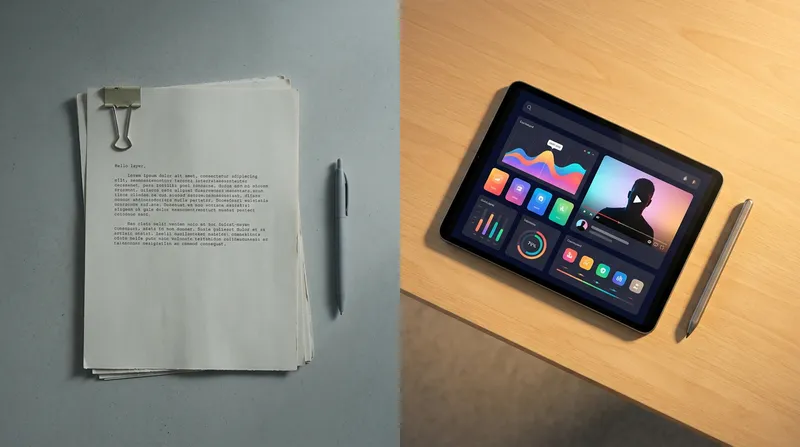
Moving from prose to proof does not mean you should abandon traditional letters in every situation. Knowing when to send a brief formal letter, when to attach a digital pitch inside a portal, and when to pitch a hiring manager directly saves hours every week. Most career guides offer a false choice between writing a full letter or skipping it entirely. In reality, you have three distinct options.
| Approach | Primary goal | Best use case | Main risk |
|---|---|---|---|
| Traditional cover letter | Satisfy formal compliance | Government, legal, academia, explicit requirements | Sounds indistinguishable from AI templates |
| Portal digital pitch (linked via PDF) | Prove competence inside an ATS workflow | Competitive corporate roles, career pivots, migrant applications | Broken links behind strict firewalls if no preview is included |
| Direct pitch to hiring manager | Bypass crowded applicant pools early | Startups, mid-sized firms, referrals, niche specialist roles | Feels pushy if unfocused or overly long |
Use this quick decision rule before applying:
- Send a concise traditional letter only when the job posting explicitly requires one (common in public-sector, legal, or university roles), and keep it under 200 words with a bonus link to your proof of work.
- Send a portal digital pitch when the application form includes an optional cover letter or "additional documents" slot and you are applying to a medium or large company using an Applicant Tracking System (ATS).
- Pitch the hiring manager directly via email or LinkedIn within 24 hours of submitting your online application, especially if the listing already has 100+ applicants or your background does not match a conventional title.
Before reaching out directly, verify that your online application parsed cleanly so HR can locate your file effortlessly. If you are applying through enterprise portals, review our guide on how to fix Workday resume autofill errors before sending any follow-up note.
7 free digital pitches to send instead of a cover letter
You do not need paid software or a hidden free-trial subscription to create modern alternatives to traditional cover letters. Every format below relies on 100% free web-based tools to pitch employers, requires between 15 and 45 minutes to assemble, and gives busy decision-makers fast, unmistakable proof that you can do the job.
1. The 90-second video walkthrough or micro-audit
- Free tool: Loom (free plan) or your browser's built-in screen recorder.
- Build time: 20 minutes.
- Best for: Sales, customer success, product management, marketing, UX design, and client-facing roles.
Most video cover letter alternatives fail because applicants stare into a webcam and recite their resume verbatim. Hiring managers do not want a spoken biography. They want to see how you think and communicate on a live screen.
Record a crisp 60 to 90 second screen-share with a small camera bubble in the corner (or voiceover only if you prefer). Follow this exact three-beat structure:
- Seconds 0 to 15 (The hook): Open the company's public website, app, or job listing on screen. Name one specific goal the role supports.
- Seconds 15 to 65 (The proof): Switch tabs to a sanitized past project, dashboard, or workflow you built that mirrors their challenge, or walk through one thoughtful improvement you spotted on their public user journey.
- Seconds 65 to 90 (The close): Summarize how you would bring that same discipline to their team and thank them for watching. Stop recording immediately.
Keep the tone calm and conversational. A single natural pause proves you are a real human who genuinely researched the role, instantly separating you from hundreds of silent PDF applicants.
2. The one-page candidate value proposition memo
- Free tool: Google Docs (exported as a clean PDF).
- Build time: 15 minutes.
- Best for: Operations, finance, consulting, project management, administration, and rapid applications.
If you want the fastest way to stand out in job applications without a cover letter, replace "Dear Hiring Manager" prose with an executive-style candidate value proposition memo. Hiring managers read internal memos all day, so this format feels instantly familiar and senior.
Structure a single clean page with four simple elements:
- Memo header: Include
To:(Hiring Manager or Team Name),From:(Your Name and Contact),Date:, andSubject: How I can accelerate [Specific Role Goal]. - Two-sentence thesis: State your core value proposition plainly, tying your track record directly to their top priority.
- Three matched proof blocks: Pull the top three problems implied in the job ad. Underneath each problem, write one bold metric-backed result from your past using structured impact framing (our guide on STAR method rubrics shows how to quantify these bullets cleanly).
- One-line availability note: Confirm your location, work rights (especially helpful for international applicants), and readiness for a brief call.
Because every sentence maps directly to a hiring pain point, recruiters can verify your fit at a glance instead of hunting through dense paragraphs.
3. The 30-60-90 day job application pitch
- Free tool: Google Slides or Canva Free (exported as a three-slide PDF).
- Build time: 35 minutes.
- Best for: Mid-to-senior individual contributors, team leads, revenue roles, and career changers proving day-one readiness.
A 30-60-90 day plan job application pitch shifts the psychological dynamic of your application. Instead of asking for a chance, you show the hiring manager what working with you actually looks like during probation.
Keep the pitch strictly to three slides (one slide per 30-day block) plus a minimal title bar:
- Days 1 to 30 (Learn and diagnose): List the internal stakeholders you would interview, the data or processes you would audit, and the baseline metrics you would establish.
- Days 31 to 60 (Deliver early wins): Outline two realistic, low-risk improvements you would ship to relieve immediate team bottlenecks.
- Days 61 to 90 (Scale and measure): Define the repeatable playbook, workflow, or revenue target you would build by the end of quarter one.
Always include a one-line disclaimer at the top: "Draft working hypothesis based on public information, ready to adapt to internal priorities." That single sentence demonstrates strategic humility and prevents your plan from sounding presumptuous.
4. The role-specific interactive candidate portfolio hub
- Free tool: Notion (free personal tier published to the web) or Carrd Free.
- Build time: 45 minutes once, then 10 minutes to duplicate and customize per role.
- Best for: Product, engineering, design, content, analytics, marketing, and career changers.
An interactive candidate portfolio built for free turns your track record into a clean, skimmable web page tailored specifically to one employer. Official government workforce guidance backs this approach. Australia's national career framework at Your Career highlights career portfolios as essential tools for demonstrating transferable competencies across changing industries.
Build one master Notion template and duplicate it for top applications with four clean blocks:
- Custom banner header: "Built for [Company Name]: Why I am excited about the [Job Title] role."
- Three expandable proof cards: Each card opens a brief case summary with context, your exact contribution, screenshots or artifacts, and the measurable result.
- Short credibility strip: Two brief quotes from former managers, colleagues, or clients (borrowed from your LinkedIn recommendations).
- Direct links bar: One-click buttons to download your tailored resume PDF, view your LinkedIn, or book an intro call.
Cloning your hub for a new employer takes minutes, yet it feels like a bespoke experience that almost no competing candidate takes the time to create.
5. The mini teardown or sample deliverable
- Free tool: Google Sheets, Figma Free, GitHub, or Canva Free.
- Build time: 45 minutes (strict cap).
- Best for: Data analysts, software developers, growth marketers, copywriters, recruiters, and operations specialists.
Nothing eliminates hiring risk faster than letting an employer inspect your actual craft before the first interview. A mini teardown takes one publicly visible piece of the employer's business and demonstrates how you solve problems.
Keep the scope tight so you never give away free full-scale consulting:
- Marketing or copywriting: Rewrite one underperforming landing page hero section or three onboarding emails, annotated with brief conversion rationale.
- Data or operations: Build a small mock KPI dashboard in Google Sheets using anonymized sample data that mirrors the company's business model.
- Software or QA: Submit a concise GitHub repository or three-bullet usability audit highlighting one accessibility or performance quick win on their public web app.
Frame every suggestion constructively. Start by naming two things the team already does well before sharing your ideas. Criticism without appreciation triggers defensiveness, while thoughtful optimization signals high-trust ownership.
6. The impact-proof direct email or LinkedIn pitch
- Free tool: Gmail, Outlook, or LinkedIn free messaging.
- Build time: 15 minutes.
- Best for: Reaching hiring managers directly at startups, agencies, and fast-moving teams before shortlists close.
Many candidates assume a formal attached document is always mandatory. In fact, official guidance from the UK National Careers Service confirms that online applications can deliver your introductory pitch directly inside an email body rather than as a formal printed letter, as long as your message stays factual and aligned with the role.
Find the likely hiring manager (the Head of Department or Team Lead, not just a general careers inbox) and send a crisp note under 110 words:
Subject: [Job Title] application + quick idea on [Specific Priority]
Hi [First Name],
I just submitted my application for the [Job Title] role. I noticed your team is focused on [specific initiative from the job ad or recent company news].
In my last role at [Company], I solved a similar bottleneck by [specific action], which delivered [concrete metric]. I put together a quick [two-minute Loom / three-slide plan] showing how I would approach that in month one: [Clean Link].
Either way, wishing your team a smooth hiring process.
Best, [Your Name]
Notice what this pitch leaves out: no apologies for messaging, no vague claims about being a "passionate self-starter," and no pressure to reply immediately.
7. The three-slide proof-of-work case study deck
- Free tool: Google Slides or Pitch Free (exported as a lightweight PDF).
- Build time: 30 minutes.
- Best for: Graduates turning coursework into commercial proof, migrants whose overseas employers are unfamiliar locally, and career changers.
When a recruiter does not recognize the university, small business, or overseas company on your resume, they mentally discount the achievement because they lack context. A three-slide case study deck bridges that trust gap immediately.
- Slide 1 (The stakes): Define the real-world size and complexity of the problem (team size, customer volume, budget, or regulatory constraints).
- Slide 2 (Your exact methodology): Show the tools, frameworks, or steps you personally owned so the reviewer sees your hands-on rigor.
- Slide 3 (Verified outcome and transferability): Present the measurable before-and-after result and write two lines explaining how that exact playbook maps to the open role.
If you are early in your career and turning university or personal projects into commercial proof, pair this slide deck with the formatting tips in our student resume and academic project guide.
How to submit a digital pitch inside a strict ATS portal
One practical obstacle stops many job seekers from using non-traditional cover letter formats: online job portals rarely offer a field for a Loom link or Notion hub. Instead, they show a mandatory "Upload Cover Letter" file box that accepts only PDF or DOCX attachments.
Use the ATS Portal Bridge method so your creative pitch passes both automated screening and human review without breaking the portal.
- Open a blank one-page document in Google Docs or Microsoft Word.
- Add a crisp header matching your resume (your name, target role, location, email, and LinkedIn).
- Write a three-bullet executive summary mirroring the top keywords from the job description. Some ATS platforms also index text in uploaded cover letter files, so these three bullets can help keep your application searchable.
- Insert a prominent clickable callout box in the center of the page: "Instead of a generic three-paragraph letter, I built a 90-second walkthrough / interactive brief tailored to [Company Name]. View it here: [Clickable Link]." Include the clean visible URL right beneath the button in case the recruiter prints the document.
- Add a two-line preview summarizing the single biggest insight inside your link so the recruiter has an immediate reason to click.
- Export as a text-selectable PDF under 2 MB with a clean filename such as
Maya_Patel_Product_Operations_Pitch.pdfand upload it to the cover letter slot.
Track every portal submission alongside your direct outreach follow-ups so you never lose momentum or double-message the same manager. You can organize both tracks in one place using our free Excel job application tracker template or inside JobSparrow's application dashboard.
Career changers and migrants: how to pitch across the US, UK, Australia, and New Zealand
Standard resume screening penalizes anyone with a non-linear path. Yet macro labor trends are moving in your favor. The World Economic Forum Future of Jobs Report 2025, surveying over 1,000 global employers across 55 economies, projects that 39% of core job skills will change by 2030, with 63% of employers citing skills gaps as their biggest barrier to business transformation and 70% planning to hire staff with new skills. Employers need adaptable problem-solvers, provided you show proof instead of making them guess.
How to apply for a job without a cover letter during a career change
Career changers often sabotage traditional cover letters by opening with an apology ("Although I do not have direct experience in tech..."). A digital pitch removes the need to justify your past titles because it puts your target-industry capability front and center.
Pick either the 30-60-90 day pitch or the mini teardown as your lead asset. Translate every past metric into the vocabulary of your target industry (for example, turning retail store management into operations capacity planning, or classroom teaching into customer onboarding and enablement). For concrete before-and-after examples of rewriting your underlying resume bullets for a pivot, see our career change resume guide with sample bullets.
Translating overseas experience and calibrating regional tone
Skilled migrants entering the United States, United Kingdom, Australia, or New Zealand face a specific hurdle: local recruiters often skip applications when they do not recognize overseas brand names, local regulations, or visa statuses. A concise three-slide case study deck or candidate value proposition memo solves this by framing your overseas company's scale in familiar terms (revenue tier, customer count, or comparable local industry peers) and stating your local work rights cleanly in one line. If you are navigating the Australian or New Zealand markets specifically, read our guide on translating overseas experience for Australian and NZ resumes.
Just as important, calibrate the tone of your digital pitch to local workplace culture:
- United States: Direct, outcome-driven, and bold ROI framing works well. Sending a brief cold email or LinkedIn Loom pitch directly to a hiring manager is widely seen as initiative.
- United Kingdom: Keep pitches structured, understated, and evidence-led. As reflected in the Chartered Institute of Personnel and Development (CIPD) recruitment factsheet, UK hiring teams favor structured, evidence-based selection over hype. Position your pitch as a concise working brief rather than a loud sales deck.
- Australia and New Zealand: Aim for grounded, practical, collaborative language with zero self-aggrandizing buzzwords (overly aggressive self-promotion can trigger Tall Poppy Syndrome). Guidance from Careers.govt.nz also notes that Kiwi employers still value concise personal context showing genuine local fit and motivation. Frame a 30-60-90 day plan or micro-audit humbly as "initial observations to discuss" rather than telling an existing team what they are doing wrong.
Next steps: pair your digital pitch with a recruiter-ready resume
A memorable digital pitch earns a hiring manager's attention, and the very next thing they inspect is your resume. If your resume buries your strongest outcomes, misses critical role requirements, or undersells your seniority, even the sharpest 90-second video cannot save the shortlist decision.
That is why JobSparrow is built as an AI career advisor across the entire Offer Path (Diagnose, Position, Execute, Prepare, and Close), rather than a generic template generator:
- Diagnose first: Upload your current resume for a free CV diagnosis to see your recruiter-lens score out of 100 and the specific gaps costing you interviews right now.
- Uncover proof for your pitches: Build your centralized Career Profile and use guided gap analysis and profile enhancement to surface hidden metrics and impact stories you can repurpose across your memos, decks, and portfolios.
- Execute and prepare with confidence: Generate ATS-clean tailored resumes (and concise cover letters whenever an employer strictly requires one), then prepare for role-specific interview questions with AI mock interviews.
Ready to stop sending applications into the void? Start with a free CV diagnosis today. When you are ready for unlimited tailored resumes, cover letters, and mock interviews, try the full Offer Path for 7 days for US$5.99, then US$45 a month (with local pricing available in the UK, Australia, and New Zealand). Cancel anytime.
Frequently asked questions
Do hiring managers actually run AI detectors on job applications in 2026?
Rather than relying on automated scanning tools alone, hiring teams routinely lean on rapid human pattern recognition: spotting generic openings, overused buzzwords, and vague, company-agnostic praise with zero specific detail. Even if an application never passes through a detector, boilerplate prose rarely earns an interview. Switching to a concrete work sample, memo, or short walkthrough removes skepticism immediately instead of relying on fragile wording tweaks.
Will sending a link or creative pitch instead of a cover letter hurt my ATS score?
No, provided your primary resume stays a clean, text-selectable document and you never hide core role keywords exclusively inside an external link or video. Applicant Tracking Systems primarily parse and index your uploaded resume rather than optional attachments or live web links. Treat your tailored resume as the searchable ATS foundation and your digital pitch as the human proof layer that converts a quick review into an interview.
Can a company firewall block my Notion or Loom link?
Yes. Highly regulated employers in banking, healthcare, defense, and government frequently block third-party web apps or streaming video domains on staff computers. When applying to enterprise or public-sector organizations, always export your Notion portfolio, memo, or slide deck as a clean standalone PDF (under 2 MB) rather than relying solely on an external URL. That way the recruiter can read your full pitch offline even if clickable links are disabled.
Is it rude to message a hiring manager directly on LinkedIn after applying?
Direct outreach feels intrusive only when candidates demand status updates, send walls of text, or chase the same person across multiple channels. Sending one polite message under 110 words within 24 hours of applying, linking a relevant work sample with zero pressure to reply, is accepted professional etiquette across the US, UK, Australia, and New Zealand. If you hear nothing after seven business days, send at most one brief polite follow-up and move on.
Should I show my face on a video pitch in the US, UK, Australia, or New Zealand?
Hiring teams in all four markets strongly avoid photos on resumes to reduce unconscious bias, so you should never place a headshot on your resume or PDF value memo. An optional video link is different because the employer chooses whether to press play. Still, if you are applying to a company with a blind-recruitment policy or simply feel more confident off camera, record a clean screen-only walkthrough with crisp audio voiceover instead of turning your webcam on.
What if a job ad explicitly says a cover letter is required?
Always follow explicit application instructions, because ignoring a mandatory requirement signals weak attention to detail. Write a sharp, 150 to 200 word cover letter that hits the top three criteria cleanly, then place a single optional link to your interactive portfolio or three-slide case study directly below your sign-off. You stay compliant while still delivering proof that stands out.
How many custom digital pitches should I create per week without burning out?
Apply an 80/20 rule to protect your energy. Reserve bespoke 30 to 45 minute pitches (such as video micro-audits, teardowns, or 30-60-90 day plans) for your top three to five high-priority roles each week. For secondary applications, rely on a modular one-page candidate value proposition memo or a cloneable Notion template that takes under 15 minutes to tailor.
Tags
Keep reading
Recommended articles.
job search strategy · resume optimization
Why Your Job Application Tracking Spreadsheet is Hiding Your Skill Gaps (And What to Use Instead)
Discover how an AI job tracker reveals hidden skill gaps before you apply, helping you land more interviews than any Google Sheets template ever could.
ai resume builder · career change
AI Resume Strategies: Raw Prompting vs. Smart Resume Builders for Your 2026 Career Move
Compare raw AI prompting vs. smart resume builders for 2026. JobSparrow tailors your CV to beat ATS and land interviews. Start your free diagnosis today.
job tracker · ai resume builder
Stop Manual Data Entry: Why the Best Job Tracker Apps Now Use AI Skill Matching
Stop manual data entry. Discover how the best job tracker app uses AI skill matching to optimize applications, beat the ATS, and land more interviews.