
internships
The Ultimate Internship Application Tracker: Best Apps & Spreadsheets for Graduates in 2026
By Job Sparrow Team

You have sent out 50 applications this month. Radio silence. If that sounds familiar, you are not alone. The job search process can be emotionally exhausting, especially for international students navigating visa uncertainty. The problem is not necessarily your experience, but rather your organization. Students, graduates, and migrants often apply to hundreds of roles simultaneously, only to lose track of strict cohort deadlines, online assessment due dates, and visa sponsorship requirements. Standard job trackers completely ignore these critical elements, leaving you scrambling when a recruiter finally calls.
Research from the National Association of Colleges and Employers highlights the highly competitive nature of the entry-level market, noting that slightly less than 55 percent of Class of 2024 bachelor's degree graduates reported full-time employment within six months of graduation, down from more than 57 percent the year before. To be part of that successful group, you need more than a basic list of companies. You need a comprehensive system that tracks your entire pipeline from diagnosis to offer.
At JobSparrow, our team has reviewed over 100,000 resumes and hired candidates across Australia, New Zealand, the United States, Singapore, and Hong Kong. We have seen firsthand how disorganized candidates miss out on top-tier graduate campaigns simply because they missed an online assessment deadline or failed to follow up.
In this guide, we will break down the best job tracker apps and spreadsheets for 2026, show you how to build a hybrid tracking system, and explain why your tracker must integrate with your resume builder to actually win you interviews.
What is a job application tracker (and why do you need one?)
A job application tracking system is your personal command center for the job hunt. Whether it is a customized Google Sheets template or a dedicated job search CRM, a tracker organizes every detail of your applications in one place.
According to the Columbia University Center for Career Education, students must use customizable trackers to monitor not just application statuses, but also networking connections, referral sources, and multi-stage interview processes.
Why is this so important for graduates in 2026?
- Volume management: Graduate campaigns require a high-volume approach. You cannot rely on memory when applying to 40 different internship programs.
- Deadline precision: Missing a submission window by one hour means automatic rejection.
- Version control: You must know exactly which version of your resume you sent to which company.
If you are still relying on a messy folder of PDFs on your desktop, you are already falling behind candidates who use automated tools to manage their job application pipeline.
Ready to land more interviews? Start your free CV diagnosis with JobSparrow and see your recruiter-lens score in minutes.
The hidden traps of graduate campaigns (what traditional trackers miss)
Most traditional career platforms are built for experienced hires moving from one senior role to another. They fail spectacularly when applied to the graduate and internship market. Here is what standard Kanban job trackers miss.
The online assessment (OA) focus
If you are applying for graduate programs in Australia, New Zealand, or the UK, you will face Online Assessments (OAs). These include coding tests, psychometric evaluations, and personality questionnaires. Standard trackers only have "Applied" and "Interviewing" stages. They completely ignore the OA stage, which often has a strict 48-hour completion window. If your tracker does not alert you to pending OAs, it is useless.
The migrant and visa sponsorship angle
For international students and migrants, tracking visa requirements is non-negotiable. Does the company offer sponsorship? What is the required working rights status? A good internship tracker spreadsheet must include columns for visa eligibility and sponsorship status to prevent you from wasting hours on applications that will be automatically rejected by the Applicant Tracking System (ATS).
Strict document and GPA requirements
Government and federal internships are notoriously rigid. The U.S. Department of State explicitly states that federal internships require meticulous tracking of supplemental materials, such as official transcripts and specific GPA calculations. Generic auto-apply bots often submit incomplete profiles, resulting in instant disqualification.
The referral and networking disconnect
Applying online is only half the battle. Many graduate roles are filled through networking events, career fairs, and internal referrals. Traditional trackers treat networking as a separate activity from applying. A superior job application tracking system links the two. If you met a senior manager at a university career fair, your tracker must connect that manager's name to the specific internship application. When you secure an interview, you can reference that conversation, demonstrating proactive interest and industry engagement.
Actionable Tip: Update your current tracker today to include three new columns: "OA Deadline", "Visa Sponsorship Available", and "Referral Contact".
Key features to look for in a job tracker
When evaluating a graduate program application tracker, you must look beyond pretty interfaces. Here are the features that actually move the needle.
Centralized master profile
Your tracker should connect to a Master Profile. Think of this as your comprehensive career database that holds every skill, project, and academic achievement. Instead of retyping your experience for every application, a smart system pulls from this central source of truth.
AI match scoring and gap analysis
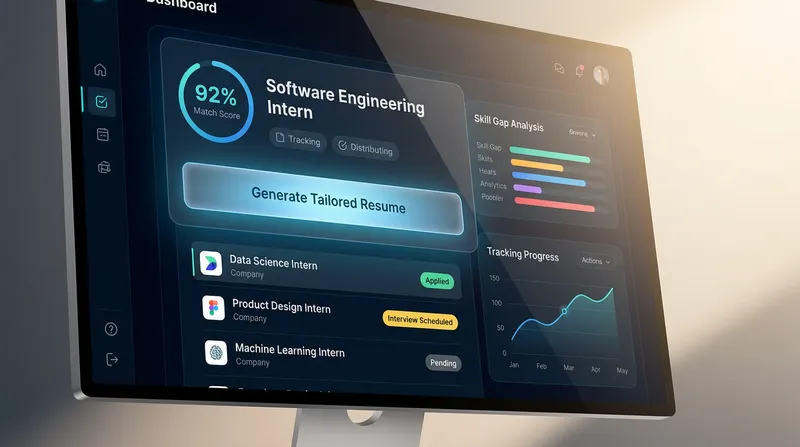
Before you even apply, your tracker should tell you if you are a good fit. The best job tracker apps now feature a Match Score that compares your Master Profile against the job description. Even better, they provide a Gap Analysis to show you exactly which skills you are missing, allowing you to upskill or adjust your resume proactively. You can learn more about how this works in our guide on The Smart Job Search Tracker: Organize Applications & Predict Match Scores.
Integrated tailoring
A tracker that only monitors statuses is just a digital filing cabinet. The most effective systems integrate tracking with document creation. When you move a job to the "Preparing to Apply" stage, the system should automatically generate a tailored resume and cover letter.
Agent-readable resume export
In 2026, your resume is not just being read by human recruiters or traditional ATS parsers; it is being analyzed by AI agents. Your tracker and resume builder must export documents that are optimized for these new systems. If your current tool produces heavily formatted, unreadable PDFs, you will be filtered out before the process even begins. Learn more about this crucial shift in our guide: Beyond the PDF: Why Your 2026 Resume Must Be 'Agent-Readable' (And How to Do It).
Best job tracker apps in 2026 (and where they fall short)
The market is flooded with AI job application trackers, but not all are created equal. While we will not name specific competitors, it is crucial to understand the limitations of the tools currently dominating the market.
| Feature | Traditional Tools | JobSparrow |
|---|---|---|
| Focus | Experienced hires | Graduates and migrants |
| OA Tracking | Rarely included | Built-in alerts |
| Tailoring | Manual or basic | AI-driven personalization |
Traditional AI auto-apply bots
Many new platforms promise to automatically apply to hundreds of jobs on your behalf.
- The promise: Save time by letting AI do the work.
- The reality: Auto-apply tools reduce application quality. Recruiters can spot generic, bot-generated applications instantly. These tools optimize for quantity over quality, which actively harms your chances of securing competitive graduate roles.
Basic Kanban board extensions
Some tools offer a simple Chrome extension to save jobs into a Kanban board.
- The promise: Visual organization of your job search organizer.
- The reality: While visually appealing, these tools often lock their best features behind expensive monthly paywalls. Furthermore, they lack deep interview preparation tools and fail to track the specific nuances of graduate cohort deadlines.
Resume builder add-ons
Many legacy resume builders have bolted on a job application dashboard as an afterthought.
- The promise: Build your resume and track jobs in one place.
- The reality: The tracking features are incredibly basic. They do not automatically save jobs from external sites, and you are usually locked into recurring subscription models that drain a student budget.
The ghost town trackers
Some tools act as a graveyard for applications. You input the data, and it sits there. There are no reminders to follow up, no nudges to complete an online assessment, and no insights into why you were rejected. A modern job search CRM must be proactive.
To truly stand out, you need a system that acts as an AI career advisor, guiding you from diagnosis to offer.
How to use a job search spreadsheet (the hybrid approach)
If you prefer maximum flexibility without hidden paywalls, a job search template Google Sheets setup is highly effective. According to Indeed, maintaining a job search spreadsheet to track applications, document deadlines, and schedule follow-ups significantly increases a candidate's chances of securing employment by preventing missed opportunities.
We recommend a hybrid approach: use a customized spreadsheet for high-level pipeline tracking, and pair it with an AI tool for document tailoring and interview prep.
Essential columns for your internship tracker spreadsheet
- Company Name & Role: The basics.
- Application Link: Direct URL to the job posting.
- Cohort Intake Date: e.g., "Feb 2027 Intake".
- Application Deadline: Highlight this in red.
- OA Status & Deadline: Track your online assessments here.
- Visa/Sponsorship Status: Crucial for international applicants.
- Referral Contact: Name and LinkedIn profile of anyone you networked with.
- Match Score: Your honest assessment of how well you fit the role.
- Date Applied: To calculate when to follow up.
- Current Status: Preparing, Applied, OA Pending, Interviewing, Rejected, Offer.
Step-by-step guide to building your job search organizer
- Step 1: Open Google Sheets and create a new blank document.
- Step 2: Freeze the top row so your headers remain visible as you scroll through hundreds of applications.
- Step 3: Implement data validation. For your "Current Status" column, create a dropdown menu with specific stages (Drafting, Applied, OA Pending, Interview 1, Interview 2, Rejected, Offer). This keeps your data clean and easy to filter.
- Step 4: Add a "Notes" column. This is where you record specific details from the job description that you want to bring up in an interview, or the names of the interviewers you met.
Actionable Tip: Use conditional formatting in Google Sheets to automatically turn the "Application Deadline" cell red when the date is less than 48 hours away.
To speed up the actual application process, pair your spreadsheet with tools that eliminate manual data entry. Discover how in our article: Stop Manual Data Entry: Why the Best Job Tracker Apps Now Use AI Skill Matching.
The JobSparrow solution: from diagnosis to offer
At JobSparrow, we believe everyone deserves expert career support. We do not just provide a basic job application tracking system. We coach you through the entire Offer Path: Diagnose, Position, Execute, Prepare, and Close.
Here is how JobSparrow streamlines every stage of the internship application process for graduates and career pivoters.
The master profile and gap filler
Instead of juggling multiple Word documents, you start by building your Master Profile. Our AI acts as an interactive coach, identifying missing metrics or unexplained gaps in your experience. It walks you through targeted Q&A to fill these gaps, ensuring your foundational profile is as strong as possible.
If you are pivoting majors or applying to internships outside your direct field of study, check out our 5 Career Change Resume Examples (And Why Recruiters Love Them) to see how to position your transferable skills. You can also learn more on our Master Profile feature page.
Smart job search and tracking
Stop switching between LinkedIn, Indeed, and Seek. JobSparrow aggregates jobs across multiple markets (with a primary focus on Australia and New Zealand) into one dashboard. When you save a job, our system instantly fetches the details and provides a Match Score. The Gap Analysis shows exactly what skills you are missing, helping you address weaknesses upfront.
Instant tailoring and AI mock interviews
When you are ready to apply, our AI generates a hyper-personalized resume and cover letter tailored specifically to that job description in under 60 seconds. You can choose from five professional templates and download them as a PDF. Want to see this in action? Read How to Use an AI Resume and Cover Letter Creator to Apply in Under 5 Minutes.
Once you land the interview, our AI Mock Interview feature simulates real scenarios with real-time audio recording and feedback, tailored to the exact role you applied for. This builds the natural confidence you need to deliver under pressure. For technical roles, check out The Engineer's Guide to AI Mock Interviews: Mastering Technical, Behavioural & Competency Scenarios.
The AI agent API integration
For tech-savvy graduates and developers, JobSparrow offers a unique advantage. We provide a public API that allows external AI assistants (like Claude Desktop or Cursor) to help you apply for jobs directly through JobSparrow. You provide your API key once, and your preferred AI assistant handles the entire workflow, from job analysis to PDF download, without leaving your preferred tool. If you are applying for technical roles, you can also learn How to List Agentic AI and Automation Skills on Your Resume: 2026 Guide for Tech & Business Roles.
Transparent pricing
Unlike traditional career coaches who charge around US$300 for a single resume, JobSparrow is transparent. You can start with a free CV diagnosis to see your recruiter-lens score and identify the gaps costing you interviews. To unlock the full generation capabilities, the complete Offer Path is US$45 per month, or US$33 a month when billed US$99 every three months. No hidden fees, and you can cancel in one click.
From application tracker to job offer: your next steps
Tracking your applications is only the first step. To actually win the job, you need to tailor every single application, prepare rigorously for interviews, and present a professional narrative. In our review of over 100,000 resumes, we consistently found that generic applications have a less than 1 percent success rate. Conversely, JobSparrow's internal data shows that tailored applications can increase response rates by 40 percent.
Ready to land more interviews? Start with a free diagnosis to see your recruiter-lens score and the exact gaps costing you interviews in minutes. JobSparrow combines cutting-edge AI with proven career strategies to level the playing field.
Start your free diagnosis with JobSparrow today and take control of your career journey.
Frequently asked questions
How do I track job applications effectively in 2026?
Effective tracking requires a centralized system that monitors not just the status of your application, but also cohort deadlines, online assessment due dates, and networking contacts. You must transition from static lists to dynamic pipelines that integrate directly with your resume tailoring tools, ensuring you never miss a critical step in the graduate hiring process.
Is a spreadsheet better than a job tracker app?
A spreadsheet offers maximum customization and is completely free, making it ideal for students on a tight budget. However, it requires tedious manual data entry. The best approach is a hybrid model: use a spreadsheet for high-level pipeline tracking, but pair it with a comprehensive platform like JobSparrow that automates data capture and provides actionable insights like Match Scores.
What exactly should I include in an internship application tracker?
Beyond the basics like company name, role, and application deadline, a graduate campaign tracker must include columns for Online Assessment (OA) deadlines, visa sponsorship availability, referral contacts, and the specific version of the resume submitted. For migrants applying in Australia or New Zealand, tracking working rights requirements is absolutely essential.
Are AI job trackers worth the premium price?
It depends entirely on the pricing model. Platforms that charge expensive monthly subscriptions often drain your budget before you secure a role. Look for platforms that publish their pricing openly and let you cancel in one click (like JobSparrow), and that provide tangible value through AI tailoring and mock interview preparation, rather than just auto-applying to generic jobs which can actually harm your chances.
How do I track online assessments and graduate program deadlines?
Set strict calendar alerts linked directly to your tracker. If you use a spreadsheet, utilize conditional formatting to highlight approaching deadlines in red. Prioritize OAs immediately upon receipt, as they almost always have non-negotiable 48-hour completion windows that standard trackers fail to monitor.
Tags
Keep reading
Recommended articles.
job search · resume tips
Job Application Black Hole AU/NZ: 8 Reasons You're Not Hearing Back & How to Fix It
Getting ghosted by jobs in AU/NZ? We reveal 8 reasons your application is ignored and a framework to get seen. Get your free resume match score now.
resume tips · career advice
How to Explain an Employment Gap on Your Resume: A 2026 AU & NZ Guide
Turn your resume gap into a strength. Our 2026 guide for Australia & NZ shows you how to explain career breaks and impress recruiters. Land your next job.
job search · career advice
How to Get a Job You're Not Qualified For | Job Sparrow
Stop letting missing skills hold you back. Learn how to land a job when you don't meet every requirement with our 4-step guide. Try Job Sparrow today!